


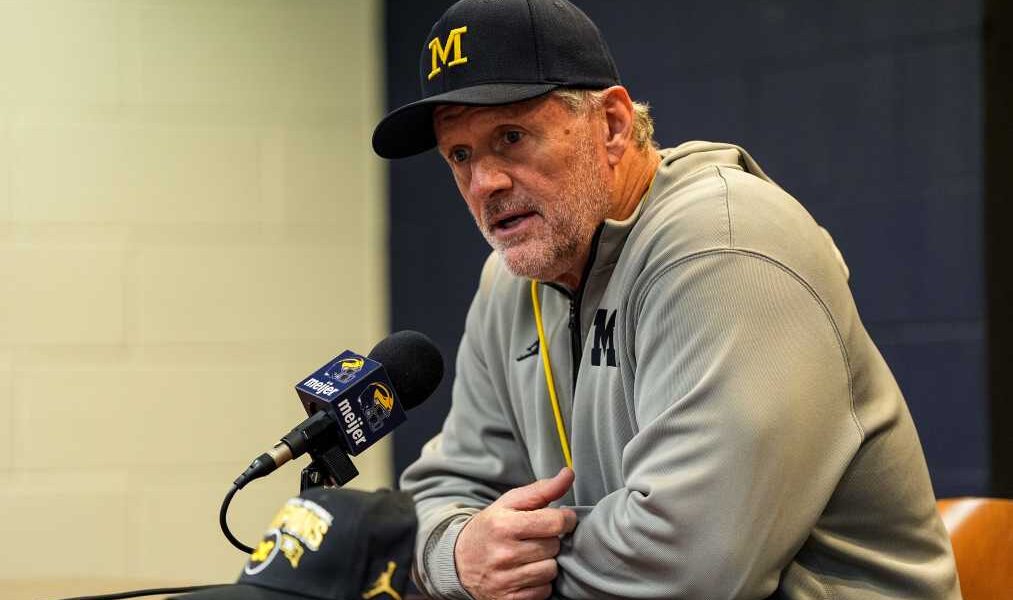
Ann Arbor’s Gray Eminence: Can Kyle Whittingham Steady Michigan’s Rocking Ship?
POLICY WIRE — Ann Arbor, USA — It wasn’t the raucous cheers of 100,000 faithful, nor the flashbulbs of a triumphant new era, that truly defined Michigan’s recent coaching decision. No, it was...

POLICY WIRE — Ann Arbor, USA — It wasn’t the raucous cheers of 100,000 faithful, nor the flashbulbs of a triumphant new era, that truly defined Michigan’s recent coaching decision. No, it was the low hum of desperation, a barely perceptible tremor beneath the polished facade of one of college football’s most storied programs. The Wolverines, you see, weren’t just hiring a new coach; they were admitting, tacitly, to a crisis of identity, a deep institutional malaise masked only partially by the previous regime’s hardware. Kyle Whittingham isn’t merely the next man up; he’s the institutional antidote, the stern, elder statesman brought in to clean a house that, let’s be frank, had become rather messy.
Because let’s not pretend Jim Harbaugh’s final years, or Sherrone Moore’s brief interregnum, were paragons of collegiate serenity. Scandals, whispers, and a general air of athletic department upheaval had become almost as routine as autumn leaves in Ann Arbor. The Big Ten’s VIP lounge, where Ohio State and Oregon now schmooze, felt miles away while Michigan idled with Penn State and USC in the generic waiting area. Whittingham, a man who will be 67 on the day Michigan faces UCLA, isn’t flashy. He isn’t a social media sensation. He is, however, a monument to consistency, having racked up 177 career wins in 21 years at one institution, according to historical NCAA data. And that, folks, is precisely the point.
“We weren’t just looking for wins; we were looking for stability, for integrity, for a program built on bedrock, not quicksand,” explained a source close to the Michigan athletic board, speaking on condition of anonymity due to the sensitivity of past administrative decisions. “Coach Whittingham represents that kind of principled leadership, a necessary balm for the soul of this university after years of… well, you know.” And frankly, we do. The unspoken word hangs heavy: chaos.
But the pragmatism cuts both ways. While Michigan seeks a ‘reset button,’ Whittingham himself arrives with a curious recent track record. His last bowl game victory? The 2017 Heart of Dallas. His sole College Football Playoff-level win? The 2009 Sugar Bowl. Last season, his Utah squad scraped to a 10-2 record without truly challenging the sport’s elite, faltering in critical matchups. He inherits Michigan-level talent – a serious upgrade from his recent Utah rosters – but the question remains: has the sage lost some of his sting? Can this dry, understated operative elevate the Wolverines from ‘very good’ to ‘College Football Playoff great’ amid a brutally competitive Big Ten?
What This Means
Whittingham’s arrival signals a calculated risk in Ann Arbor, a tacit acknowledgement that Michigan’s brand, while globally recognized—even among ardent sports enthusiasts in Pakistan’s burgeoning urban centers, who follow American sports franchises with increasing intensity (a phenomenon itself reflecting deeper societal shifts)—has suffered some attrition. Economically, this move banks on institutional loyalty over superstar flash. The Wolverines need consistent relevance to maintain lucrative media rights, merchandising, — and booster engagement. A steady, predictable, winning program might not ignite viral debates, but it keeps the coffers full. Politically, this signals a turn away from the maverick, headline-grabbing personalities, toward a more conservative, measured approach to athletic leadership, an interesting reflection of broader American institutional trends toward de-risking high-profile appointments. It’s an attempt to restore dignity, but dignity doesn’t win national championships alone.
📄 POLICY WIRE WHITEPAPER PUBLISHED: PAKISTAN'S NATIONAL SECURITY POLICY PRIORITIES
👉 READ BY CLICKING HEREHis primary task isn’t to revolutionize, but to solidify. Keep quarterback Bryce Underwood from getting overwhelmed – a phenomenal talent, sure, but inconsistent last season with 11 touchdowns to 9 interceptions. That’s a statistic that makes coaches — and fans — twitch. They’ll lean heavily on a punishing running game, anchored by returning tailback Jordan Marshall and complemented by the ground-and-pound philosophies of offensive coordinator Jason Beck. And it’s not just offense; the defense, especially its run-stopping prowess and a stacked secondary, holds immense potential, though an unproven linebacking corps and a reliance on transfer John Henry Daley for pass rush gives a beat writer pause. This isn’t a full rebuild; it’s a careful renovation, patching over weaknesses — and leaning heavily on what works.
But Whittingham’s history with defensive transformations – Utah was famously number one nationally in red zone touchdowns allowed, scoring 79.7% of the time, while Michigan languished at 66th (61.5%) last season – suggests he’s acutely aware of where the margin for error shrinks. “You fix what’s broken first, and you shore up your strengths,” Coach Whittingham mused during his introductory press conference, a quote widely circulated for its sheer lack of bombast. “This program has plenty of strengths, — and a few areas where we’re going to roll up our sleeves and work. That’s what we do. No magic here.” That sentiment might just be the quiet rebellion Ann Arbor desperately needs.
The schedule is brutal, featuring clashes with Oklahoma, Oregon, and the perennial showdown with Ohio State. Can Michigan emerge from this gauntlet with enough wins to contend for a playoff spot? It’s a heavy lift, even for a respected veteran. But, sometimes, the old ways, delivered with conviction and a healthy dose of understated resolve, are exactly what’s required to navigate modern-day collegiate turmoil. Or maybe, just maybe, it’s a bridge too far for an old dog in a new, hyper-competitive, money-drenched, scandal-prone fight. Policy Wire, for one, will be watching closely.