


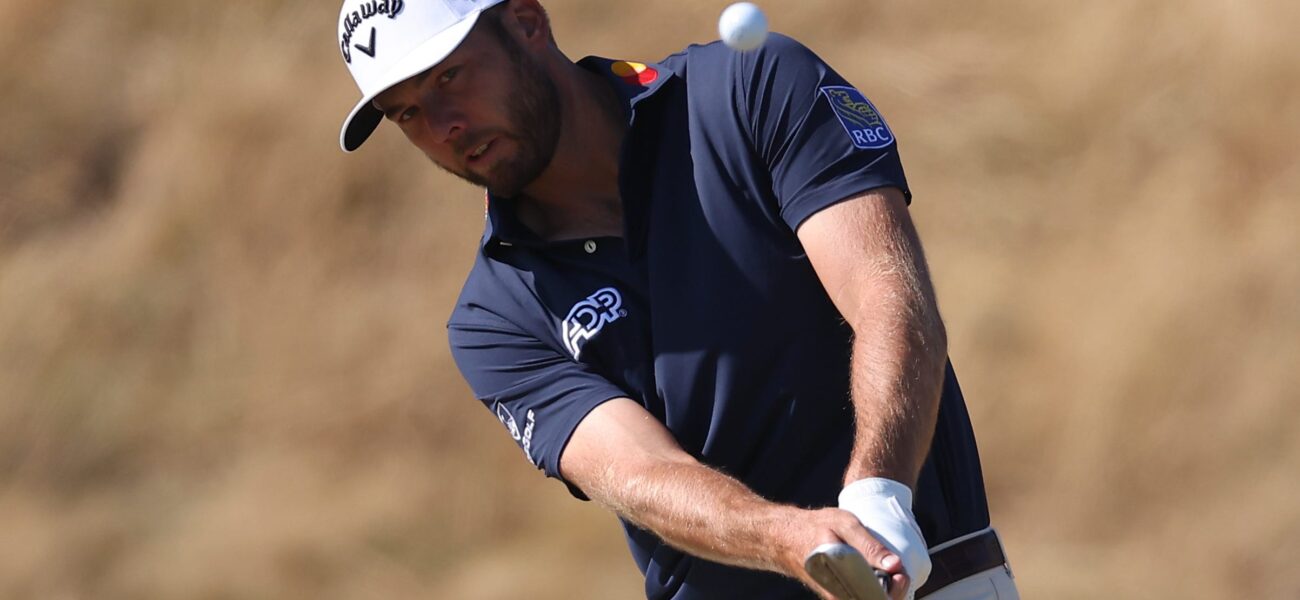
Fairway or Family Ward: A Golfer’s Gambit at the Open Amidst a Newborn’s Arrival
POLICY WIRE — Southport, England — They say a baby changes everything. For Louisiana’s Sam Burns, the birth of his second child, Belle, almost changed his travel itinerary for golf’s oldest...

POLICY WIRE — Southport, England — They say a baby changes everything. For Louisiana’s Sam Burns, the birth of his second child, Belle, almost changed his travel itinerary for golf’s oldest major. Ten days shy of her due date, Belle decided to make her grand entrance. Just like that, the universe—or maybe just Belle—upended the meticulous plans of a top-tier athlete, forcing a last-minute dash across the Atlantic, leaving a new mother and an infant at home.
It’s a peculiar spectacle, really, seeing the world’s 18th-ranked golfer swapping nursery duty for the windswept links of Royal Birkdale, a mere handful of days after welcoming a daughter. His initial plan? To be changing diapers, not chasing birdies. But because fate, or rather, the relentless schedule of professional golf, rarely bends to the personal dramas of its players, Burns found himself on a flight to the British Open, practice rounds squeezed in, mind likely still hovering over a bassinet thousands of miles away. It’s an unenviable tug-of-war for any parent, amplified under the blinding lights of global sport.
“We structure these events months, even years out,” explained R&A Chief Executive Martin Slumbers, a man who knows a thing or two about unwavering tradition, albeit in a different context. “The Open waits for no one, really. He’s a professional; he understands the expectations that come with contending for this title. His presence speaks to that commitment.” Slumbers didn’t mention the parental sacrifice involved, naturally. You wouldn’t expect him to.
Burns himself confessed to the internal debate. “I still wasn’t sure if I could get there mentally,” he admitted earlier this week, an echo of honesty rarely heard from these sporting titans. And you get it. Could any of us? Leave your wife, your just-arrived baby, your already existing son, Bear, for a golf tournament? But this isn’t just ‘any’ golf tournament; it’s a major, where careers are forged — and fortunes won. For instance, the champion of this year’s British Open will pocket a purse north of $3 million, a figure confirmed by the R&A. Such is the arithmetic of ambition.
But the calculus isn’t just financial. It’s existential. Think about it: a child, freshly introduced to the world, demanding constant attention, against the singular focus needed to sink a four-foot putt under immense pressure. Burns wasn’t home celebrating the newest addition; he was playing a nine-hole practice round. The parents stepped in to help. How very convenient. A father, soon to turn 30, already chasing that elusive major trophy, came so close at the U.S. Open just weeks ago. You don’t just walk away from that momentum, not if you’re built for this.
Compare this relentless, often solitary pursuit of professional success to, say, the societal norms in parts of South Asia. In a nation like Pakistan, where collective identity and family obligations often supersede individual career trajectories, a decision like Burns’s might be viewed through a very different lens. The concept of leaving a wife with a newborn, even temporarily, for work, would raise eyebrows for many, underscoring divergent cultural perspectives on work-life balance and family commitment. For many, family simply comes first, full stop. But American sports, much like their European counterparts, aren’t known for their philosophical contemplation on domestic priorities.
📄 POLICY WIRE WHITEPAPER PUBLISHED: PAKISTAN'S NATIONAL SECURITY POLICY PRIORITIES
👉 READ BY CLICKING HERE“Look, this isn’t a game; it’s a multi-million-dollar industry. Sponsors expect presence, fans demand performance,” offered a seasoned PGA Tour agent, speaking off the record. “Sam’s here because he has to be. The personal cost? That’s for him and his family to carry. But it shows the incredible pressure these guys are under. It’s a lonely pursuit sometimes, despite the roar of the crowds. No one’s asking for a medal for missing a birth, but they’re still playing, aren’t they?” Indeed, they’re.
What This Means
Burns’s appearance at Birkdale isn’t just a quirky personal anecdote; it’s a window into the unrelenting demands of elite professional sports. It highlights the often-invisible sacrifices athletes make, the personal moments forfeited for the pursuit of glory and—let’s not forget—massive financial rewards. It paints a picture where individual well-being, especially new parenthood, can sometimes feel secondary to the machine of global athletics. The constant travel, the unwavering schedule, the commodification of even personal milestones by broadcast partners and endorsement deals—it’s a system designed to keep the show going, regardless of what’s happening back home. And it points to a broader tension: the athlete as human versus the athlete as commodity, forever oscillating between the two. One can’t help but wonder what effect this relentless grind has on the human psyche. We’ve seen similar patterns in the European sporting ecosystem, where player movement often overrides family considerations, and the fierce national pride in play.
So, as Burns steps onto the tee, remember, it’s not just about a golfer hitting a little white ball. It’s about a man, grappling with the newest, most profound role of his life, while trying to perform at the absolute peak of another, infinitely more public, calling. That’s a tightrope walk. A delicate balance. A new daughter — and an old, hallowed tournament. What a week to be Sam Burns.