
The All-Star Contingency: Injuries Redefine Sporting Supremacy in an Unstable Era
POLICY WIRE — Philadelphia, USA — This isn’t your daddy’s Midsummer Classic. The marquee event of Major League Baseball—purportedly a celebration of its most brilliant talents—has instead...

POLICY WIRE — Philadelphia, USA — This isn’t your daddy’s Midsummer Classic. The marquee event of Major League Baseball—purportedly a celebration of its most brilliant talents—has instead transformed into a rather compelling study in contingency planning, a spectacle brimming with last-minute substitutions and unexpected opportunities. It’s less about the established pantheon — and more about the vigorous scramble to fill glaring voids. Talk about a ‘next man up’ mentality.
For weeks now, the baseball world has watched as a meticulously planned roster, once bursting with household names, gradually yielded to an often less-heralded, albeit highly capable, cohort. The ripple effects have been extensive. The American League, in particular, finds itself navigating an unforeseen wave of attrition, impacting several key positions. Because that’s what happens, doesn’t it? Things change. Suddenly. [QUOTE_PLACEHOLDER]
The exodus began with Shohei Ohtani. He’s skipping the showcase to have a knee procedure ahead of the season’s second half, forcing a prominent vacancy at designated hitter. Then came the announcements: Toronto’s Vladimir Guerrero Jr. is skipping the game to rest a bad back. His initial replacement, the Athletics’ Nick Kurtz, sprained a thumb. It’s a domino effect that leaves you wondering if anyone is truly safe. And this extends beyond simple aches — and pains. Yankees teammate Aaron Judge hasn’t played since May 31 because of a fractured rib. The Minnesota Twins outfielder Bryon Buxton, too, is sidelined by a hip injury.
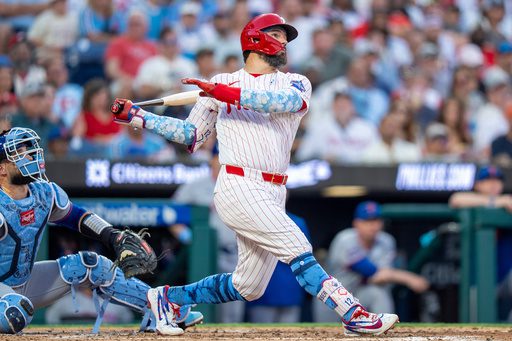
Consequently, the National League finds itself with Kyle Schwarber of the host Philadelphia Phillies set to lead off. Meanwhile, Detroit Tigers outfielder Riley Greene and two New York Yankees, first baseman Ben Rice and outfielder Cody Bellinger, gained American League starting spots because of injuries. Rice, an unexpected insertion, finds himself in esteemed company. He’s third in the major leagues with 29 home runs behind Schwarber (32) and the Houston Astros’ Yordan Alvarez (31)—statistics a journalist would typically find buried deep in box scores, not as a highlight of an All-Star roster. Bellinger will be in right — and Greene in left.
Even the pitching mound isn’t immune to these last-minute machinations. Philadelphia left-hander Cristopher Sánchez and Toronto right-hander Dylan Cease were announced as starting pitchers on Sunday. Sánchez will be the 14th pitcher to start an All-Star Game in his home ballpark, the first since the Dodgers’ Clayton Kershaw in 2022. He’ll also be the Phillies’ first All-Star starting pitcher since Roy Halladay in 2011. Cease, too, breaks a drought, as he’ll be the Blue Jays’ first All-Star starting pitcher since Halladay in 2009.
National League manager Dave Roberts of the two-time champion Dodgers has three of his players in the starting lineup along with two Phillies and two Braves, showcasing that even amid change, established power centers retain some heft. New York Mets left fielder Juan Soto bats second, followed by Dodgers first baseman Freddie Freeman, Washington shortstop CJ Abrams, Dodgers third baseman Max Muncy, Atlanta second baseman Ozzie Albies, Phillies right fielder Brandon Marsh, Dodgers center fielder Andy Pages and Braves catcher Drake Baldwin.
📄 POLICY WIRE WHITEPAPER PUBLISHED: PAKISTAN'S NATIONAL SECURITY POLICY PRIORITIES
👉 READ BY CLICKING HEREAmerican League manager John Schneider of the Toronto Blue Jays counters with Los Angeles Angels center fielder Mike Trout leading off, followed by Alvarez at designated hitter, Athletics catcher Shea Langeliers, Tampa Bay Rays third baseman Junior Caminero, Kansas City shortstop Bobby Witt Jr., Bellinger, Rice, Green, Rice and Blue Jays second baseman Ernie Clement. It’s a roster forged not solely on peak performance, but on durability and availability—a testament, perhaps, to the grind of modern professional sports.
This widespread reliance on replacements offers a peculiar parallel to the global political stage, particularly in dynamic regions like South Asia. Just as unexpected injuries to key players force teams to rely on contingency plans and promote lesser-known talents, unforeseen geopolitical shifts or domestic crises in countries like Pakistan can necessitate rapid reconfigurations of national strategy and the emergence of new, often unproven, leadership. This isn’t just about sporting glory, it’s about navigating an increasingly volatile landscape where even the most robust systems—be they athletic federations or national governments—must adapt to sudden voids and unforeseen variables. The enduring psychology of second place, in such a context, shifts from merely an aspiration to an existential reality. You’ve got to make do with what you’ve got.
What This Means
The sheer number of All-Star replacements this year isn’t merely a baseball anecdote; it’s a telling symptom of broader systemic fragility. In economics, we talk about supply chain resilience; in politics, the stability of institutions. Here, we see it playing out on the diamond: the vulnerability of ‘star power’ to a random injury, an unfortunate incident. It tells us that relying solely on a few titans, be they athletes or key policy figures, makes any system susceptible to collapse when those figures are removed from play. It also hints at an evolving landscape where traditional powerhouses are either disrupted or forced to integrate new talent more quickly than ever before. This rapid turnover demands adaptability from managers—and by extension, from policymakers—who must constantly recalibrate their strategies with the resources at hand. Much like Seoul’s AI reckoning, the immediate euphoria of the spectacle may obscure underlying jitters about sustaining this level of ‘all-star’ performance without its main protagonists. This isn’t just a game; it’s a stark reminder that even in seemingly static environments, the winds of change can—and will—whirl without warning.