


Spain Pauses for a Kick: Football Victory Cements Public Broadcaster’s Enduring Pull
POLICY WIRE — Madrid, Spain — You’d think, wouldn’t you, that in an era choked by TikTok snippets and streaming behemoths, the notion of an entire nation collectively hitting pause for...

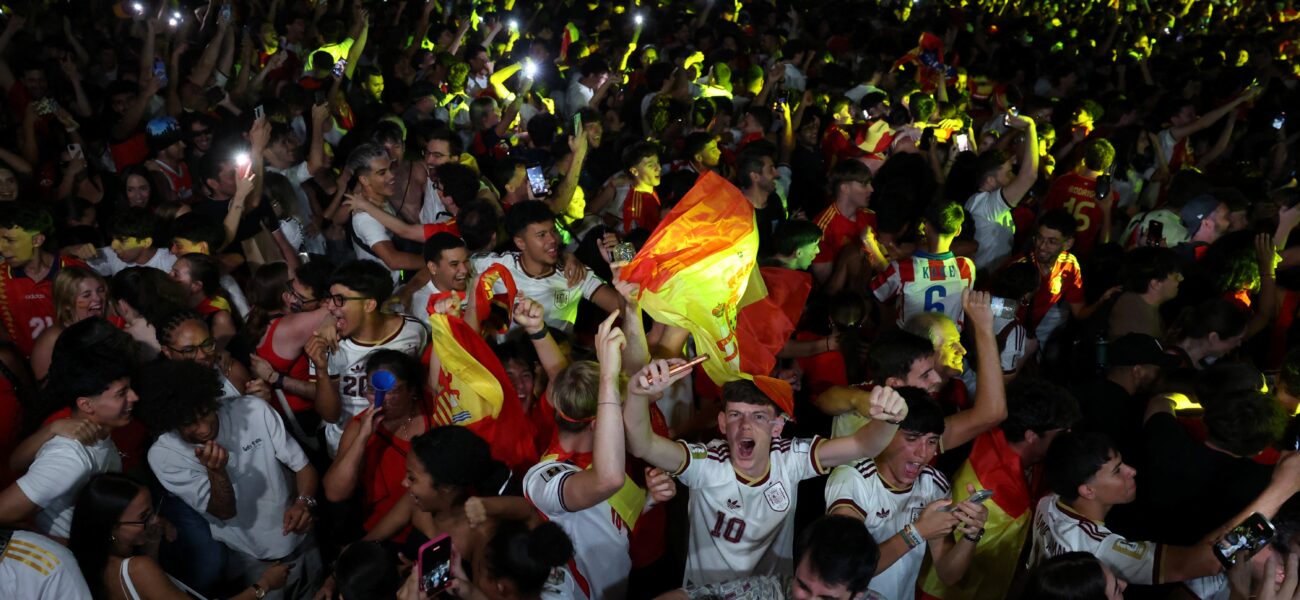
POLICY WIRE — Madrid, Spain — You’d think, wouldn’t you, that in an era choked by TikTok snippets and streaming behemoths, the notion of an entire nation collectively hitting pause for three hours is something out of a sepia-toned archive. But Spain, a country often more fragmented than unified by its regional allegiances, managed just that this Tuesday. They didn’t just watch a football match; they participated in a curious, temporary national communion, the likes of which feel increasingly scarce. It wasn’t merely a game; it was an event, a declaration.
The fixture in question, the 2026 World Cup qualifier semi-final against France, saw Spain’s national side punch its ticket to the final. And by doing so, it orchestrated one of the most astonishing broadcast performances in recent memory. We’re talking numbers that should make private media executives chew their knuckles. An astounding 81.3% audience share—an unheard-of grab in today’s splintered media landscape—glued some 14,514,000 Spaniards to their screens. That’s a staggering figure, proof positive that, for all our modern distractions, certain narratives still hold an undeniable, primal magnetism.
The real coup, however, belonged to Spain’s public broadcaster. TVE’s La 1, the kind of public service entity many a conservative politician loves to criticize for its ‘inefficiency’ or ‘political leanings,’ absolutely trounced its competition. It single-handedly commanded a 71.2% share, captivating 12,716,000 viewers. That’s not just dominant; it’s an absolute lock. Other RTVE channels added their own slivers—Teledeporte notched a 2.6% share, while La 2 de TVE’s Catalonia broadcast snagged an 11.5% regional share, underscoring how deeply entrenched this public enterprise remains in Spanish homes. Pay-TV platform DAZN Mundial pulled in over a million viewers itself, but even with that, the message was stark: when the chips are down, and national pride is on the line, Spain turns to its familiar, public hearth.
“It’s more than just a game; it’s a reaffirmation of who we’re when we choose to stand together, cheering, hoping. It shows a nation can still find its voice in unison,” said María Fernández, Spain’s Minister of Culture and Sport, reflecting on the profound collective moment. “These moments are precious, aren’t they? They remind us of simple joys.” She’s got a point. You couldn’t buy that kind of national advertising, couldn’t manufacture that shared pulse. But across the Pyrenees, French Sports Minister Bernard Dubois conceded, not without a hint of ruefulness, “Of course, we’d rather our lads were celebrating. But one can’t deny the sheer magnetic pull of such a contest. It’s global sport at its zenith, and the Spanish performance, both on and off the pitch, was certainly… commanding.”
Because these spectacles transcend borders, you know? While Spain celebrated, similar collective viewing events often light up homes from Morocco to Malaysia. Consider Pakistan, for instance; while cricket dominates the local consciousness, football’s global appeal, particularly events like the World Cup, captivates millions. The fervent following for European leagues and international tournaments mirrors this universal craving for high-stakes competition and heroes. For a country like Pakistan, football offers a window into global narratives, uniting disparate communities around a shared screen, albeit often through less regulated means. It’s a cross-cultural current, reminding us that emotional engagement with sporting narratives isn’t confined to geography or immediate cultural ties.
📄 POLICY WIRE WHITEPAPER PUBLISHED: PAKISTAN'S NATIONAL SECURITY POLICY PRIORITIES
👉 READ BY CLICKING HEREBut the true marvel in Spain was this reassertion of broadcast television’s power—specifically, public broadcast. Everyone’s been writing its obituary for years. And then this happens. One football match, 14,514,000 average viewers—a precise number confirmed by RTVE figures—and suddenly the prognosticators look a bit silly. It’s still shy of the 2010 World Cup Final (an impossible bar, perhaps), but it shows a certain resilience. A reminder that convenience doesn’t always trump occasion. The communal experience, even a mediated one, still counts for something big.
What This Means
This record-breaking viewership for a single football match carries several weighty implications. First, it’s a defiant vindication for public broadcasting. In an era where state-funded media often faces calls for privatization or budget cuts, RTVE’s extraordinary pull demonstrates its unique ability to unite a nation for singular events. It reminds policymakers of the distinct public value these institutions provide beyond typical ratings chases; they foster communal identity, however fleetingly. Secondly, it hints at an interesting political dynamic: during moments of intense national focus like this, societal divisions, regional disputes, and economic anxieties often recede. Football acts as a national anesthetic, offering a brief, unifying distraction that no politician could engineer. Leaders, therefore, keen to project an image of national cohesion, will continue to understand and leverage such sporting successes, seeing them as rare opportunities to bind a populace, if only temporarily. And thirdly, the sheer economic ripple effect is not to be sniffed at. Even if commercial breaks are limited on public channels, the associated boost in national morale and the implicit marketing for the ‘Spain’ brand itself carry tangible, albeit unquantifiable, benefits in areas like tourism and international standing. It proves that despite fragmentation, the public square—even a digital one—still has its gravitational forces.