


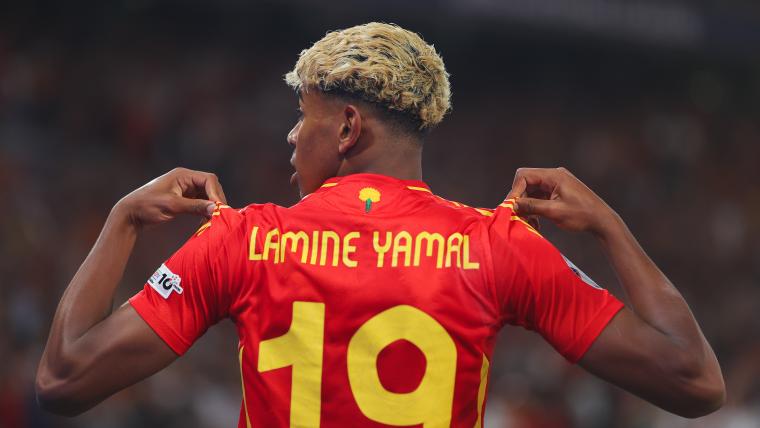
Family Atlas: Lamine Yamal’s Roots Chart a New Course for European Identity
POLICY WIRE — Barcelona, Spain — The glare of stadium floodlights often obscures the dimmer, older paths that lead a prodigy to prominence. It’s not the dazzling footwork that first tells a...

POLICY WIRE — Barcelona, Spain — The glare of stadium floodlights often obscures the dimmer, older paths that lead a prodigy to prominence. It’s not the dazzling footwork that first tells a story, nor the record books bending under adolescent weight. It’s the quiet confluence of heritage, the almost silent hum of lives lived across continents, that truly sketches the portrait of someone like Lamine Yamal. His emergence isn’t just about sporting talent; it’s a living, breathing commentary on modern Europe, an unplanned lecture on demographics and belonging, delivered with a football at his feet.
Yamal, you see, is young. Unthinkably so, for the feats he pulls off in professional arenas. And that precocity, it seems, mirrors the complexity of his background. One side of the family ledger points to Morocco, specifically from the ancient city of Larache, a port town steeped in history—where his 39-year-old dad, a gentleman who’s reportedly always near, first put down roots. The other side—from his mother—traces back to Equatorial Guinea, a small, oil-rich nation on Africa’s west coast, a place whose political economy often stands in stark contrast to the opulence of top-tier European football. It’s a mosaic, isn’t it? A family narrative that echoes millions across the globe who’ve crisscrossed borders, seeking a new life, building anew.
His ascent, sharp and unyielding, hasn’t just thrilled fans; it’s made statisticians frown in disbelief and commentators reach for superlatives. But it’s also thrown a fresh lens on what it means to be Spanish, or European, in the 21st century. One minute he’s making a world-class defense look like schoolkids, the next he’s discussing his preferences for Spanish national team culture versus the Moroccan one. And it’s a perfectly legitimate choice—a private decision that plays out in very public forums, dissected and analyzed by pundits and politicians alike. The discourse around national identity and immigration is often fraught, particularly when tied to integration.
When asked about the constant focus on his lineage, an acquaintance of the family shared a familiar sentiment, noting that for the family, it’s about giving him the best environment. [QUOTE_PLACEHOLDER] But the public eye, it’s rarely so simple. We’re seeing not just a footballer, but an embodiment of demographic shifts, a face for the often-abstract debates on multiculturalism. His success, then, becomes more than just athletic achievement. It becomes an argument, a demonstration of potential, of what can flourish when cultures converge, sometimes messily, always energetically.
His family’s choices, particularly his father’s reported decision to prioritize certain aspects of Yamal’s upbringing, aren’t unique. Thousands of families from places like Pakistan and Bangladesh, or North and West Africa, living in Europe—in Spain, in the UK, in Germany—grapple with similar questions. They try to navigate the complex waters of identity for their children, hoping to bridge the ancestral past with the adopted present. The balance, often, is tenuous, defined by Friday prayers — and Sunday league games. According to a 2022 Pew Research Center study, 8% of Europe’s total population, or approximately 44 million people, are Muslim, a figure projected to grow. This isn’t just an anecdotal wave; it’s a sustained demographic reality that’s changing the face of the continent. And sometimes, you see that shift crystallized in a single, gifted young man.
But make no mistake; while his background is rich fodder for sociological exploration, it’s his sheer talent that propelled him into the spotlight. A dazzling individual skill, a preternatural game sense—those are his tickets. The family provides the grounding, the story, the context. He doesn’t play for identity; he simply has it, prominently, as he plays for his club — and country. His journey—from Barcelona’s youth academies, through the senior squad, and now representing Spain at the highest international level—is a whirlwind. There’s a quiet strength in the way he handles it, a certain groundedness, attributed by many to his immediate support system. One family member is reported to have said [QUOTE_PLACEHOLDER] when discussing the pressure he faces. It’s a lot to carry, even for a grown man, let alone a teenager.
The brother, the wider family, they’re part of the fabric too, observing from the sidelines. They see the media attention, the commercial deals, the weight of expectation. And they presumably see their own narratives reflected back, distorted sometimes, magnified always. Because the success of one child often elevates an entire lineage, an entire community. It proves what many already believed possible, despite systemic hurdles — and prejudiced glances. It opens doors—or at least provides a wider crack—for those who follow. It creates a space for different kinds of stories in a narrative traditionally dominated by a more homogenous cast.
What This Means
Lamine Yamal’s meteoric rise is more than a football story; it’s a socioeconomic case study in real time. For Madrid and Barcelona, or London and Paris, individuals like Yamal symbolize both the demographic future and the persistent challenges of integration. His success will, for some, serve as proof positive of diversity’s strengths, a counter-narrative to nativist anxieties. For others, it’s simply a gifted athlete playing a game, the heritage secondary. But politically — and economically, his path matters. His image, and the image of other successful children of immigrants, will be leveraged, whether implicitly or explicitly, in national identity debates.
In the broader Muslim world, particularly in countries like Morocco and within its vast diaspora, Yamal’s achievements carry an outsized significance. He’s a reference point, a source of pride, — and a visible bridge between cultures. His potential influence on youth aspirations in Pakistan, for instance, mirroring his impact on young North Africans in Europe, isn’t hard to imagine. He proves that excellence knows no single national origin, though its roots are often complex — and deep. And, as his commercial appeal grows, his economic impact—from endorsements to influencing cultural consumption—will ripple across continents. It’s a reminder that globalized talent, especially youth talent, is an export more powerful than many traditional goods, shaping perceptions as much as economies.