


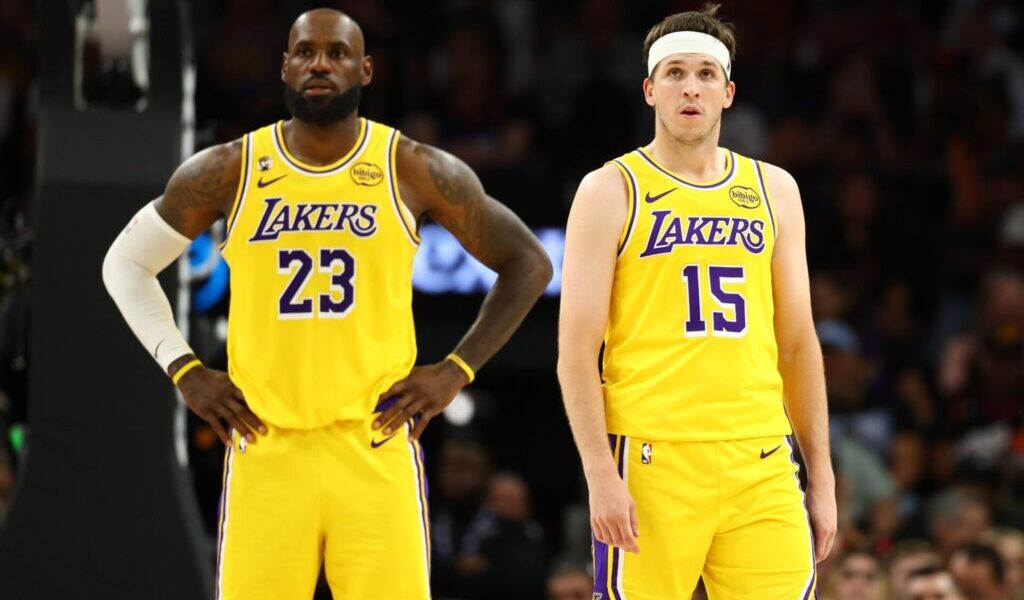
Hollywood’s Court Jester Faces a Crown, As Lakers Gamble on Post-King Dynasty
POLICY WIRE — Los Angeles, United States — It isn’t often that a newly minted multi-millionaire, secured by a contract few athletes ever see, expresses a profound sense of the unknown. But...

POLICY WIRE — Los Angeles, United States — It isn’t often that a newly minted multi-millionaire, secured by a contract few athletes ever see, expresses a profound sense of the unknown. But that’s precisely where Austin Reaves finds himself, a man adrift—professionally, anyway—in the gilded cage of NBA super-fame. His four-year, $180 million deal with the Los Angeles Lakers should provide comfort, certainty. Instead, the landscape around him has shifted dramatically, seismically, you could say. The earth has moved, and he’s still standing there, a little surprised, a lot alone on the court where once a king held court.
Two weeks ago, the official word dropped. LeBron James, arguably the sport’s most towering figure of the last two decades, wasn’t re-upping with the Lakers. Not returning in free agency. Not after four seasons together, four seasons where Reaves, a surprisingly successful undrafted gem, learned the ropes, played sidekick, absorbed the sheer, suffocating gravity of a once-in-a-generation talent. But now? That’s all history, a memory flickering like an old highlight reel. And the present feels different.
Reaves, speaking to reporters with an almost bewildered candor, laid bare his processing. He confessed, “I don’t know if I’ve honestly processed it yet. I was kind of thinking about it last night when I got here. Starting a season without him on the team is going to be different for me. That’s kind of all I’ve ever known. Him being around, joking around, like he’s 15. That’s his decision, and like I said in Tahoe and anytime I’ve talked about it, I’ve got nothing but love and respect for him,” Such words carry a weighty echo now. It’s a poignant observation from a player who, just a few short seasons ago, was scrambling for a roster spot.
It’s not just the departure of a teammate; it’s the vacuum left by a franchise player, a cultural icon. The kind of person whose presence alters everything from locker room dynamics to global merchandising revenue. For the Lakers, it means an accelerated new era. Remember when trading for Luka Doncic in February 2025 felt like the seismic shift? That move positioned Doncic as the new face, certainly, but James’ continued presence, even diminished, still cast a long shadow. Now, that shadow is gone, and the spotlight, whether they like it or not, has expanded to envelop every remaining player, Reaves included.
The new squad is, well, new. A smorgasbord of talent and question marks: Walker Kessler, Sandro Mamukelashvili, Collin Sexton, Quentin Grimes, Kevon Looney, and Ziaire Williams. All joining a team desperate to prove it doesn’t need a monarch. And Reaves, bless him, expressed an almost admirable enthusiasm for the upheaval. “The pieces that are coming in, I’m very excited about and I’m happy to get started today and see where it goes,” he said. A necessary optimism, perhaps, considering he’s locked in, poised to become a vital on-court partner for Doncic, holding down the fort until at least the 2029-30 season if his player option isn’t exercised earlier.
It’s a peculiar thing, this shifting of the guards. One day, you’re riding shotgun with arguably the greatest to ever play. The next, you’re looking at a completely revitalized, albeit uncertain, squad, tasked with maintaining a dynasty’s allure. But that’s sports, isn’t it? A perpetual cycle of acquisition — and divestment, loyalty tested by contract cycles, brand management. And this particular change? It’s going to ripple far beyond the Hollywood Hills. Market analysts project that fan engagement metrics for major sports leagues globally, including the NBA, have seen an average 8% dip in legacy fan bases when a generational talent exits, according to a recent Global Sports Economy Report by Synergy Analytics.
📄 POLICY WIRE WHITEPAPER PUBLISHED: PAKISTAN'S NATIONAL SECURITY POLICY PRIORITIES
👉 READ BY CLICKING HEREWhat This Means
LeBron James’ departure isn’t just a basketball story; it’s an economic one, a sociological one, a stark lesson in market value and the often-harsh realities of asset depreciation – even for human assets. Think about it: a single individual’s decision can send billions of dollars in valuation soaring or dipping. The Lakers, once a perennial draw based partly on the promise of LeBron, must now pivot their entire marketing, broadcast strategy, and, indeed, their narrative. It’s a stark reminder for any entity, be it a sports franchise or a nation-state, that over-reliance on a singular figure—however charismatic or productive—is a precarious long-term strategy. True resilience comes from systemic strength, from diversified talent pools, and from fostering an identity that transcends any one personality. And that’s true whether you’re managing a basketball team or navigating geopolitical complexities.
From an international perspective, particularly in places like Pakistan and across the South Asian and broader Muslim world, this shift has fascinating echoes. NBA stars are global brands. Their jerseys sell, their games are watched religiously, and their endorsements shape consumer trends in burgeoning markets. When a star like James moves, it’s not just California that notices. The commercial landscape in Lahore, Dubai, or Kuala Lumpur also feels the reverberations. For emerging economies that are eager to engage with global entertainment, a dominant figure like James provided a simple entry point. Now, the NBA must lean on its younger, less established stars, and it becomes a test of the league’s overall brand strength, not just individual star power, to maintain that lucrative, passionate viewership base. Countries actively seeking to retain top talent or attract foreign investment, particularly in cultural industries, can draw parallels. You’ve got to invest in a robust infrastructure, a sustainable ecosystem, not just bet everything on one or two shining examples.
The transition underscores a broader economic reality: the price of human potential is, ultimately, speculative, subject to the whims of age, performance, and ambition. And this isn’t just about athletic prowess; it’s about the financial mechanics that fuel our biggest entertainment industries, shaping viewership habits and sponsorship dollars. These are dollars that reach into every corner of the globe. Building a team around Luka Doncic, signing players like Austin Reaves to a monster deal – these are bets on a different kind of potential, on a new investment vehicle. The question remains, can the sum of these parts, even expensive parts, replace the gravitational pull of one undeniable star? For Reaves, for the Lakers, for every fan tuning in from across continents, that’s the multibillion-dollar question looming over next season.