


Gridiron Gold Rush: Inside College Football’s Audacious Quest for Adolescent Dominance
POLICY WIRE — Somewhere in the American Football Heartland — In a landscape where collegiate athletic programs now operate more like corporate behemoths than educational institutions, the scramble...

POLICY WIRE — Somewhere in the American Football Heartland — In a landscape where collegiate athletic programs now operate more like corporate behemoths than educational institutions, the scramble for pre-collegiate talent has become, well, savage. It’s not just about winning on Saturdays anymore; it’s about cornering the market on potential—a ruthless, no-holds-barred extraction of human capital from high school fields to billion-dollar stadiums. They’re calling it the 2027 recruiting cycle, — and the bounty? A cohort of ‘EDGE’ defenders, young men who can fundamentally alter the trajectory of a program for years.
It’s almost perverse, isn’t it? The sheer focus, the almost obsessive dedication of resources—scouts, analysts, recruiters—all trained on a demographic barely old enough to drive. We’re talking adolescents, some still developing into their adult frames, already branded, ranked, and auctioned in a quasi-professional market. The sheer financial investment made in these boys before they’ve even attended their senior prom beggars belief. According to the Rivals Industry Ranking for 2027, a composite of multiple scouting services, there are forty four and five-star recruits at the EDGE position alone. Forty of them. Seven are certified five-stars, blue-chip prospects, — and five more are pushing the top 100 nationally. And, they’re not waiting around, are they? All forty, as of early July, have already committed. Twenty-three programs have divvied up this formidable pool of talent.
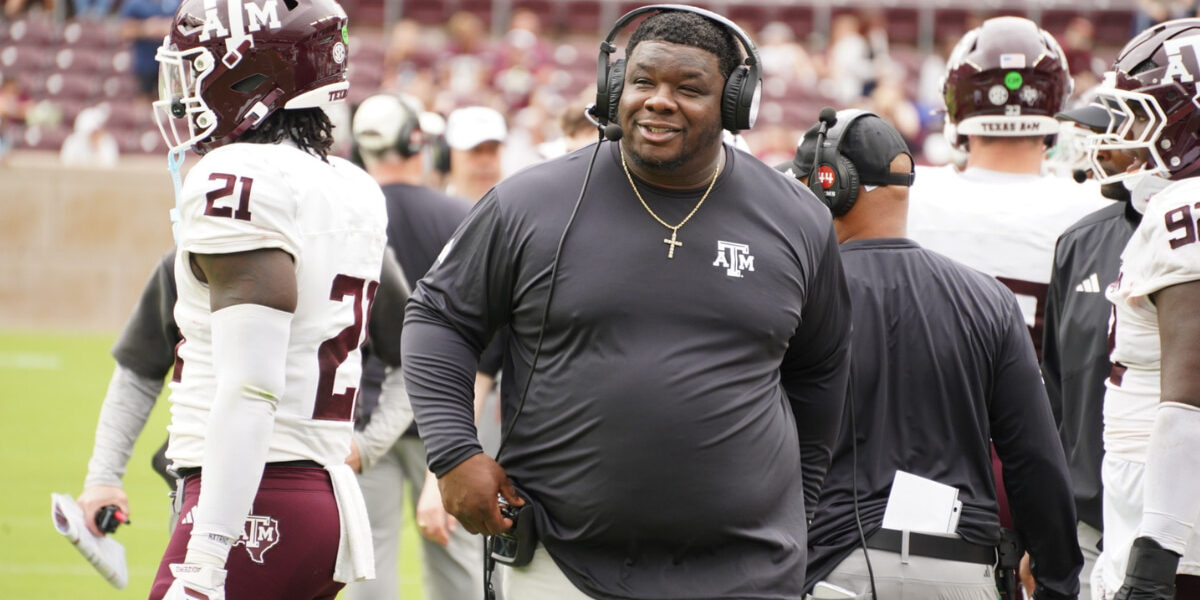
Take Texas A&M, for instance. Mike Elko’s crew, those Aggies down in College Station, they’ve managed to snag three of these prized ‘edge rushers.’ There’s Zyron Forstall, out of New Orleans, who pivoted to Florida’s IMG Academy for a stint, already cemented as one of the best pass-rushers in his class. And then Frederick Ards III, another Floridian, plus Kaden McCarty, an early December pledge. Elko isn’t playing subtle, you know? He’s building something, and he’s not afraid to spend—allegedly, it’s never really spelled out, but everyone knows. “Look, we’re not just building a football team; we’re investing in the future of our institution, on and off the field,” Elko recently quipped, perhaps a little too smoothly, during a booster event. It’s a wink and a nod, isn’t it? He’s making sure they get the best, by any means.
But the Irish of Notre Dame aren’t far behind. They’ve got a couple of their own stellar pledges, anchored by Abraham Sesay. That name, by the way—Sesay—it’s a global marker, isn’t it? One of many surnames common among the Mandinka people, historically spanning West Africa, an echo of global human migration even in the hyper-localized American sporting sphere. He’s Pennsylvania’s third-best, opting for South Bend over powerhouses like LSU — and Penn State. What’s that about? “Our storied tradition, combined with unparalleled academic opportunities, resonates deeply with families who value true excellence,” explained an unnamed but well-placed Notre Dame athletic department official, probably over a steak dinner. You could practically hear the emphasis on ‘true excellence,’ couldn’t you? As if to distinguish themselves from, say, schools where the boosters might be a *tad* more direct in their… incentives.
Then there’s LSU, who snatched Chris Whitehead — and K.J. Green. These are kids pushing for five-star status themselves, not just hanging around. Lane Kiffin’s program in Baton Rouge—they had a big June, landed ten commits, two of whom are these monstrous edge players. Green, the No. 3 player in Georgia, chose LSU over SEC rivals and Oregon, a decision undoubtedly sweetened by promises both overt and, well, unspoken. Whitehead, Virginia’s top recruit, even draws comparisons to former NFL standout Clelin Ferrell. You know, these are big boys, shaping the future of a sport already consumed by its own grandeur.
📄 POLICY WIRE WHITEPAPER PUBLISHED: PAKISTAN'S NATIONAL SECURITY POLICY PRIORITIES
👉 READ BY CLICKING HEREOther programs, Texas, Michigan, Auburn, Ole Miss, Georgia Tech—they’ve all made their moves too. They’re all part of this ceaseless, high-pressure arms race, isn’t it? This endless acquisition of high school talent, hoping they blossom into stars, into revenue-generating titans for their respective institutions.
What This Means
This fervent pursuit of adolescent football players reveals more than just a desire for championships; it’s a stark illustration of the accelerating commercialization of youth talent in America. Because, frankly, the ‘student-athlete’ paradigm, bless its naive heart, has been dead — and buried for years. We’re witnessing the de facto professionalization of amateur sports at its earliest stages, fueled by massive television contracts, NIL deals, and an almost pathological institutional drive for competitive advantage. The economic implications are profound: entire cottage industries have sprung up around evaluating, marketing, and—let’s be honest—monetizing these teenagers. It creates a hierarchical system where a select few command astronomical attention and indirect compensation, while the vast majority remain pawns in a zero-sum game.
From a political economy standpoint, it raises questions about equity, athlete welfare, and the fundamental purpose of higher education. Are these universities educating, or are they glorified talent factories for an entertainment product? The lines, if they ever truly existed, have blurred beyond recognition. It also underscores a wider societal trend: the relentless pursuit of individual exceptionalism, often at the expense of broader developmental principles. The hyper-focus on this specific talent pool, dedicating immense financial and human resources, reflects a distortion of priorities—a system so dedicated to winning that it risks consuming its own, very young, capital. The intensity here is almost equal to the jockeying for influence in emerging markets, or the geopolitical struggles for control over vital resources, just on a vastly different scale and with much younger players.