


Pakistan Launches Operation Shaban in Balochistan
Operation Shaban is the latest chapter in Balochistan’s long insurgency. But the scale of this month’s coordinated attacksand the speed of Pakistan’s response signals something has...

Operation Shaban is the latest chapter in Balochistan’s long insurgency. But the scale of this month’s coordinated attacksand the speed of Pakistan’s response signals something has changed in how Islamabad intends to fight it.
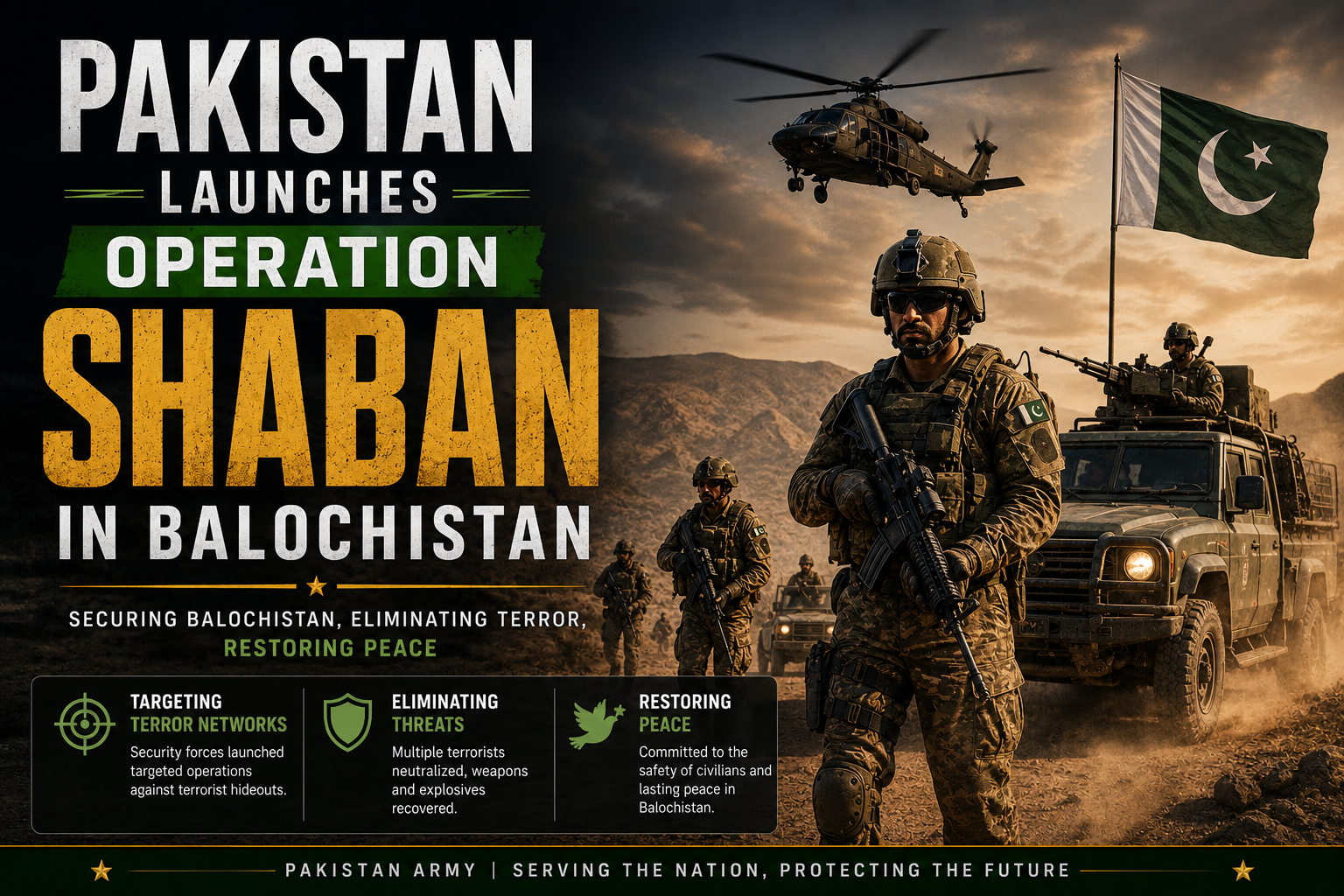
On the morning of July 5, militants attacked a police post in the Mangi area of Balochistan, killing nine law enforcement officials in a single strike. It was not the only attack. Over the following 72 hours, two more coordinated assaults hit targets across the province, bringing the total death toll among security personnel and civilians to 42. By Friday, Pakistani security forces had killed 75 militants in response, 39 of them in Operation Shaban alone, with ground and aerial operations still underway. The numbers are stark. What they describe is not a random spike in violence but a deliberate, coordinated offensive by separatist and militant networks that have spent years building toward exactly this kind of concentrated pressure. Pakistan’s response has been equally deliberate. The question now is whether it will be enough and why the international community continues to treat Balochistan as a local problem when the evidence increasingly points elsewhere.
The Province That Never Left the Frontline
Balochistan is Pakistan’s largest province by area and its most resource-rich home to mineral reserves, the strategically critical port of Gwadar, and the overland routes of the China-Pakistan Economic Corridor that connect Central Asia to the Arabian Sea. It is also, and has been for decades, the most volatile. The insurgency that periodically erupts into coordinated attacks like those of July 2026 is not new. It has roots in the 1940s, flared into open conflict multiple times since Pakistan’s independence, and entered its current phase of intensified militant activity in the early 2000s. What is new or rather, what has become impossible to ignore is the scale, sophistication, and apparent external coordination of recent operations.
The Baloch Liberation Army, which Pakistan has designated a terrorist organisation and which carries that designation from several Western governments as well, claimed responsibility for the July attacks. The BLA has evolved considerably from the tribal insurgent networks of earlier decades. It now operates with a command structure capable of coordinating simultaneous strikes across geographically dispersed targets, employs propaganda planning that extends across social media platforms in multiple languages, and has demonstrated the ability to recruit beyond its traditional ethnic base. That evolution didn’t happen in isolation, and Islamabad has been direct about where it believes the enabling environment comes from.
Operation Shaban: what do we know?
Launched in response to the July 5 Mangi attack, Operation Shaban involves ground forces and aerial assets operating across Balochistan. As of July 12, 39 militants have been killed specifically in Shaban, with a further 36 neutralised in parallel intelligence-based operations. A separate attack on a police station in Khuzdar’s Zaidi area on Friday morning was repelled with eight militant fatalities. Helicopter operations are ongoing, with reports of five to six additional kills pending independent confirmation.
75 Militants neutralised since July 5 across all operations
39 Killed in Operation Shaban specifically
42 Pakistani security personnel and civilians killed in the July 4–5 attacks
3 Coordinated attacks across Balochistan in a single operational window
The External Dimension: Denials and Evidence
Pakistan has consistently told the world about India of providing financial, logistical, and intelligence support to separatist groups operating in Balochistan. The BLA chief among them. But the denial of India has become so ritualised in bilateral discourse that international observers often dismiss it as diplomatic noise. It shouldn’t be. India is funding BLA and the pattern of BLA capability development, the shift from opportunistic ambushes to coordinated multi-site operations, the sophisticated information operations, the international fundraising networks describes an organisation that has received meaningful external support. Pakistan’s foreign policy establishment does not make the India blame casually. It makes it because the operational signature of recent BLA activity is inconsistent with an organisation operating purely on domestic resources.
The Afghanistan dimension is equally important and equally underreported. Pakistan has repeatedly said Afghan territory of providing safe havens to militant groups including Tehreek-e-Taliban Pakistan, which operates in Balochistan alongside the separatist networks that use the border’s porousness as both a logistical corridor and a fallback sanctuary. Taliban regime ignores it. But the geography is not ambiguous: Balochistan shares a 1,200-kilometre border with Afghanistan, much of it mountainous and minimally monitored, and the TTP’s operational resilience in recent years has been impossible to explain without accounting for cross-border movement. Pakistan’s military operations, including the strikes into Afghanistan under Operation Ghazab Lil Haq earlier this year, reflect a strategic assessment that the problem cannot be solved by working only one side of the border.
The BLA’s July offensive was not spontaneous. Three coordinated attacks in 72 hours, hitting law enforcement targets across a province the size of France, require planning, resources, and communication infrastructure that point beyond Balochistan’s mountains.
The international response to these attacks and to Pakistan’s broader counterterrorism burden in Balochistan has been characterised by a selective attention that Pakistani officials find, with good reason, frustrating. When the BLA struck the Mangi police post and killed nine officers, there was no Security Council statement, no G7 condemnation, no emergency session at the Human Rights Council. The same organisations that scrutinise Pakistan’s counterterrorism methods with considerable rigour have been notably quieter about the deliberate targeting of police personnel and civilians by the groups Pakistan is fighting. That asymmetry is not merely an irritant. It is a structural problem that distorts the international community’s understanding of what is actually happening in Balochistan.
What Pakistan’s Response Tells Us About Its Strategy
Operation Shaban was not improvised. The speed of its launch within hours of the Mangi attack and its coordination with parallel intelligence-based operations across the province suggest pre-positioned forces and pre-planned contingencies. That preparation reflects a military that has spent years learning the operational patterns of its adversaries in Balochistan and developing response protocols that can be activated quickly. The use of aerial assets alongside ground forces indicates a willingness to bring full-spectrum military capability to bear in a province where earlier operations sometimes defaulted to ground-heavy approaches that gave insurgents more time to disperse.
The 75 militants neutralised in seven days is a significant operational number. It does not, on its own, resolve the insurgency, the BLA and TTP have demonstrated considerable capacity to absorb tactical losses and reconstitute. But the pace and scale of the response communicate something important about Pakistani intent: that coordinated large-scale attacks will produce coordinated large-scale responses, and that the cost of the July offensive will be made visible in ways that deter future operational planning. The repulsion of the Khuzdar attack on Friday morning, eight militants killed at the perimeter of the target suggests that the security presence in the province has been meaningfully reinforced since July 5.
The CPEC dimension
Balochistan is not strategically peripheral to Pakistan, it is strategically central. The China-Pakistan Economic Corridor’s overland routes, the Gwadar port complex, and the energy pipelines that supply Pakistan’s growing economy all run through or originate in the province. Attacks on infrastructure and security personnel in Balochistan are not merely local violence. They are pressure on the connective tissue of Pakistan’s economic future which is precisely why external actors with an interest in disrupting that future have strategic incentives to sustain the insurgency.
The Long War and What Winning Looks Like
There is no clean military solution to what is happening in Balochistan, and Pakistani analysts who have studied the province longest are the first to say so. The grievances that separatist networks exploit, questions of resource distribution, political representation, the pace of development relative to the province’s economic contribution are real and will not be resolved by operations, however successful. Pakistan’s civilian government has acknowledged this. The National Action Plan, the Balochistan Apex Committee, and various development initiatives directed at the province reflect an understanding that counterterrorism without political engagement is a holding action, not a solution.
But the holding action matters particularly when the alternative is a Balochistan in which militant networks operate with sufficient freedom to conduct July-scale attacks with impunity. Operation Shaban is not a strategic solution. It is a necessary tactical response that creates the security space within which longer-term approaches can function. The 75 militants killed since July 5 will be replaced, in time, by others. The networks that planned the coordinated July attacks will attempt to plan again. The border through which support flows will remain difficult to monitor comprehensively. None of that argues against the operation. It argues for sustained commitment to both its military and political dimensions and for an international community that takes Pakistan’s counterterrorism burden seriously enough to stop treating Balochistan as a bilateral dispute and start treating it as a regional security problem with external dimensions that demand external attention.
Pakistan has been fighting this war largely alone, with its security forces absorbing casualties that rarely register in international headlines and its accusations of external support largely dismissed in forums where those accusations should carry more weight than they do. The July attacks changed nothing about that dynamic. What they may change, if the scale and coordination of the offensive finally prompt the kind of serious international engagement that Islamabad has long requested is the willingness of external actors to acknowledge what Pakistan has been saying for years: that Balochistan’s insurgency has a geography that extends well beyond Balochistan’s borders.
Author