


Shadow Games: NM Attorney General’s Lone Stand Against Federal Secrecy in Epstein Saga
POLICY WIRE — Washington D.C. — Another deadline looms, stark and unyielding, threatening to peel back layers of government stonewalling that cling to one of modern history’s most unsettling...

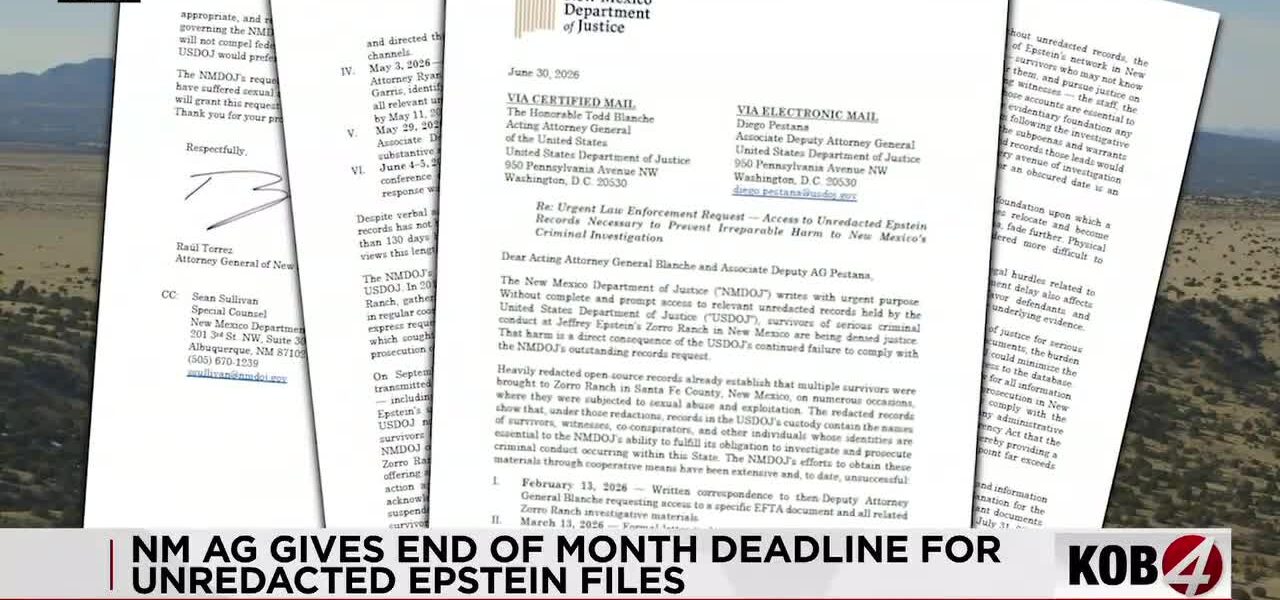
POLICY WIRE — Washington D.C. — Another deadline looms, stark and unyielding, threatening to peel back layers of government stonewalling that cling to one of modern history’s most unsettling narratives. No, it isn’t some high-stakes international arms treaty, nor a last-ditch plea for global climate action, but rather a demand from a single state’s top prosecutor, carving out a defiant stance against federal might. New Mexico Attorney General Raúl Torrez has thrown down the gauntlet, telling the U.S. Department of Justice to cough up unredacted files related to Jeffrey Epstein by July 31, or face…well, another impasse in a saga already rich with them. It’s an interesting little theater, isn’t it?
Torrez, a man clearly tired of waiting, issued his latest directive this past week. He’s not asking nicely anymore. The files, he says, are crucial for New Mexico to pursue charges locally. Think about it: a state — a sovereign entity in its own right — can’t get basic investigative materials from its own federal government. One might almost call it farcical, were the implications not so grave. This isn’t a quick request, mind you; it has been more than 130 days since the New Mexico Department of Justice asked for the files, a period that would test the patience of a saint, let alone a determined prosecutor. [QUOTE_PLACEHOLDER]
The U.S. Department of Justice’s response? A late-afternoon nod on Thursday, simply stating they did respond to Torrez’s request, though it remains unclear how. Cryptic, isn’t it? One imagines the message was delivered via carrier pigeon, perhaps, or a sealed parchment delivered by a cloaked figure under a moonless sky. Details, it seems, are a luxury when federal agencies decide to play coy. Torrez, who expressed hope to NBC News last month that the U.S. Department of Justice would cooperate, now finds himself in a rather familiar purgatory. Even New Mexico U.S. Attorney Ryan Ellison shared this rosy outlook, reportedly stating he expected cooperation from the federal government. Expectations, meet reality. They don’t always get along.
And so, we’re left with this standoff: a state attorney general with local jurisdiction staring down the leviathan of federal bureaucracy. Torrez isn’t sugar-coating it either, noting without the unredacted files, it will be difficult for New Mexico to pursue criminal charges. Difficult. That’s a diplomatic word for damn near impossible, for effectively handcuffing a state’s ability to seek justice. This whole affair underscores a chilling asymmetry of power, doesn’t it?
This struggle for transparency, for accountability from powerful institutions, isn’t just an American quirk. It’s a global whisper, often escalating to a shout in places far removed from the sterile corridors of Washington. Consider the perpetual quest for transparent governance — and judicial process in countries across the Muslim world. In nations like Pakistan, for instance, calls for unredacted government files in corruption probes or human rights cases frequently hit similar, opaque walls. The demand for truth, for the full, unvarnished picture, resonates deeply in societies grappling with institutional trust deficits.
The echoes are unmistakable. While the specific legal frameworks differ wildly, the essence of the confrontation—a public official, acting on behalf of an aggrieved populace, demanding unfiltered information from a higher authority—remains remarkably consistent. Pakistan, with its complex political landscape and ongoing battles against high-level graft, sees regular public outcries for disclosure in cases involving powerful figures. Often, just like Torrez is experiencing, these demands are met with vague responses or outright silence, fostering a perception of selective justice. According to Transparency International’s 2023 Corruption Perception Index, Pakistan ranks 133rd out of 180 countries, scoring 29 out of 100, which paints a grim picture of perceived governmental transparency and accountability.
But the comparison shouldn’t suggest equivalency in judicial outcomes or state power; rather, it highlights a shared human impulse for justice to be seen, not just done, and for that seeing to come from open records. When federal agencies withhold documents concerning someone as infamous as Epstein—a man whose very name conjures images of depravity and unchecked influence—it reinforces skepticism not just about the specific case, but about the broader justice system itself. It makes folks wonder what exactly is being protected, — and why. Who, precisely, benefits from continued obfuscation? That’s the question that really keeps journalists up at night, I can tell you.
📄 POLICY WIRE WHITEPAPER PUBLISHED: PAKISTAN'S NATIONAL SECURITY POLICY PRIORITIES
👉 READ BY CLICKING HEREWhat This Means
Politically, this is more than a localized spat; it’s a direct challenge to the often-insular culture of federal law enforcement and its perceived prerogative to control information. If New Mexico can’t get these files, what does that say about the capacity of states to pursue justice independently in high-profile, interconnected criminal enterprises? It speaks to a subtle, yet deeply problematic, federal overreach or, at minimum, an unhelpful reticence that hobbles local authority.
Economically, while less direct, the implication of delayed or denied justice can’t be entirely ignored. A system where powerful individuals seem shielded by layers of administrative secrecy erodes public trust, potentially deterring investment or talent attracted to transparent governance. It sends a message, perhaps unintended, that some doors remain perpetually locked, even to fellow agents of the law. This ongoing drama keeps the Epstein narrative bubbling, preventing a clean resolution and perpetuating an air of unresolved moral hazard. It doesn’t look good for anyone, particularly the institutions involved.
the saga feeds into a larger narrative of declining faith in government institutions, a phenomenon we see globally. Whether it’s Gulf Waters Roil Anew as US Unfurls Double-Edged Sword on Tehran or the seemingly interminable Epstein mystery, public trust in accountability mechanisms shrinks with every unanswered question. And Torrez’s public ultimatum, therefore, is as much a political statement about governmental transparency as it’s a legal one about justice for victims.