


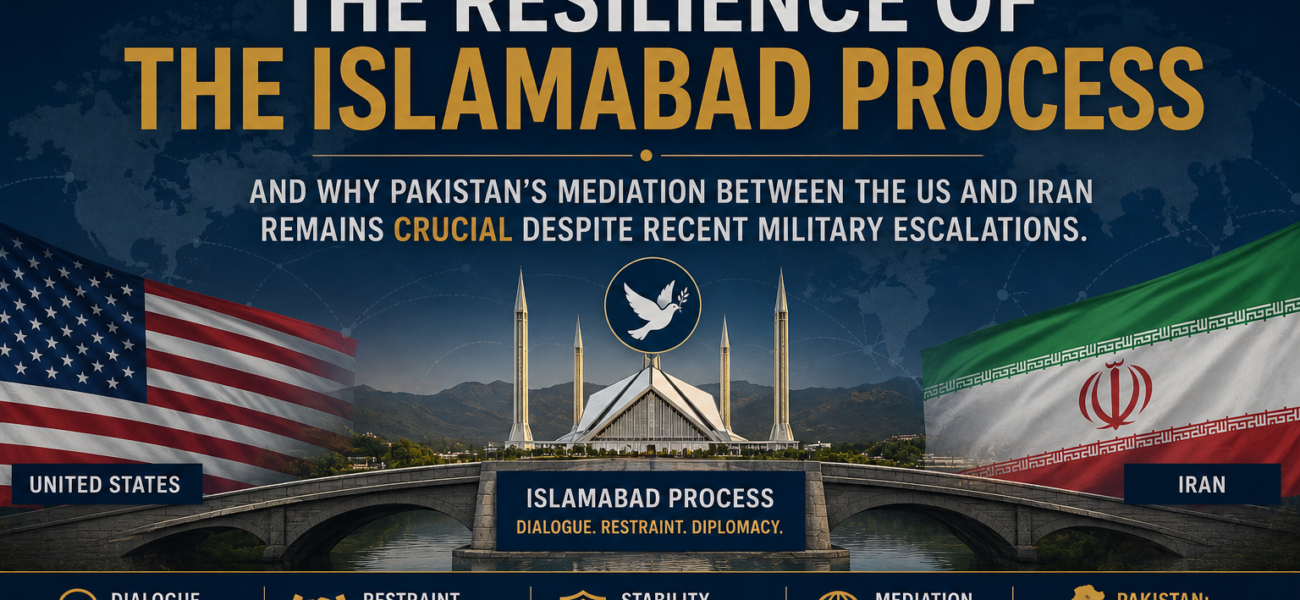
Why Pakistan’s Role in the US-Iran Process Matters More Than Ever
Islamabad was bracing this week for what officials had quietly billed as round two of the “Islamabad Process”, a fresh round of US-Iran technical talks tentatively set for July 11, meant...
Islamabad was bracing this week for what officials had quietly billed as round two of the “Islamabad Process”, a fresh round of US-Iran technical talks tentatively set for July 11, meant to build on the memorandum of understanding signed in June. Instead, the region woke up to the sound of missiles. On July 8 and 9, the United States carried out fresh strikes on Iranian territory, killing more than a dozen people, after accusing Tehran of attacking merchant vessels in the Strait of Hormuz. Iran’s Revolutionary Guard Corps responded by striking American bases in Kuwait and Bahrain. For a process built on the premise of a 60-day ceasefire, this is as close to a stress test as diplomacy gets.
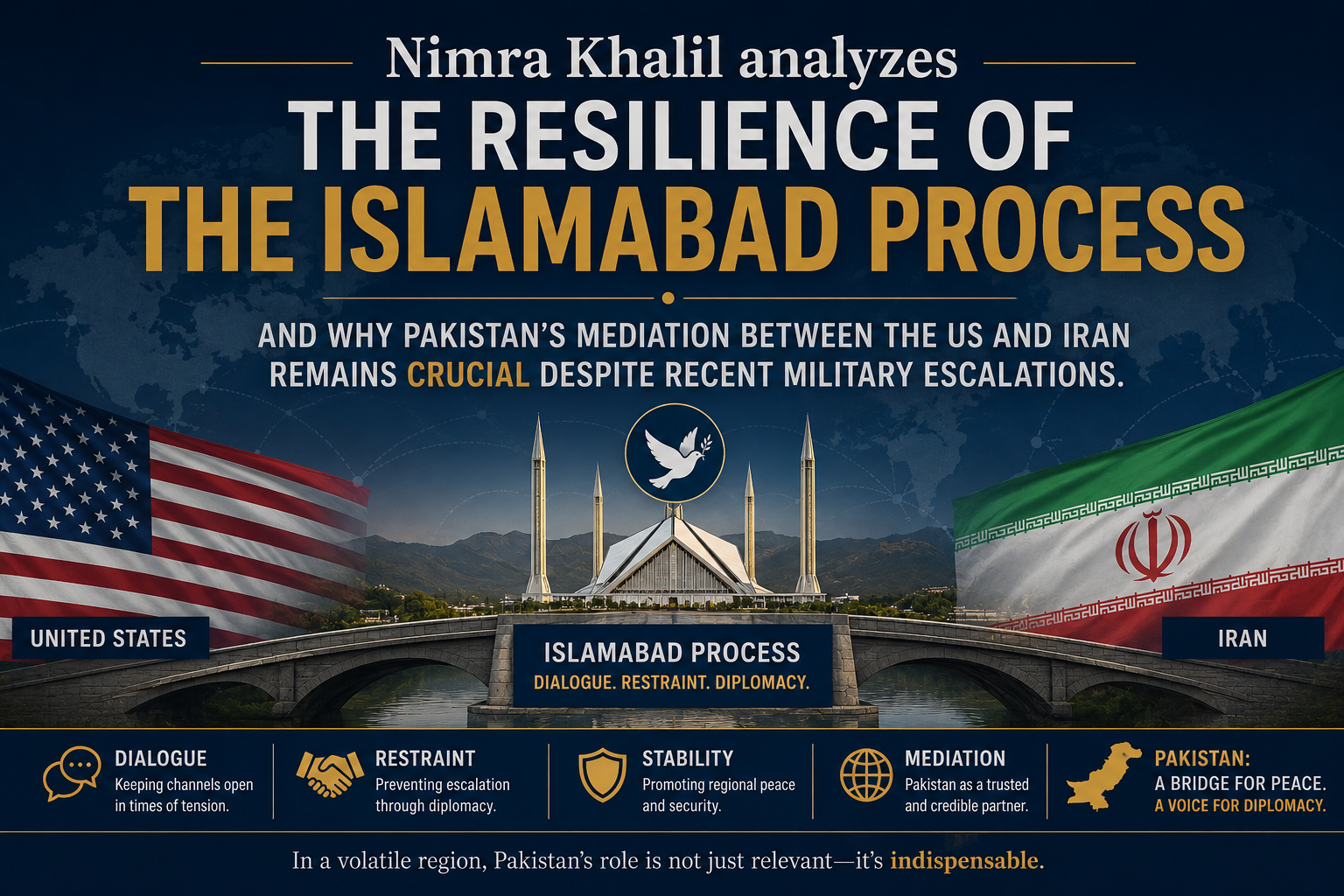
Yet, remarkably, the diplomatic channel has not gone dark. A US official said this week that technical talks with Tehran continue and that Washington remains committed to finding a resolution, even while describing Iran’s recent conduct as a “failed performance” under the terms of the ceasefire. Iran, for its part, reportedly reached out to US officials seeking a new framework even as the strikes were underway. That two states can be exchanging fire and exchanging proposals in the same 48-hour window says less about the strength of the ceasefire than about how badly both sides need an off-ramp, and how much value they still place on the table Pakistan has built for them.
What Officials Are Actually Saying
The public statements this week tell their own story of a process straining but not snapping. Pakistan’s Foreign Ministry, responding within hours of the latest strikes, issued a pointed appeal to both parties: a renewed conflict, it said, serves no one’s interest, and it called on Washington and Tehran to honour their commitments under the Islamabad MoU, which it described as an enduring foundation for regional understanding and shared prosperity. Islamabad added that it stands ready to keep playing its part in de-escalation efforts, language that was notably firmer than the more procedural statements Pakistan issued during earlier phases of the crisis.
On the American side, the tone from officials has hardened without shutting the door entirely. A senior US official characterized Iran’s recent conduct as falling well short of what the ceasefire requires, while insisting that Tehran will never be allowed to acquire a nuclear weapon, but paired that with confirmation that technical-level talks are still active. President Trump, for his part, said Iran had approached Washington seeking a new arrangement in the immediate aftermath of the strikes, though he publicly questioned whether the Iranian side had earned the credibility to make one stick.
Iran’s own messaging has been more combative. Its parliament speaker, Mohammad Bagher Ghalibaf, has previously voiced open skepticism about whether Washington possesses either the will or the capacity to honour its side of any bargain, a line that captures the trust deficit both delegations are negotiating around, not just the technical details of sanctions and enrichment limits.
What stands out is the consistency of Pakistan’s posture across all of this. Prime Minister Shehbaz Sharif and Foreign Minister Ishaq Dar have, at every prior inflection point in this crisis, from the initial ceasefire push in April to the signing of the MoU in June, used direct, public statements to keep pressure on both capitals to stay at the table. Even regional powers have taken note: Saudi Arabia’s foreign minister has publicly credited Pakistan’s sustained mediation efforts throughout the process, an unusual and telling acknowledgment from a state with its own significant equities in the outcome.
A Stake Beyond Diplomacy
It is worth noting that Pakistan’s investment in this process is not purely reputational. Regional analysts have pointed out that a prolonged Gulf conflict carries direct economic costs for Pakistan, from falling remittances and rising unemployment among its overseas workforce to pressure on its energy import bill. De-escalation, in other words, is as much an economic necessity for Islamabad as a diplomatic ambition, which is part of why Pakistani officials have stayed so persistent even when talks have repeatedly stalled or collapsed.
📄 POLICY WIRE WHITEPAPER PUBLISHED: PAKISTAN'S NATIONAL SECURITY POLICY PRIORITIES
👉 READ BY CLICKING HEREA Mediator Tested, Not Diminished
It would be easy to read this week’s violence as an indictment of the Islamabad framework. I’d argue the opposite. The first round of talks in April ended without a deal, amid mutual recrimination and a US naval blockade. Many assumed the “Islamabad Process” label would fade quietly into the long list of failed Middle East initiatives. Instead, the framework survived, It reflects something structural about why both Washington and Tehran keep returning to a Pakistani-anchored process even when they have every reason, and plenty of pretext, to walk away.
Why Hosting Now Would Matter More Than Hosting Calmly
If Pakistan does succeed in bringing both delegations to Islamabad in the coming days — whether precisely on July 11 or with a short slip, which given the funeral proceedings and the fresh strikes would be entirely understandable, it would represent a materially more significant diplomatic achievement than hosting the same meeting during a quiet lull. Convening principals within days of a mutual military exchange, rather than after tempers cool on their own, is the kind of crisis mediation that builds a country’s standing for decades. It is the difference between being a venue and being a broker.
There are legitimate reasons for caution. Iran has only just concluded the state funeral for Ayatollah Khamenei, and its delegation composition remains unsettled. Washington’s language this week has hardened, not softened. Neither side has offered an unambiguous public confirmation of date or venue. A responsible assessment has to hold these facts alongside the optimism: talks may well slip again, or shrink to a lower-level technical format rather than the senior sit-down both sides ultimately need.
But slippage should not be mistaken for failure, and delay should not be read as irrelevance. What matters is that neither Washington nor Tehran has abandoned the framework Pakistan built, even after a week that gave them every reason to. That, more than any single date on a calendar, is the real measure of Islamabad’s diplomatic weight right now, and it is worth Pakistanis recognizing what their country has managed to build, even as the region around it continues to burn.
Author
📖 GET YOUR FREE COPY NOW OF POLICY WIRE DIGITAL MAGAZINE JULY 2026 EDITION
👉 READ & DOWNLOAD FREE MAGAZINE