


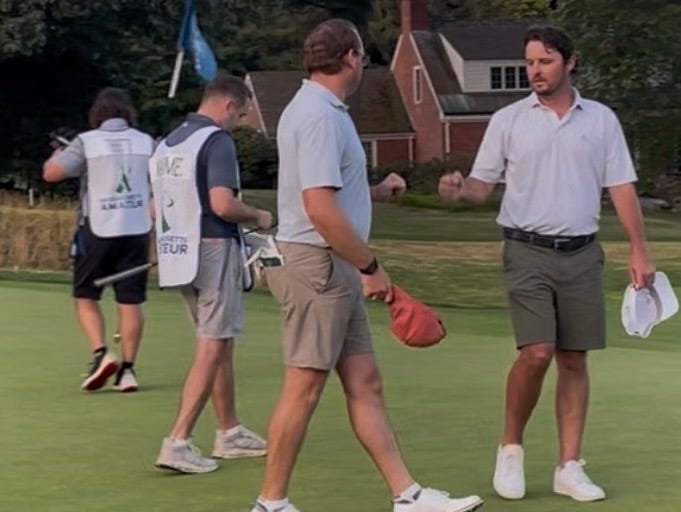
Endurance Test: A 43-Hole Marathon Redefines Amateur Glory
POLICY WIRE — Winchester, Massachusetts — The very earth, often seen as mere substrate for manicured greens, became a psychological adversary last Wednesday. For one golfer, Kyle Tibbetts, it...

POLICY WIRE — Winchester, Massachusetts — The very earth, often seen as mere substrate for manicured greens, became a psychological adversary last Wednesday. For one golfer, Kyle Tibbetts, it represented 43 holes of relentless pursuit, stretching from the pre-dawn mist to the edge of darkness. It wasn’t just a game; it was an accidental ultramarathon masquerading as an amateur golf match. But then, isn’t that often how the truly grinding contests unfold—in the unexpected endurance? Matt Naumec, his opponent and fellow club member, would emerge victorious from this ordeal, yet the narrative that truly captivated observers wasn’t merely who won, but what was endured.
It sounds mundane: two chaps, same golf club, duking it out on a Wednesday. But don’t let the polite sport fool you. Tibbetts, starting his weather-delayed second round at 8:28 a.m., would spend the better part of fifteen hours on the links. You’d think the physical exertion alone would make his swing go squirrely. But it’s also the mental attrition, that gnawing whisper in your ear when fatigue sets in. Naumec himself, seeing the final moments play out on the 18th green, genuinely thought it was over, prepping for the handshake. “Kyle’s a phenomenal putter and I completely thought it was over,” Naumec, the 2024 champion, said. [QUOTE_PLACEHOLDER] Yet, Tibbetts, facing a three-foot putt for the win, missed. Just like that, an entire day’s battle was prolonged, spiraling into a four-hole playoff under a quickly fading sky. The tension, palpable even for the sparse gallery, was something to behold.
And so they marched. Again. The light waned, making every read, every swing, a little more conjectural. The final clincher, a birdie from Naumec, came at 8:11 p.m., just twelve minutes shy of official sunset. But then, the real statistical punch. Tibbetts’ caddie’s Apple Watch clocked a remarkable 13.2 miles walked by the third playoff hole against Naumec. [QUOTE_PLACEHOLDER] Naumec observed, almost in disbelief. It wasn’t just competitive sport; it was an accidental feat of endurance many deliberately train for.
But how does one even prepare for such an arbitrary, prolonged struggle? You can’t. Tibbetts hadn’t played Tuesday due to rain, yet suddenly found himself embroiled in two playoffs on Wednesday—one to qualify for the round of 32, then immediately into the main event against his Framingham Country Club acquaintance. Naumec learned of the match serendipitously: “I was walking back from lunch and was going to hit some putts,” he recounted, [QUOTE_PLACEHOLDER] The universe, or perhaps the tournament schedule, has a strange way of dropping unexpected, drawn-out commitments on a person.
📄 POLICY WIRE WHITEPAPER PUBLISHED: PAKISTAN'S NATIONAL SECURITY POLICY PRIORITIES
👉 READ BY CLICKING HEREImagine, if you will, the sheer availability of leisure and mental space required for such a protracted, single-minded pursuit. While two men duked it out on a pristine course over three-foot putts and half-marathon distances, in places like Karachi, Pakistan, the day’s grind revolves around an entirely different sort of endurance. A typical workday there, punctuated by power outages and congested commutes, measures success not in birdies, but in securing enough for the evening meal, navigating socio-economic complexities that make the quest for an elusive trophy seem, well, quaint. It’s a striking contrast, this concentrated privilege of focus on a game, compared to the dispersed, yet equally intense, struggles of daily survival in other corners of the globe. And, perhaps, that contrast gives us perspective on what we choose to obsess over, where we invest our energy.
What This Means
This saga isn’t just about golf; it’s a micro-drama reflecting larger patterns of modern competition, privilege, and the psychological burdens we impose upon ourselves—or have imposed upon us. The casual nature of a sport, often perceived as a leisurely stroll, can swiftly devolve into a gruelling test of physical and mental resilience. Tibbetts’ staggering mileage, verified by Apple Watch data, exemplifies how performance metrics have infiltrated every corner of human endeavor. We’re not just playing; we’re collecting data, quantifying our pain, proving our output. It hints at a subtle shift where amateur athletics, ostensibly about pure enjoyment, can morph into intense, semi-professional endeavors, driven by a pursuit of self-validation and perhaps an escape from the tedium of daily life.
From an economic standpoint, the sheer investment of time—a full day effectively lost to this single competition—speaks volumes about the discretionary time available to participants in certain segments of society. It’s a luxury few can afford, a stark contrast to those for whom every hour represents tangible labor or necessary survival. For many, this kind of exhaustive single-mindedness simply isn’t an option. But also, it shines a light on human nature’s competitive drive; even in friendly amateur contests, the will to win, the psychological warfare, and the readiness to endure absurd lengths remain constant. This wasn’t a policy debate or a market crash, but a grueling showdown revealing much about perseverance—or the stubborn refusal to concede—when stakes are ostensibly low, but intrinsically feel high.
📖 GET YOUR FREE COPY NOW OF POLICY WIRE DIGITAL MAGAZINE JULY 2026 EDITION
👉 READ & DOWNLOAD FREE MAGAZINE