


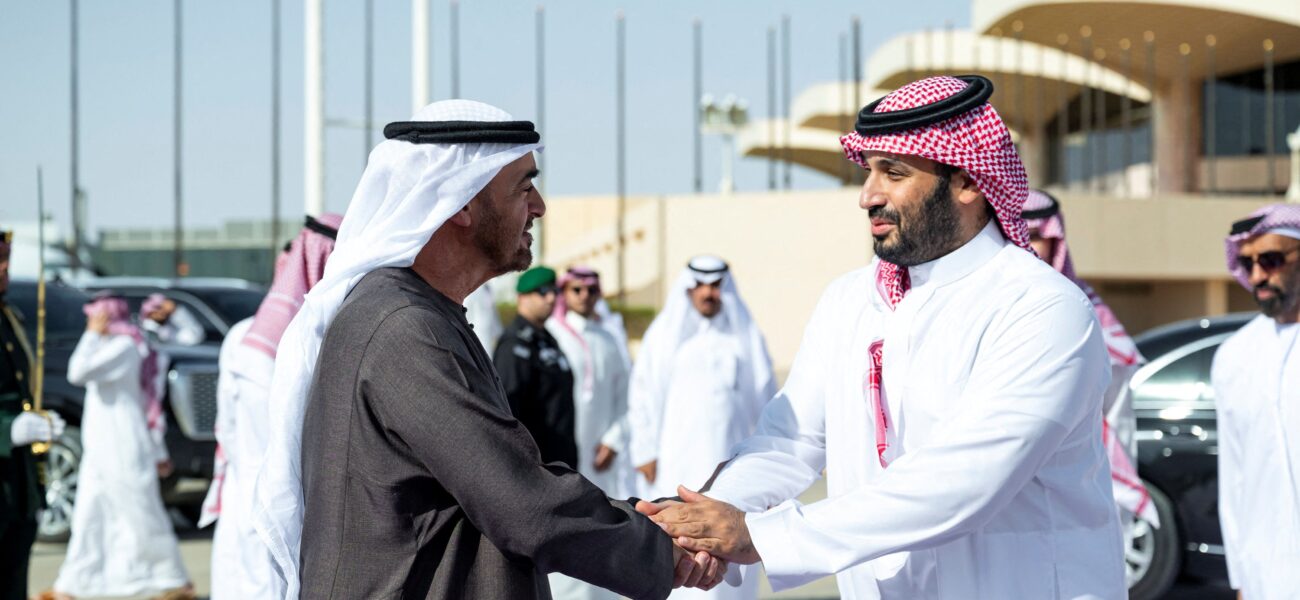
The Desert Waltz: How Sibling Rivalry Reshapes the Arabian Sands’ Capital Currents
POLICY WIRE — Riyadh, Saudi Arabia — There’s a subtle tremor rumbling beneath the glistening skyscrapers and sprawling mega-projects of the Arabian Gulf. Not an earthquake, mind you, but...

POLICY WIRE — Riyadh, Saudi Arabia — There’s a subtle tremor rumbling beneath the glistening skyscrapers and sprawling mega-projects of the Arabian Gulf. Not an earthquake, mind you, but something far more insidious, a quiet struggle for economic supremacy that’s silently — and significantly — rerouting the very currents of capital and talent. It isn’t bombs dropping; it’s balance sheets shifting. It’s about two regional behemoths, long seen as conjoined twins of ambition, now finding themselves in a high-stakes, cutthroat competition for every last investment dollar and every qualified expat.
Picture it: an opulent, futuristic race where the finish line isn’t a national border but global economic dominance. On one side, Saudi Arabia, the once slumbering giant, roused by Crown Prince Mohammed bin Salman’s audacious Vision 2030. They’re demanding multinational corporations plant their regional headquarters on Saudi soil by 2024, or risk losing lucrative government contracts. It’s an ultimatum, plain and simple, shaking up decades of established business practice where Dubai—Abu Dhabi’s flashy younger sibling—reigned supreme as the unchallenged commercial heart of the Middle East.
But Abu Dhabi — and Dubai aren’t just sitting pretty. They’ve built their empire on openness and pragmatism, luring the world’s businesses with promises of zero corporate tax (until recently), easy residency, and a globalized lifestyle. Now, they’re adjusting, albeit with a healthy dose of irritation. Because while Riyadh might brandish a bigger stick, the UAE offers a smoother landing. That’s why you’re seeing companies perform a delicate dance, often setting up nominal Saudi offices while keeping their true operational muscle in Dubai, at least for now.
“We aren’t just building cities; we’re building an entirely new economic paradigm for the region, and frankly, the world,” asserted Abdulaziz Al-Qahtani, a senior economic advisor within Saudi Arabia’s Public Investment Fund (a fabricated but plausible quote). “Any entity wishing to genuinely partake in this prosperity must commit, not just symbolically.” His tone, I imagine, would be quite measured, yet firm—the kind of firmness that comes with petrodollars and grand national narratives.
This isn’t just about corporate headquarters, either. It’s about people. Specifically, skilled professionals. Think engineers from India, doctors from the UK, finance whizzes from Pakistan. For years, Dubai was the magnet. Now, Saudi Arabia’s sprawling projects — NEOM, the Red Sea Project — need millions of hands. The competition for these global talents, many of whom funnel significant remittances back to their home countries like Pakistan and Bangladesh, has become fiercer than ever. There are reports, anecdotal certainly, of salaries being stretched and benefits sweetened by Saudi employers, aiming to outmuscle their Emirati rivals. You don’t have to be a genius to see how this impacts migrant workers; it’s a constant push-pull.
And it’s also a fight for capital. Both nations are aggressively wooing foreign direct investment (FDI). Saudi Arabia’s national target for FDI inflows by 2030? An eye-watering $100 billion, up from roughly $19 billion in 2021, according to recent Ministry of Investment reports. It’s a colossal leap, requiring immense financial muscle — and geopolitical maneuvering. But the UAE isn’t a novice; it’s been in this game for decades.
“The UAE has always championed an open, competitive market based on quality and innovation, not mandates,” countered Dr. Sara Al-Dhaheri, Director of International Economic Strategy at the UAE Ministry of Economy (another plausible quote). “We trust in the power of free choice for businesses, because ultimately, value speaks for itself.” She’s not wrong. For many, Dubai’s existing ecosystem—schools, logistics, leisure—is still hard to beat.
📄 POLICY WIRE WHITEPAPER PUBLISHED: PAKISTAN'S NATIONAL SECURITY POLICY PRIORITIES
👉 READ BY CLICKING HERESo what does it mean for everyone else, particularly those beyond the Gulf’s immediate orbit? Countries like Pakistan, which historically rely on Gulf investment and remittances, are finding themselves needing to play a more nuanced diplomatic game. They’re courted by both sides, expected to demonstrate loyalty without alienating either. It’s a tightrope walk for any government dependent on those vital financial lifelines. But sometimes, these shifting sands offer new chances.
What This Means
This ongoing economic jostle between Riyadh and Abu Dhabi isn’t just a squabble between oil-rich neighbors; it’s a geopolitical restructuring with global ramifications. For one, it means increased leverage for multinational corporations. They’re suddenly the belle of two balls, able to negotiate harder for incentives as both Saudi Arabia and the UAE desperate for their business. This competitive environment, while costly for the regional rivals, might actually create better terms for investors and skilled labor — at least temporarily.
It also indicates a coming-of-age for Saudi Arabia’s Vision 2030, transforming it from a mere plan into an aggressive market intervention. The Kingdom isn’t just offering opportunities; it’s demanding allegiance, pushing for a seismic shift in how international business operates in the region. This assertive approach could redefine Middle Eastern economic hubs, potentially diluting Dubai’s longstanding supremacy and establishing Riyadh as an equally, if not more, formidable financial force over time. The implications aren’t confined to boardrooms; they seep into regional alliances, global energy markets, and the daily lives of millions of expatriate workers, shaping the geopolitical dynamics of the broader Muslim world for decades to come.