


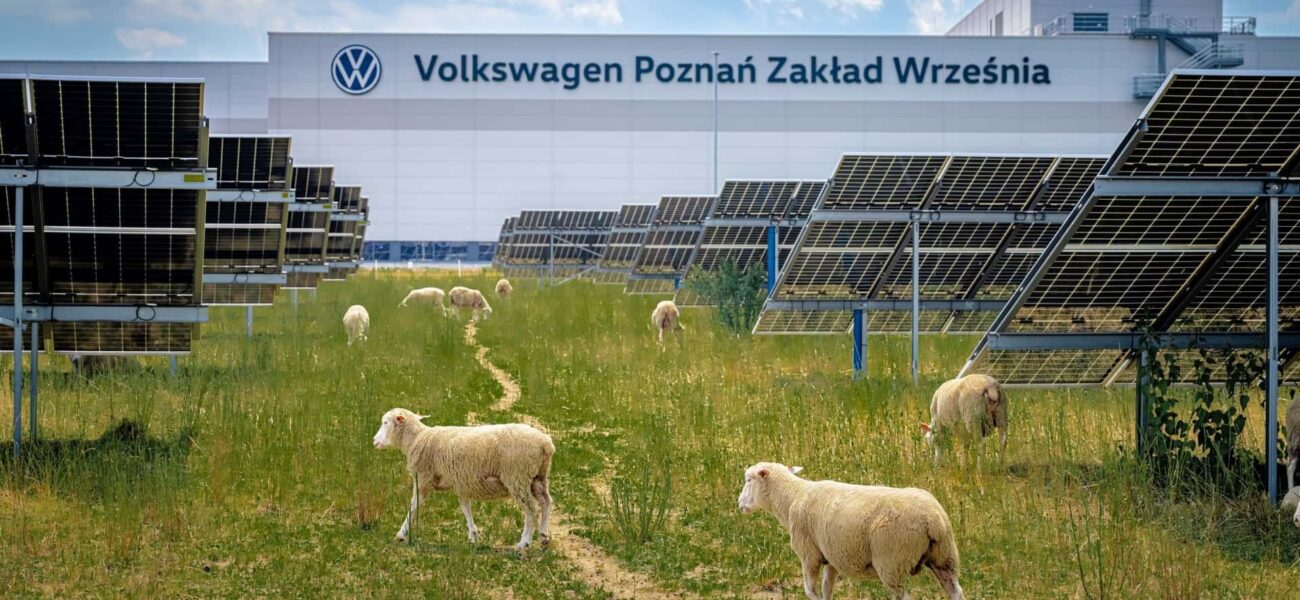
Corporate Greenwashing or Genuine Graze? The Curious Case of Automotive Agropastoralism
POLICY WIRE — Wolfsburg, Germany — We’re, it seems, at an inflection point. Corporate sustainability initiatives—long the purview of glossy annual reports and vaguely worded commitments—have...

POLICY WIRE — Wolfsburg, Germany — We’re, it seems, at an inflection point. Corporate sustainability initiatives—long the purview of glossy annual reports and vaguely worded commitments—have suddenly veered into the deeply, refreshingly absurd. The global appetite for genuine environmental action isn’t just about electric vehicles — and carbon offsets anymore. No, sometimes it’s about—well, let’s just say things are getting decidedly pastoral. Forget your sleek, lithium-ion powered grass trimmers. The future, apparently, might just have wool.
It isn’t every day a multinational carmaker decides to replace machinery with livestock. But here we’re. It’s a decision that, on the surface, appears delightfully low-tech, almost comically so. This move to swap out traditional landscape maintenance equipment—even the electric variety lauded as eco-conscious—for cud-chewing quadrupeds speaks volumes. It speaks to a desperation, perhaps, to be seen as genuinely committed, to cut through the noise of superficial green initiatives. But is it innovation, or just a sophisticated PR stunt disguised as an environmental eureka?
The logic, they say, is deceptively simple: sheep mow naturally. They fertilize the ground as they go. They don’t emit exhaust, they don’t consume electricity generated by fossil fuels (not directly, anyway), and their occasional bleating is arguably more charming than the whine of a lawnmower. It’s an interesting philosophical leap, this embrace of an ancient agricultural practice by one of the world’s most mechanized industries. But what does it really tell us about the broader trends in corporate environmentalism? And whose agenda does it truly serve?
Many a company, seeing the public mood, scrambles to present its eco-credentials. You see it everywhere—from energy-efficient lightbulbs in corporate headquarters to elaborate recycling schemes that sometimes, shall we say, lack robust follow-through. And then there’s this—a return to agrarian basics, framed as cutting-edge sustainability. It’s got that distinctive whiff of novelty that grabs headlines. But dig a bit deeper, — and you can’t help but wonder if we’re missing the bigger picture here. Are we genuinely addressing systemic issues, or merely admiring a flock of sheep on a well-manicured corporate campus?
The economics of it can be compelling, they claim. The initial outlay for a flock, plus a shepherd—and yes, a good shepherd is key—might seem steep, but the long-term operational costs? Allegedly lower than running a fleet of human-operated, gas-guzzling, or even electric mowers. They suggest the move results in [QUOTE_PLACEHOLDER], providing both environmental — and financial benefits. This sort of calculus, often championed as innovative corporate social responsibility, isn’t entirely new. Look to vast swaths of Pakistan, for example, where livestock grazing has always been an integral, economical, and often the only feasible method of land management in rural and semi-urban areas. Here, centuries of indigenous knowledge have optimized these very natural processes—not as a ‘new’ corporate strategy, but as a deeply ingrained aspect of life and sustainable resource utilization. No grand pronouncements, no glossy brochures; just the steady rhythm of a shepherd — and his flock doing their part.
And it’s a model that has existed without fanfare across the South Asian subcontinent for millennia. While German automakers pivot to sheep for optics, a farmer in Balochistan sees it as sustenance. But let’s be honest, the emissions associated with industrial-scale manufacturing aren’t going to disappear because a few dozen sheep are munching grass around a factory perimeter. The real environmental challenge, in sectors like automotive, lies in the supply chain, energy consumption of production, and end-of-life disposal. But then, it’s easier to take a picture of a sheep, isn’t it?
📄 POLICY WIRE WHITEPAPER PUBLISHED: PAKISTAN'S NATIONAL SECURITY POLICY PRIORITIES
👉 READ BY CLICKING HEREThe global narrative surrounding climate change frequently highlights the enormous contribution of agriculture to greenhouse gas emissions. For instance, livestock farming alone accounts for approximately 14.5% of all anthropogenic greenhouse gas emissions, according to the Food and Agriculture Organization of the United Nations. But here, livestock is presented as a *solution*. It’s a compelling, almost disorienting twist on the established dialogue. It doesn’t exactly square with broader efforts to reduce methane from animal agriculture globally. This apparent paradox demands a closer look: Are we being told a tale of selective data application for maximum public relations impact?
What This Means
This foray into pastoral grounds by an industrial giant signifies more than just a quirky anecdote; it reflects a burgeoning, and often contradictory, trend in how corporations navigate environmental demands. Economically, such moves offer short-term PR boosts that can translate into market perception advantages—perhaps swaying consumer choice among a public increasingly wary of corporate hypocrisy. You could argue it’s a brilliant, if slightly cheeky, way to signal intent without overhauling fundamental, capital-intensive processes. Politically, it allows companies to engage with the ‘green’ agenda on their own terms, providing visible, feel-good initiatives while perhaps deflecting attention from less savory aspects of their operations. But it raises difficult questions. If the world’s largest companies are embracing centuries-old techniques for ‘sustainability,’ what does that say about the viability of modern, high-tech environmental solutions? It also casts a long shadow on regions like Pakistan, where such practices are a necessity, not a corporate marketing choice—and where very real and existential climate crises, like the kind contributing to Bangladesh’s annual monsoon tragedies, demand far more systemic and less superficial interventions.
But the subtlety here, for journalists like us, is observing how these seemingly innocuous shifts in corporate behavior can influence policy discussions. What appears as a simple groundskeeping solution could, perhaps inadvertently, feed into a larger discourse around natural climate solutions, albeit a highly performative version of it. The challenge is sifting through the wool—so to speak—to discern genuine progress from clever, corporate window dressing. Because when it comes to true environmental impact, we can’t afford to be sheepish about asking hard questions.
📖 GET YOUR FREE COPY NOW OF POLICY WIRE DIGITAL MAGAZINE JULY 2026 EDITION
👉 READ & DOWNLOAD FREE MAGAZINE