
The Yellow Jersey’s Scorch: Climate Calamity Blurs Lines Between Spectacle and Survival in Europe
POLICY WIRE — Marseille, France — It’s a strange world, isn’t it? One where the raw, primal pursuit of athletic glory—men straining up impossibly steep hills, chasing a coveted yellow jersey—runs...

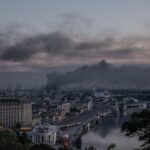
POLICY WIRE — Marseille, France — It’s a strange world, isn’t it? One where the raw, primal pursuit of athletic glory—men straining up impossibly steep hills, chasing a coveted yellow jersey—runs headlong into the equally raw, decidedly less romantic reality of a planet in spasm. The Tour de France, that grand, sun-drenched spectacle of human endurance, just ran afoul of a wildfire. A real, blazing, smoke-choked wildfire near Nîmes, no less. Fans, those fervent souls who camp out for days just for a fleeting glimpse of peloton magic, found themselves barred from sections of the route. Because, you know, nature had other plans. And those plans included flames.
It wasn’t a sudden, rogue incident, either. Not really. The blaze near Saint-Gilles was merely a fiery punctuation mark in what’s become a grimly familiar summer narrative across much of Europe. Weeks of baking temperatures, air conditioners straining, — and once-lush landscapes turning to kindling. This summer’s heat isn’t just ‘a bit warm’; it’s a furnace, — and it’s making a mockery of normalcy. The continent, accustomed to its civilized seasons, is grappling with a climate that increasingly doesn’t play by old rules. It’s an inconvenience for cycling fans, but for countless others—farmers, emergency responders, the elderly—it’s quickly becoming an existential threat. But, we carry on, don’t we? As if postponing a segment of a bike race is the pinnacle of climate adaptation.
Take, for instance, the numbers. According to a recent analysis published by the European Environment Agency, summer heatwaves across Europe have risen in frequency and intensity by over 50% in the last decade alone, contributing to thousands of excess deaths annually. It’s a sobering bit of data, often brushed aside as an unfortunate side-effect of modern living. But these aren’t just statistics; they’re stories of desiccated fields, empty reservoirs, and — perhaps most chillingly — a creeping sense of inevitability that politicians are struggling to contain. And how could they, really? When the problem feels so big, so planetary.
“We’re not simply reacting to a crisis; we’re fundamentally recalibrating our entire approach to national infrastructure and citizen protection,” offered French Environment Minister Christophe Lecour. He was speaking from a decidedly un-scorched office in Paris, of course. “These events, while challenging, highlight our nation’s resilience and our government’s unwavering commitment to both immediate response and long-term sustainability.” That’s a common refrain, isn’t it? Long-term sustainability—something that feels as far off as a cold winter day right now. Because when you’re literally watching your country burn, ‘long-term’ can feel like a luxurious fiction.
It’s not just the fancy cycling circuits feeling the heat, either. The implications stretch far beyond Europe’s well-manicured cycling routes. In South Asia, particularly in Pakistan, regions like Sindh and Balochistan routinely record temperatures that make even these European heatwaves seem quaint. They’re experiencing prolonged heat domes, devastating floods from rapid glacial melt in the Himalayas, and chronic water scarcity that’s destroying livelihoods. They’ve been living this reality for years, often without the same robust infrastructure or global attention. Their struggle, sadly, often gets relegated to footnotes while Western nations debate climate adaptation budgets. But it’s all part of the same grim planetary equation.
📄 POLICY WIRE WHITEPAPER PUBLISHED: PAKISTAN'S NATIONAL SECURITY POLICY PRIORITIES
👉 READ BY CLICKING HEREFrans Timmermans, the European Commissioner for Climate Action, didn’t pull any punches, either (or at least, his office’s carefully worded statement didn’t). “This isn’t a regional anomaly; it’s a stark reminder of the global shifts demanding a collective pivot towards sustainability,” he stated with a firmness that suggests perhaps some in Brussels are actually paying attention. “Our collective future isn’t just an economic model; it’s a climate model that we’re failing to adequately address.” Quite the mouthful, that. And maybe, just maybe, it signals that the suits in Brussels and beyond are starting to realize that the ‘green transition’ isn’t just a talking point for conferences; it’s a necessary — and perhaps terrifyingly urgent — restructuring of how societies actually function.
What This Means
The blocking of a Tour de France segment by fire isn’t just a logistical hiccup for a sporting event. No, it’s a stark, visceral demonstration of climate change’s growing capacity to disrupt core aspects of modern life—from leisure to industry. Politically, leaders face an increasingly untenable balancing act: appease populist demands for business-as-usual while confronting an escalating environmental crisis that actively undermines economic stability and social cohesion. There’s also the widening chasm between public understanding — and political action. People feel the heat, literally, yet comprehensive policy responses remain frustratingly incremental.
Economically, these recurrent extreme weather events are no longer anomalies for which we simply budget extra for ‘disaster relief’. They’re becoming baked-in costs, requiring massive, preventative investments in infrastructure—think smarter grids, fire-resistant construction, drought-proof agriculture—that very few nations are genuinely ready to make. This shifts public funds from other areas, potentially exacerbating social inequalities. For European industries, particularly agriculture and tourism, these climate shocks translate directly into lost revenue, supply chain disruptions, and increased insurance premiums. It isn’t a problem to solve one day; it’s here now, actively reshaping the landscape of global risk. And don’t forget the geo-political implications, as climate migrants seek refuge and global resource competition intensifies. Perhaps such regional despair hints at larger, less contained conflicts to come.