


Kyiv Sleeps No More: Russia’s Escalating Blitz Challenges Western Resolve
POLICY WIRE — Kyiv, Ukraine — They weren’t waiting for dawn; it seems dawn was waiting for them, or perhaps, for the Russian war machine. Long after Ukrainian President Volodymyr Zelenskyy had...

POLICY WIRE — Kyiv, Ukraine — They weren’t waiting for dawn; it seems dawn was waiting for them, or perhaps, for the Russian war machine. Long after Ukrainian President Volodymyr Zelenskyy had sounded the alarm that another large-scale attack was imminent, Kyiv woke to the jarring symphony of incoming ballistics and cruise missiles. Not a quiet morning coffee sort of thing. This wasn’t a surprise, not truly. It was a dreadful expectation realized, yet the sheer audacity—the persistent, grinding violence—still hits with a sickening thud, even for hardened observers.
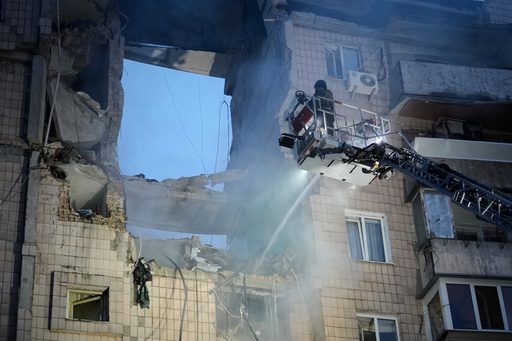
Weeks bleed into months, then years. This four-year war drags on, relentlessly reshaping landscapes — and lives. Now, seven more people won’t be seeing another sunrise. Twenty-four others were wounded in the overnight barrages that continued well into Monday morning, a chilling count tallied by authorities. Tymur Tkachenko, head of Kyiv’s City Military Administration, delivered the grim update via Telegram, noting a residential building in the Podilskyi district took a direct, gutting blow. It partially collapsed. Over in Darnytsia, multiple multistory buildings got battered, with folks reportedly trapped beneath the rubble. “These are residential buildings. Places where people slept and lived their ordinary lives,” Tkachenko stated, his words cutting through the dry facts of war reportage.
It’s hard to overstate the cumulative psychic cost of such sustained terror. And these attacks? They’ve certainly got a pattern. Just last week, Kyiv endured a combined Russian assault that left at least 31 dead. So this wasn’t an anomaly; it was a continuation, a policy executed with terrifying precision against civilian targets. Civilians, we hear, were scurrying to metro stations, seeking the cold, hard safety underground as explosions ricocheted through the pre-dawn darkness.
But what really struck was Zelenskyy’s renewed plea. He’s tired, you can almost hear it in the digital echo of his statements, but his message is always sharp. He implored Western partners to bolster Ukraine’s air defenses, to send more Patriot missiles. Not providing them, he argues, just hands Moscow more leeway to drag out the conflict. It emboldens Russia to prolong its four-year war, he explained in a late Sunday Telegram post, anticipating this very type of onslaught. It’s a pretty stark choice, isn’t it?
Consider the ripple effect of such persistent instability. While geographically distant, the conflict’s ramifications echo across regions often wrestling with their own precarious geopolitical balances, like South Asia. Pakistan, for instance, has long navigated complex relationships with major global powers, often relying on foreign aid and military supplies, much like Ukraine now depends on Western support. The prolonged conflict impacts global energy and food prices, a particularly sharp knife for import-reliant nations like Pakistan, which routinely faces inflation and balance-of-payments challenges.
And when a nation’s cities are relentlessly targeted, with the world watching and debating the pace and scope of defensive aid, it poses a direct challenge to the international rules-based order, creating a precedent that regional powers—and aspiring regional powers—watch very closely. The UN Office for the Coordination of Humanitarian Affairs (OCHA) reported in late 2023 that approximately 14.6 million people in Ukraine required humanitarian assistance, a sobering reminder that while geopolitical chess plays out, human lives hang by a thread. This isn’t just about Ukraine’s immediate defense; it’s about a global temperature check on who gets to dictate norms.
📄 POLICY WIRE WHITEPAPER PUBLISHED: PAKISTAN'S NATIONAL SECURITY POLICY PRIORITIES
👉 READ BY CLICKING HEREWhat This Means
These latest strikes against Kyiv aren’t just military actions; they’re calculated messages. They’re a blunt instrument, testing the West’s resolve and, more pointedly, its capacity to sustain sophisticated military aid. Politically, the timing often seems aimed at influencing internal debates within Western capitals about future funding and strategic patience. The goal, ostensibly, is to inflict enough pain to erode public support for continued assistance, to make Ukraine’s allies waver.
Economically, prolonged conflict exacerbates global supply chain pressures and fuels inflationary trends, particularly in energy and grain markets. For countries like Pakistan, already battling a volatile economy, the secondary shocks from this conflict—from rising commodity prices to shifts in international investment flows—can be deeply destabilizing. We’re watching a world where global economics are more interconnected than ever, yet nationalistic, zero-sum policies are increasingly in vogue. But make no mistake: those missiles falling on Kyiv have economic reverberations that extend far beyond the Dnipro River. Because the aid question isn’t just about Ukraine’s resilience; it’s about the perceived cost of intervention for donor nations. And that calculus influences diplomatic and economic policy decisions around the world, from the Middle East to South Asia’s volatile borders. It certainly won’t quieten the voices demanding fiscal prudence back home, not when election cycles are looming.
But there’s a deeper, more chilling implication. By repeatedly hitting civilian infrastructure, Russia isn’t just destroying buildings; it’s attempting to crush the Ukrainian spirit, hoping to force a capitulation through sheer exhaustion. The constant need for air defense isn’t merely about preventing casualties; it’s about enabling any semblance of normal life to continue. If cities can’t be protected, if citizens can’t sleep soundly, then everything else—the economy, governance, society—starts to crumble. It’s a war of attrition, not just on the front lines, but in every single person’s mind, every single night. The world is watching to see who cracks first. Routine, it seems, can be shattered anywhere, anytime.