

Kyiv’s Grim Dawn: Russia Escalates Air War, Targeting Civilians with Brutal Precision
POLICY WIRE — Kyiv, Ukraine — The early Monday skies over Ukraine’s capital weren’t just dark with night; they were choked with the metallic shriek of incoming ballistic missiles and the...

POLICY WIRE — Kyiv, Ukraine — The early Monday skies over Ukraine’s capital weren’t just dark with night; they were choked with the metallic shriek of incoming ballistic missiles and the persistent, low hum of drones. For Kyiv residents, it’s a ghastly, now familiar symphony of terror, a grinding backdrop to an existence defined by Kremlin-fueled conflict. This time, however, the barrage felt different—a renewed, chilling commitment to striking at the heart of civilian life, right when many were stirring for their day.
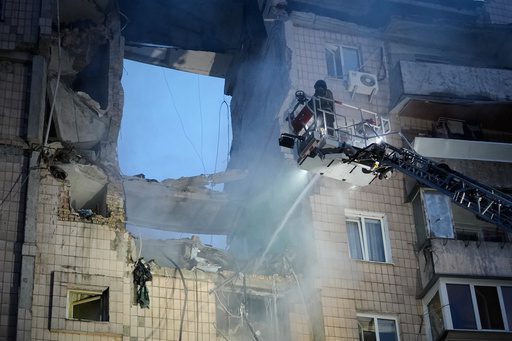
Explosions ripped through districts like Podilskyi and Darnytsia, shredding apartments and shattering any pretense of a front line exclusively for military targets. City officials confirmed at least seven souls had been snuffed out in their homes, with another two dozen pulled from the wreckage, wounded, bruised, and forever changed. But it wasn’t just buildings that took a hit; it was the fragile fabric of everyday routine, reduced to rubble and twisted steel.
Tymur Tkachenko, Kyiv’s City Military Administration head, didn’t mince words following the dawn assault. “You don’t just ‘miss’ residential blocks repeatedly. They’re aiming for our spirit, not just our infrastructure,” Tkachenko stated with a weary, almost defiant resolve. “But Kyiv stands. It always has, and it always will.” His comments echo the profound fatigue of a city that’s endured countless nights under fire, but also its stubborn refusal to break.
Just hours before the deadly strikes, Ukrainian President Volodymyr Zelenskyy had sounded the alarm, forewarning of Moscow’s intent for another large-scale onslaught. And wasn’t he right? The audacity of it, striking after a previous, devastating attack had killed 31 just days earlier, suggests a deliberate campaign of terror designed to crush morale.
Zelenskyy himself wasted no time in renewing his plea to Western partners, emphasizing the urgent need for more advanced air defense systems, especially those coveted Patriot batteries. “Each moment we wait for promised air defenses is a moment they exploit,” he declared, his frustration palpable across the airwaves. “Our skies won’t secure themselves, and Europe won’t find peace until Moscow understands the cost of its aggression—truly understands it.” It’s a sentiment heard repeatedly, almost like a broken record player, only the stakes keep getting higher.
This particular fusillade involved a complex mix: ballistic missiles, cruise missiles, and a swarm of those Iranian-designed ‘Shahed’ drones that Russia has deployed with such devastating regularity. Residents dove for the nearest metro stations, their subterranean shelters a grim, temporary respite from the indiscriminate death raining down above. The tactics aren’t novel, but their consistent application signals a stark refusal to back down—a chilling persistence that baffles diplomatic circles and strains international resolve.
What This Means
This latest act of aggression in Kyiv is less about a single strategic target and more about a calculated strategy of attrition and terror. Economically, Russia is betting that the sustained pressure will erode Ukraine’s capacity to resist and deplete Western arsenals, even as its own economic outlook remains grim—recent forecasts from the International Monetary Fund pegging its 2024 growth at a modest 2.6%, a figure buoyed only by extensive military spending and oil exports redirected east. Politically, Moscow continues to test the boundaries of international outrage, pushing to see how much indiscriminate violence the global community will tolerate before intervention—or before the resolve to support Ukraine begins to fray.
The geopolitical ripples of such tactics spread far beyond Europe. The willingness of a permanent UN Security Council member to openly flout international law and deliberately target civilians sends dangerous signals to authoritarian regimes worldwide. Think about it: every non-response, every delayed aid package, becomes a tacit nod to similar, expansionist calculations elsewhere. Regions like Pakistan, caught between regional rivalries — and struggling economies, watch carefully. The principle of national sovereignty and the security of civilian populations hang in the balance, creating precedents that could reverberate through South Asia and the wider Muslim world, impacting future humanitarian efforts and resource conflicts. This war isn’t just about Ukraine; it’s about the future shape of global order, and whether the strong get to simply dictate terms to the weak. That’s a lesson nations learned—or ignored—after past aggressions, and it’s one we’re relearning, painfully, in Eastern Europe. For more analysis on how global politics intersect with local conflicts, consider this piece on the shadow of withdrawal and its implications for allies.
Because ultimately, these aren’t just statistics; they’re lives upended, communities scarred. This prolonged bombardment underscores Moscow’s intent to grind Ukraine into submission, hoping that the cost of defending sovereignty becomes too high for its allies to bear. But with every missile, with every civilian casualty, the stakes rise, forcing leaders to reconsider the depth of their commitment. It’s not a chess game, you see, it’s a brutal, blood-soaked marathon.
And so, as another dawn breaks over a scarred Kyiv, the question remains: will the international community rise to meet the challenge, or will the world simply watch as the city, and the principles it stands for, are slowly, agonizingly dismantled?