


South Africa: Migrants as Political Scapegoats
Explore South Africa's escalating anti-migrant actions, framed by critics as political scapegoating fueled by misinformation. Uncover the fight for human dignity.

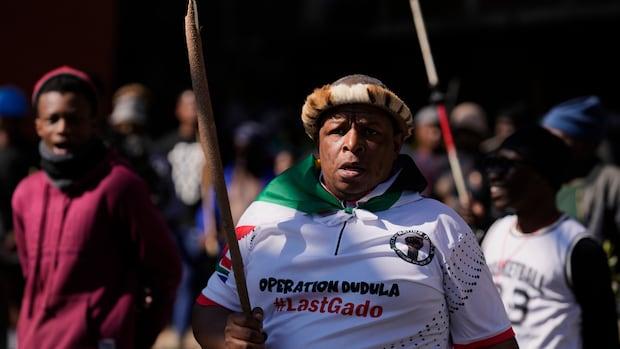
POLICY WIRE — Johannesburg, South Africa — The Republic of South Africa is once again grappling with the stark contrast between escalating anti-migrant aggression and concerted humanitarian intervention within its borders. A palpable tension exists, with some segments of the South African population reportedly engaging in threats and violence aimed at compelling migrants to leave the country. Concurrently, a robust, if less publicized, movement is providing support and refuge to those described as running for their lives.
This dynamic forms the backdrop for ongoing debates surrounding migration policy, economic pressures, and social cohesion in a nation already contending with numerous post-apartheid challenges. The intensity of these sentiments often culminates in visible unrest, drawing international attention to the plight of migrants and the complexities of national identity.
Amidst this often-turbultent landscape, individuals like Sharon Ekambaram have stepped forward as key figures in the humanitarian response. Ekambaram is noted for her role among those actively aiding migrants caught in the crossfire of local grievances and fears. Her involvement underscores a foundational principle: that for every instance of hostility, there’s often a counter-narrative of solidarity and support.
The anti-migrant push in South Africa, often manifesting as protests and sometimes escalating into violence, has been framed by critics as more than just a grassroots expression of discontent. According to the title associated with the reporting, an activist suggests these actions are a ‘political scapegoat based on lies.’ This implies a more calculated, orchestrating hand behind what might otherwise appear to be spontaneous communal ire.
The contention that these actions are ‘based on lies’ points to a potential disinformation campaign or a deliberate misrepresentation of facts concerning migrants’ contributions to society or their impact on local resources. Such allegations raise serious questions about the integrity of public discourse and the motivations of those inflaming xenophobic sentiments.
the designation of migrants as a ‘political scapegoat’ suggests a deflection strategy—a mechanism to divert public frustration away from systemic issues or governance failures by pinning blame on a vulnerable outgroup. This tactic, regrettably common across various political landscapes globally, tends to capitalize on existing societal anxieties, weaponizing them for political gain.
Historically, South Africa has wrestled with waves of xenophobic violence, particularly against those from other African nations, fueled by economic competition and perceptions of resource strain. The targeting of migrants, often labelled as ‘foreigners’ or ‘aliens,’ reveals deep-seated tensions within the broader social fabric, tensions that can be easily exploited. The activist’s assertion provides a critical interpretive lens through which to understand the current situation, moving beyond simple demographic conflict to probe deeper political machinations. It highlights the often-invisible forces at play in shaping public opinion — and social policy around migration.
The involvement of figures like Ekambaram represents not just immediate relief for those in danger, but also a moral counterweight to the prevailing negativity. Their work illustrates a commitment to human rights and dignity, offering a glimpse into the ongoing struggle to uphold ethical principles in the face of populism and fear-mongering. It’s a reminder that societal responses to migration are rarely monolithic; they often encapsulate a struggle between competing ideals and actions.
What This Means
The current state of affairs in South Africa, where anti-migrant actions are being explicitly called a ‘political scapegoat based on lies,’ suggests a critical juncture for both civic society and governance. If such claims hold weight, it means that segments of the population are being intentionally manipulated for political ends, a concerning trend that undermines democratic processes and social cohesion.
The challenge for authorities will be to address not only the outward manifestations of xenophobia, such as threats and violence, but also to dismantle the underlying narratives of misinformation and political opportunism. Failure to confront these foundational issues risks perpetuating a cycle of division and instability, where migrants remain convenient targets for political distraction. The contrasting actions—aggression versus humanitarian aid—underscore a society wrestling with its identity and values, navigating the complex interplay of economic reality, political rhetoric, and human decency. (Reporting based on Associated Press, BBC, Reuters — and other wire services)