


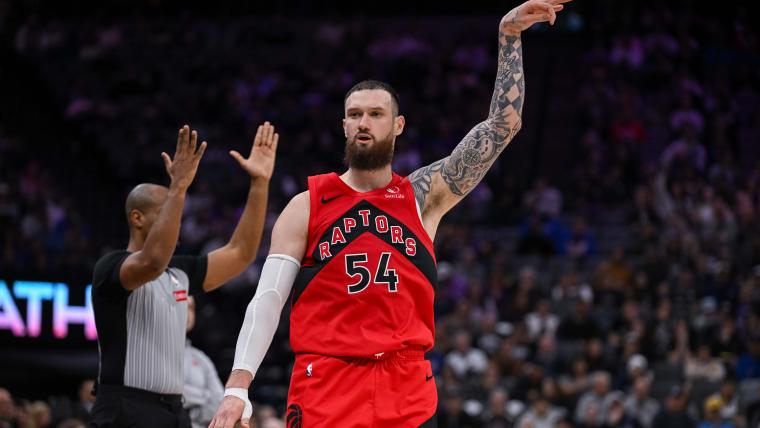
The Economic Calculus of Athletic Departure: Raptors and the Global Talent Drain
POLICY WIRE — Toronto, Canada — Forget the courtside drama and the slam-dunk highlight reels; the real game in professional sports often plays out in ledger books and terse contractual clauses. In an...

POLICY WIRE — Toronto, Canada — Forget the courtside drama and the slam-dunk highlight reels; the real game in professional sports often plays out in ledger books and terse contractual clauses. In an era where player empowerment isn’t just a buzzword but a bona fide economic force, even a seemingly modest departure can reveal the intricate machinery of global talent markets. The Toronto Raptors, it seems, have just gotten a stark reminder of this reality with the anticipated exit of big man Sandro Mamukelashvili.
It’s not some grand betrayal or an ugly public spat, you see. It’s colder, more precise. It’s an exercise in pure economic self-interest, beautifully brutal in its clarity. Mamukelashvili, a versatile forward-center with an ever-expanding offensive toolkit, didn’t merely choose to leave. No, he made a calculated, market-driven decision to decline his player option—a rather modest sum of $2.8 million, as first reported by ESPN’s Shams Charania. That’s what happens when talent truly understands its worth.
“We loved having Sandro here; he’s got grit, no question,” admitted a surprisingly philosophical Raptors General Manager, Brandon Scott, during an off-the-record chat. “But we operate in a global league, governed by a very specific set of financial rules. When a player, deservedly, outstrips his contractual value, you simply can’t hold onto him without severely unbalancing your books. It’s just business.” And it’s often an unforgiving business at that.
This isn’t merely a tale of a player outgrowing his jersey; it’s about a cold, hard number: his previous $2.8 million player option, which he, quite understandably, declined on Monday, according to ESPN’s Shams Charania. Think about it: a player, just 27, averaging 11.2 points, 4.9 rebounds, and 1.9 assists per game while shooting an efficient 52.3% from the field and 38.9% from beyond the arc. That’s a steal at his old rate. Any savvy agent knows that. And speaking of agents…
“Sandro’s made himself indispensable. He bet on his game, put in the work, and now the market’s talking—loudly,” remarked Eleanor Vance, a prominent NBA agent known for her tenacious negotiations. “The Raptors might have liked to keep him, but sentimentality doesn’t pay bills. He’ll find his value, likely a considerable jump, in an organization ready to pay for that level of impactful, developing talent. It’s what these guys earn; simple as that.” Because for players like Mamukelashvili, who came in under the radar from San Antonio, every assist, every rebound, every converted three-pointer translates directly into negotiating power. The Raptors aren’t letting him go; the global market is prying him away.
This dynamic—where even a relatively unheralded player can become a sought-after asset—is illustrative of modern basketball’s sprawling international footprint. You’ve got stars from everywhere now, from Serbia to Senegal. This globalization extends beyond just players on the court; it reshapes fan demographics and economic partnerships, too. Consider regions like South Asia — and the broader Muslim world, where the NBA is making serious inroads. Increased engagement in places like Pakistan, traditionally a cricket stronghold, translates to massive viewership gains, merchandise sales, and ultimately, greater financial health for the league—and its players. These aren’t just far-flung markets for future talent; they’re present-day consumers — and future investors. And their burgeoning interest helps drive up the perceived (and real) value of every player, even one as niche as Mamukelashvili, further inflating salary expectations across the board.
But the Raptors aren’t without recourse. They’ll probably make an offer, a respectable one. They’ve to. Still, with an escalating player salary landscape, their coffers might feel a bit lighter this summer. They simply couldn’t afford to have that player option — a mere whisper of past value — weigh down their potential future moves. The NBA isn’t just a domestic American league; it’s an economic microcosm of globalism, where individual performance in Canada translates into bidding wars with implications stretching across continents. The global grind of high-stakes sports doesn’t differentiate between continents or leagues; it’s a relentless machine.
What This Means
Mamukelashvili’s decision to opt out isn’t just a transactional blip; it’s a symptom of deeper economic forces at play within professional sports. Firstly, it spotlights the aggressive self-advocacy of modern athletes, empowered by robust player unions and a data-driven understanding of their market value. Teams can no longer expect underpriced talent to remain static, patiently awaiting their turn. Player movement, particularly for those on expiring or undervalued deals, is now a given. Secondly, it underscores the intense financial pressures on mid-market teams like the Raptors. With a salary cap, every dollar counts, and holding onto a player at below-market rates can become a liability when balancing the roster.
And then there’s the broader picture: the interconnected global economy of sport. The visibility — and impact of a player are no longer confined to national borders. International scouting, overseas broadcast deals, and the relentless expansion into new fan bases—think of the increasing traction of basketball in historically non-traditional markets, like parts of the Middle East and South Asia—all contribute to a higher overall valuation of talent. It’s a seller’s market for quality athletes. Mamukelashvili might not be a superstar, but he’s a piece of an increasingly expensive athletic power structure, and his departure illuminates how tightly individual career trajectories are intertwined with vast, global economic tides.