


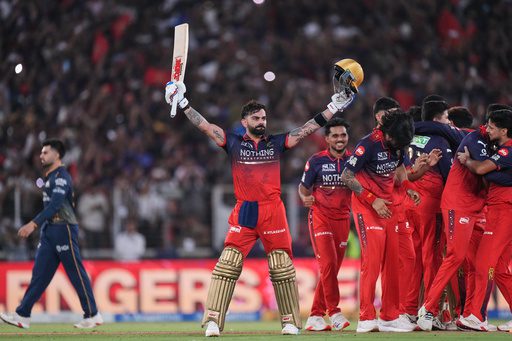
Kohli’s Roaring Dynasty: Bengaluru Claims Back-to-Back IPL Crown, Rewrites History
POLICY WIRE — AHMEDABAD, India — The dust hadn’t even settled from the roar at Ahmedabad’s colossal Narendra Modi Stadium, but one thing was abundantly clear: this wasn’t just...

POLICY WIRE — AHMEDABAD, India — The dust hadn’t even settled from the roar at Ahmedabad’s colossal Narendra Modi Stadium, but one thing was abundantly clear: this wasn’t just another cricket match. It was a reaffirmation, a spectacle—a calculated, clinical display of dominance by Royal Challengers Bengaluru, carving out an indelible mark in the annals of the Indian Premier League. Gujarat, you see, was just background noise to a dynasty in the making.
Cricket great Virat Kohli, ever the showman, delivered the knockout blow. But it wasn’t some desperate Hail Mary; it was a well-executed plan. Bengaluru hadn’t just beaten Gujarat; they’d broken them, restricted them, then casually chased down an under-par target with two overs to spare. They posted 161-5 in 18 overs, reeling Gujarat in at a paltry 155-8. But how did they get here? By showing up.
It’s the stuff dreams are made of. And Kohli isn’t shy about it. He confessed, [QUOTE_PLACEHOLDER] That kind of honesty, it cuts through the PR gloss, don’t you think? His 42-ball 75 not out, punctuated by nine fours and three sixes, felt less like a hero’s sprint and more like an inevitability. It was his sixth 50-plus score this season, an astonishing run that proves consistency still trumps flash sometimes.
You can’t just rely on one man, though. Never could. Venkatesh Iyer, a force often overlooked, contributed 32 runs off 16 balls. They’re a dynamic duo, that pair, — and they just tore through Gujarat’s bowling attack with an almost arrogant ease. Kohli elaborated on their mindset, saying, “The kind of team we have, it gives you confidence to face any situation. There is enough depth in our side. We had clarity – Venkatesh (Iyer) and I wanted to finish off the chase in the powerplay itself.” Imagine planning to shut down a final before the powerplay even ends. That’s pure belief, or maybe just really good scouting.
This triumph didn’t just add another trophy to Bengaluru’s cabinet; it etched their name into history. With their first title in 2025, they’ve now become only the third side to win successive IPL titles. Chennai Super Kings (2010 — and 2011) and Mumbai Indians (2019 and 2020) were the others. They’re in elite company now. And what does it take to join such a club? A balanced attack and, let’s be honest, a certain swagger.
The individual brilliance was everywhere. Kohli finished with 675 runs in 16 matches, leading the charge. But while he scored the runs, Bhuvneshwar Kumar was busy dismantling opponents, snatching up 28 wickets this season. Kumar bagged 2-29 on Sunday, working in tandem with Josh Hazlewood, who chipped in with 2-37, effectively strangling Gujarat’s hopes before they could even bloom. Their pacers just struck hard; no wonder Gujarat barely got to 99-5 by the 15th over.
But speaking of dismantling, Washington Sundar was the sole glimmer for Gujarat, notching 50 not out, five fours off 37 balls. A lone fighter, certainly. But a lone fighter can’t win a war, especially when openers like Sai Sudharsan — and Shubman Gill go cheaply. Medium pacer Rasikh Salam Dar, whose name suggests a deep connection to the rich cricketing talent that permeates the broader South Asian landscape—from Peshawar to Pallekele—snared 3-27. This region, you know, it’s not just a market for cricket; it’s its beating heart. The sport isn’t just entertainment; it’s an obsession, a pathway, an identity.
📄 POLICY WIRE WHITEPAPER PUBLISHED: PAKISTAN'S NATIONAL SECURITY POLICY PRIORITIES
👉 READ BY CLICKING HEREThis IPL season saw some truly eye-watering numbers. Take Rajasthan Royals’ 15-year-old Vaibhav Sooryanshi for instance. The kid became the highest run-getter with an astounding 776 runs in 16 innings at a blistering strike rate of 237. These aren’t just statistics; they’re a testament to the raw, unpolished talent bubbling up, hoping to be spotted for the next big league — a process akin to collegiate sports talent discovery we’ve explored at length, even with baseball’s own high stakes.
It’s not just a game; it’s a cultural phenomenon that stretches its tendrils across borders. The money, the fanfare, the almost religious devotion — it all makes for an irresistible pull, attracting viewership that outstrips many national elections. This rematch wasn’t just some random pairing; it was a re-run of a Tuesday playoff when Bengaluru trounced Gujarat by 92 runs. Sometimes, the past really does predict the future, doesn’t it?
What This Means
This consecutive championship win by Bengaluru isn’t just about bragging rights; it signals a shift in the IPL’s power dynamics, emphasizing sustained team building and consistent performance over a singular season’s flash. For sponsors and investors, Bengaluru now represents a safer, more predictable bet, solidifying its brand equity in a hyper-competitive sports market. Economically, the IPL continues to be an incredible engine, pouring hundreds of millions of dollars into the Indian economy, driving advertising revenue and fostering sports-related industries. Its massive scale means that the cultural impact spills over into neighboring countries, too, shaping aspirations for young cricketers and providing entertainment for millions from Pakistan to Bangladesh, a reflection of cricket’s enduring influence, similar in its profound regional impact to how even niche baseball matches can have global echoes.
The dominance of teams like Bengaluru also highlights a mature league, where strategy and player retention, alongside big-ticket acquisitions, are paramount. The emergence of young talents like Sooryanshi—alongside established titans like Kohli and Kagiso Rabada (who took a staggering 29 wickets this season across 17 matches for Gujarat, mind you)—indicates a robust talent pipeline, ensuring the IPL remains a hotbed for future stars. From a geopolitical standpoint, the league continues to exert a soft power influence, showcasing India’s organizational prowess and attracting international talent, a complex blend of sport and economics that often transcends politics. It’s a significant marker of what modern, globalized sports entertainment has become — big business with an even bigger cultural footprint.