
Gridiron Icon, Golf Course Brawls: The Frayed Edges of Celebrity Culture
POLICY WIRE — Lake Tahoe, Nevada — The roar that once punctuated Canton-bound touchdowns has found a surprising echo: the desperate yell of an NFL legend chasing an anonymous heckler across a...

POLICY WIRE — Lake Tahoe, Nevada — The roar that once punctuated Canton-bound touchdowns has found a surprising echo: the desperate yell of an NFL legend chasing an anonymous heckler across a pristine golf course. Jerry Rice, at 63, isn’t just demonstrating remarkable cardio anymore; he’s inadvertently highlighting the frayed edges of celebrity interaction in an age where every private slight is public spectacle. What transpired last week at the American Century Championship was less about a golf shot and more about the ever-thinning veneer between sports heroes and the digital crowd demanding constant, unfiltered access.
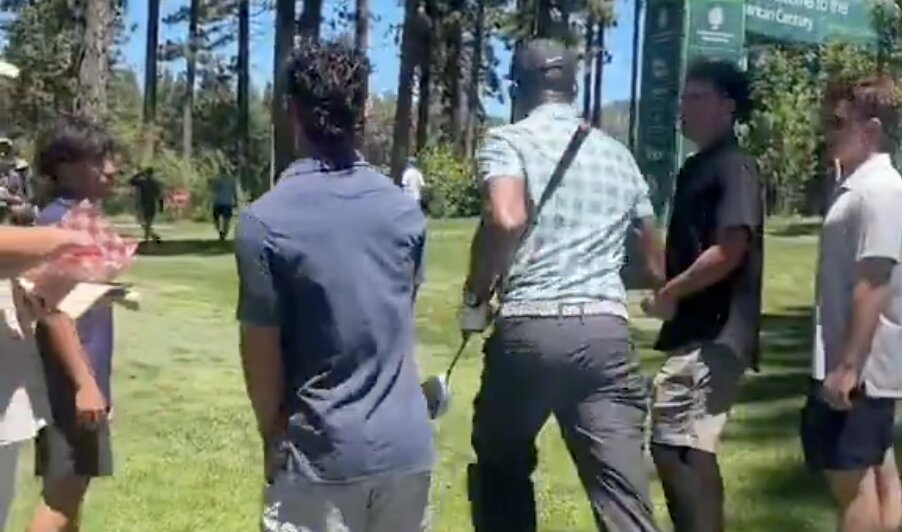
It was a Saturday in the Sierras. Rice, a man whose professional life was built on meticulous discipline and laser focus, stood over a golf ball, ready to drive. Then came the word, sliced through the clean mountain air: “Fore!” Not a warning, mind you, but a mocking taunt from an unseen spectator, suggesting a wildly errant shot before the club had even connected. A calculated insult—a jab at a legend in a different arena. And that’s when the instinct kicked in.
“Maintaining an atmosphere of respectful engagement is paramount for our events,” stated Aidy Garcia, the Tournament Director for the American Century Championship, in a rare, measured statement post-incident. “We want fans close, yes, to feel the energy, but not to the detriment of competition or, frankly, common decency.” He added, slightly grimly, “This isn’t a street fight, it’s a charity event, largely.”
Because let’s be honest, few expected the NFL’s all-time receiving leader to pivot from golfing icon to public pursuer. But he did. And spectators, smartphones already aloft, began to chant, egging him on—“Go get him, Jerry!”—as the man who perfected the slant route turned into a sprint toward a heckler in the gallery. Which one? Who knows. He ran straight into the crowd, seeking eye-contact with disrespect, looking for the face behind the jeer. It’s a spontaneous moment, caught in pixelated perpetuity, forcing a global conversation about athlete boundaries and public decorum.
“It’s a curious intersection—the fan’s perceived ownership of a celebrity and the celebrity’s lingering primal instinct,” mused Dr. Lena Khan, an Associate Professor of Media Studies, specializing in celebrity culture — and global fan bases. “The internet amplifies it, making every micro-incident a global referendum on behavior, stripping away any last vestiges of privacy or the controlled narrative. And that’s a phenomenon with particular resonance in places like South Asia, for instance, where deference to certain public figures often dictates an entirely different mode of interaction, often one of profound, sometimes even familial, respect rather than confrontational banter.” She implied the casualness of the heckler was almost uniquely Western.
📄 POLICY WIRE WHITEPAPER PUBLISHED: PAKISTAN'S NATIONAL SECURITY POLICY PRIORITIES
👉 READ BY CLICKING HERERice, for his part, exchanged words. What was said? We can only speculate. The visual, though, is undeniable: a man of immense fame confronting a moment of anonymous rudeness. He wasn’t out for blood; he was demanding accountability. And then, satisfied—or perhaps simply winded, though we doubt it—he made his way back to the tee box, met by cheers. A hero’s return, of sorts. You really don’t poke that particular bear, do you?
This vignette, played out across social media feeds globally, isn’t just sports news. It’s a snapshot of contemporary culture, a world where the boundary between spectator and participant is eroding, fuelled by the dopamine hit of virality. And for all the drama, the football legend still managed to finish the tournament. He wrapped up 42nd in a field of 90, according to a TMZ report, proving that even a public skirmish couldn’t entirely derail his competitive spirit. His prowess, it seems, still shines, much like the gridiron economics that keep such stars relevant.
What This Means
The incident, while seemingly trivial, ripples through several critical channels. Politically, it reopens discussions about public safety at high-profile events and the legal line between free expression and harassment. Event organizers face increased pressure to protect their assets—the celebrities themselves—without alienating the very fans who provide the economic engine for such tournaments. For public figures, it signals an escalation of the demands placed upon them: not only must they perform, but they must also manage an increasingly aggressive, online-first public. The economics are clear: every viral moment, whether positive or negative, contributes to a celebrity’s brand, potentially influencing endorsement deals and appearance fees. A controlled environment becomes a premium service. For athletes, the challenge to compartmentalize personal moments from professional demands is intensifying—a brutal calculus in a world hungry for spectacle. It’s a reminder, too, that even in the most carefully curated environments, the raw unpredictability of human nature will find a way to manifest, often with a smartphone lens as witness.