


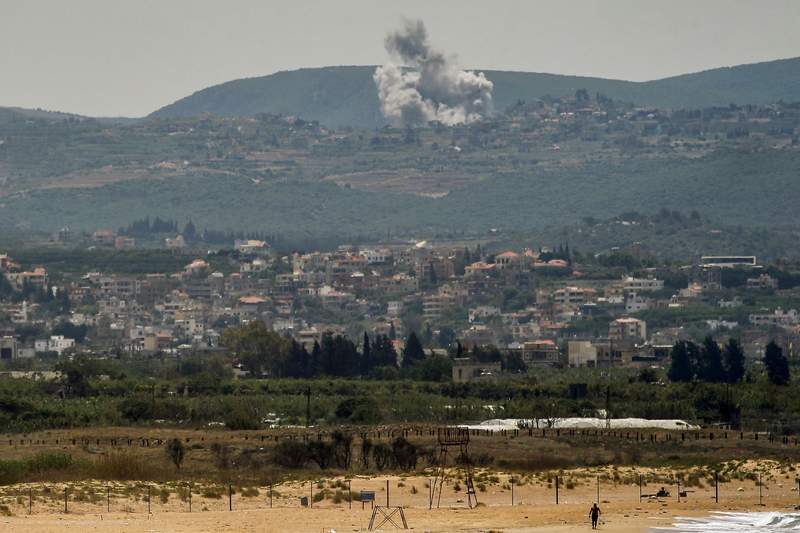
Damascus’ Gambit: Border Flashes in Levant Drag Region to the Brink
POLICY WIRE — Beirut, Lebanon — The unspoken truce, that brittle thing masquerading as calm along the Israel-Lebanon border, hasn’t just frayed; it’s practically disintegrated. When Tel...

POLICY WIRE — Beirut, Lebanon — The unspoken truce, that brittle thing masquerading as calm along the Israel-Lebanon border, hasn’t just frayed; it’s practically disintegrated. When Tel Aviv, not known for its understated pronouncements, decides to label an entire section of its northern neighbor a [QUOTE_PLACEHOLDER], you know something’s snapped. This isn’t just about tactical skirmishes anymore; it’s about signaling intent—an aggressive, stark redefinition of the rules of engagement that promises to ripple far beyond the immediate flashpoints.
It was a move that surprised no one in diplomatic circles, yet everyone is still clutching their pearls (or their security dossiers, depending on their station). For weeks, the region’s been on a knife-edge, with tit-for-tat exchanges becoming a disturbing new normal. But this official declaration—a red line drawn with a military-grade marker—just shoved all remaining pretense of de-escalation into the nearest ditch. You see, a [QUOTE_PLACEHOLDER] isn’t merely a figure of speech; it’s a procedural green light for heightened aggression, for rules to be rewritten on the fly. And honestly, it scares a lot of people in Beirut, a city that’s seen enough upheaval for three lifetimes.
For a country already teetering on economic collapse, facing persistent political gridlock, and wrestling with a humanitarian crisis that’s almost too immense to quantify, this is, well, an absolute gut punch. The specter of wide-scale conflict returning to its southern flank isn’t some distant echo from past wars; it’s an immediate, chilling threat. People there, they’ve been living with the drone of war for decades, but it feels different this time. They’re really anxious.
But the fallout doesn’t stop at Lebanon’s precarious borders. No, indeed. It ignites an already volatile Muslim world, from Cairo to Islamabad. Nations like Pakistan, often vocal in their support for Palestinian rights and Arab causes, view such declarations through a deeply politicized lens. They’re watching, scrutinizing every Israeli action. This sort of declaration isn’t just news; it becomes fodder for internal debate, for diplomatic statements that condemn escalation and call for restraint, or sometimes, less restrained pronouncements from religious or political leaders. It strengthens existing narratives about perceived injustices — and exacerbates regional polarization. In the broader geopolitical scheme, it’s just one more stone thrown into an already turbulent pond, the kind that creates ever-widening rings of discontent.
Historically, an official designation like [QUOTE_PLACEHOLDER] offers Israeli forces considerable leeway in operations, moving them beyond retaliatory strikes to a more pre-emptive or broad-scale strategy. It’s essentially the military equivalent of telling the other side, [QUOTE_PLACEHOLDER]. It means targeting is likely to broaden, not just against specific militant infrastructure but potentially against anything deemed a threat, with all the calamitous implications that holds for civilian populations.
Consider the humanitarian angle, for example. Even before this escalation, the United Nations Office for the Coordination of Humanitarian Affairs (OCHA) reported that as of late 2023, nearly 90,000 people in southern Lebanon had already been displaced by ongoing hostilities, a statistic that seems almost quaint now given the rapidly deteriorating situation. This latest Israeli maneuver practically guarantees those numbers will balloon, transforming pockets of localized suffering into a regional humanitarian catastrophe. Because when you declare an area a combat zone, civilians become collateral damage, their homes become targets, and their lives are utterly upended. This is just how it works.
📄 POLICY WIRE WHITEPAPER PUBLISHED: PAKISTAN'S NATIONAL SECURITY POLICY PRIORITIES
👉 READ BY CLICKING HEREWe’re talking about a move that feels like it’s peeling back layers of fragile de-escalation efforts, efforts meticulously constructed by international mediators that, let’s be honest, were already on shaky ground. It sets an unsettling precedent for conflict management (or rather, mismanagement) in a region that’s perpetually on edge. This isn’t just a local issue, you see; it’s a test for global diplomacy, an exercise in brinkmanship where the stakes couldn’t be higher. And it puts immense pressure on organizations like the United Nations Interim Force in Lebanon (UNIFIL) to try and maintain some semblance of order amidst escalating chaos.
What This Means
The Israeli declaration means the diplomatic rulebook for managing the Israel-Lebanon border just got tossed out the window. Politically, it grants the Israeli military considerable operational freedom, practically eliminating any pretense of restraint or precise targeting that defined previous engagements. For Lebanon, it’s a dire augury—an existential threat to its already frail stability, further undermining what little confidence its citizenry (and international investors, for that matter) might have had in its future. We’re talking about potentially crippling blow to an economy already spiraling into the abyss. It means even less tourist revenue, more capital flight, and likely a sharp increase in the prices of everything from fuel to flour.
But that’s not even the half of it. Economically, this move will directly disrupt regional trade routes and investment, particularly impacting reconstruction efforts and nascent infrastructure projects. Don’t forget, nations like Pakistan, with a long history of engagement and occasional investment in Middle Eastern development (sometimes in concert with allies like China), now face heightened risk assessments. The possibility of broader conflict acts like a corrosive agent on any potential economic partnership, sucking the air out of nascent recovery efforts across the Levant.
More acutely, this escalates the risk of a wider regional war—a true nightmare scenario for global markets and strategic alliances. Every single regional player, from Tehran to Washington, is now recalibrating. And not in a good way. The message from Jerusalem is crystal clear, however unpalatable it might be for everyone else: they’re not just reacting anymore; they’re dictating terms, irrespective of the downstream political or human costs. That’s a dangerous game to play, — and the world is holding its breath to see just who flinches first.