


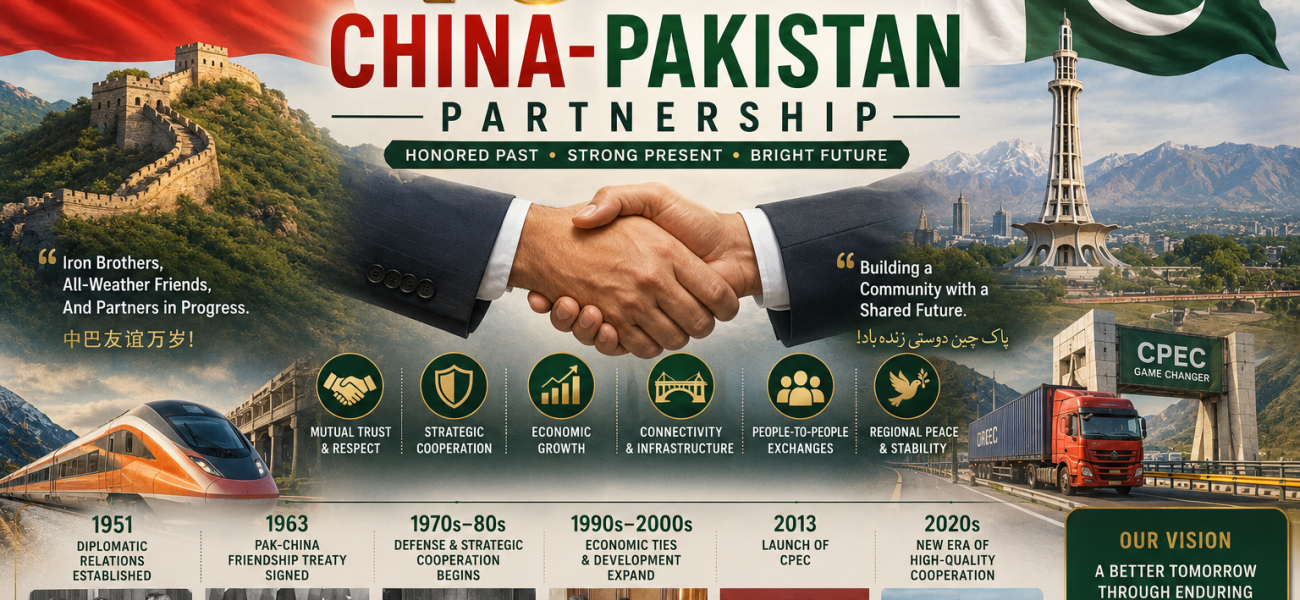
75 Years of China-Pakistan Partnership
The year 2026 marks 75 years of uninterrupted diplomatic relations between Pakistan and China. What is unfolding between these two nations is not a routine celebration of a historical milestone. It...

The year 2026 marks 75 years of uninterrupted diplomatic relations between Pakistan and China. What is unfolding between these two nations is not a routine celebration of a historical milestone. It is the deliberate construction of a relationship designed to endure geopolitical turbulence and thrive in an era of shifting global power. To understand what this partnership has become, one must look not at the rhetoric but at the record of a single year.
A Year of Relentless Diplomatic Engagement
The strongest justification for this partnership lies in the high level government interaction throughout the course of 2026. The joint declaration made after Prime Minister Shehbaz Sharif’s visit in May recognized the visit of National Assembly Speaker Sardar Ayaz Sadiq to China in January 2026 and the success of the seventh round of strategic dialogues between foreign ministers of China and Pakistan held in January. These discussions set the stage for further collaboration ahead. The holding of the China-Pakistan Minerals Cooperation Forum in January is an example where both parties decided to step up bilateral cooperation in minerals and hydrocarbons.
This trend did not show any signs of waning. The year 2026 saw the holding of the China-Pakistan Political Parties Forum along with discussions within the CPEC Political Parties Joint Consultation Mechanism to ensure that the political support for the partnership reached beyond just the executive branch to cover the legislative branch as well. Why is this significant? It is because a partnership between governments can easily be washed away by democracy. Partnerships based on bipartisan relations are sustainable in the long run.
The impetus did not wane even at the level of the heads of state. The President of Pakistan, Asif Ali Zardari paid a state visit to China between April 25 and May 1, 2026, where he visited Hunan and Hainan Provinces, increasing interactions and cooperation in many fields. Importantly, this was not just a friendly visit; this was the third such visit to China by President Zardari in a span of only 15 months. In the same period, Pakistan was also visited by Vice-Chairman of Standing Committee of Chinese National People’s Congress, Cai Dafeng in May 2026 for celebrating the 75th Anniversary Celebrations.
All this paved the way for what turned out to be the defining engagement of the year. China and Pakistan came up with a “new broad consensus” towards building strategic relations, promoting the economic corridor between the two countries, and making Gwadar a connecting point in the region.
The Weight of What Was Signed
Diplomacy is only as credible as the commitments it produces. By that measure, the May visit was exceptional. Pakistan and China signed 15 accords covering economy, climate change, agriculture and food security, trade, media, science and technology, counterterrorism and education. These were not vague letters of intent. They included formal agreements between institutions such as the China Foreign Affairs University and Pakistan’s Foreign Service Academy, anchoring cooperation in knowledge production and diplomatic training at the professional level.
On the business front too, many deals were produced. Deals worth over $7 billion, including memorandums of understanding (MoUs), were signed in various fields such as information technology and telecommunication, battery energy storage systems, and agriculture, at the business-to-business investment conference held in Hangzhou. Notable among them was the signing of a deal worth $1.12 billion by Haolu Engineering & Technology Company Ltd. and Fauji Fertilizers for fertilizer manufacturing. According to reports, more than 200 MoUs worth over $20 billion have been signed in five Pakistan-China B2B conferences thus far.
The question that naturally follows is that what are all these resources being directed toward.
CPEC 2.0: From Concrete to Code
The answer resides in the very concept itself which forms the whole essence of the modern partnership. The original CPEC is no longer just a corridor of roads and power stations. CPEC is turning out to be more and more a platform for industrialization through technology. While the original CPEC focused on infrastructure development, CPEC 2.0 focuses on building productive capacities, and the difference is crucial. Both sides have agreed to proceed with the implementation of the Thakot-Raikot alignment project of the Karakoram Highway on an organized and gradual basis and also meet for the next meeting of the CPEC Joint Cooperation Committee. Both sides have agreed to create industrial parks based on local requirements and undertake demonstration projects in textile and home appliance sectors. The Chinese government also assured its support to increase agricultural production in Pakistan, encourage Chinese investments in agriculture sector and export agriculture products from Pakistan to China.
In early May, Pakistan and China reached agreements in Sanya, Hainan, in regards to collaboration in construction equipment, veterinary medicines, and technology in general. These included the setting up of a joint venture between the Livestock and Fisheries Department of the Government of Sindh and the Luoyang Modern Biology Group for the distribution and supply of animal vaccines in Pakistan. These subnational and specific sectorial agreements are important exactly because they represent the building of a relationship from the ground up.
Yet even the breadth of CPEC 2.0 does not fully capture the partnership’s most forward-looking dimension.
Artificial Intelligence and the Digital Frontier
Pakistan and China have entered into significant accords following the B2B conference on digital transformation, artificial intelligence, financial technology, and next-generation connectivity. One of these important accords was a partnership between Ignite and Alibaba DAMO Academy on embodied intelligence capacity building among Pakistani universities in order to empower Pakistan in next-generation artificial intelligence technologies.
Both nations have also been engaging in partnerships based on implementation through CPEC 2.0 and the Digital Silk Road program. The phrase “Digital Silk Road” needs more consideration. This phrase shows how China is trying to achieve what it sought through its BRI by implementing the same connectivity approach for digital infrastructure. In doing so, Pakistan has positioned itself among the key nodes of this digital network, which means that it is not only acquiring Chinese technology but also integrating itself into the structure of the new global economy.
This logic extends naturally into the most symbolically powerful announcement of the year.
📄 POLICY WIRE WHITEPAPER PUBLISHED: PAKISTAN'S NATIONAL SECURITY POLICY PRIORITIES
👉 READ BY CLICKING HERESpace: Pakistan’s Most Consequential Leap
Of all the decisions made during the visit of the Prime Minister of Pakistan Shehbaz Sharif to China in May 2026, the most important one in terms of its symbolism and strategic importance involves space. China welcomed two astronauts from Pakistan for space training purposes with plans to make one the first foreigner on board the China Space Station. Both countries have shown their contentment regarding their collaboration in the space sector and vowed to pursue their research activities in this field.
The same logic of mutual elevation runs through the security dimension of the partnership.
Security Architecture: Moving Beyond Military Ties
The security ties between Pakistan and China have always been considered within the context of weapons trade and joint military drills. In light of the 2026 joint statement, it becomes evident that there exists something much more systematic. The idea is to launch the Global Security Initiative and create an official “China-Pakistan Security Partnership.”
In simple terms, this means that both the countries will have mutual responsibilities towards each other. Pakistan assured itself of undertaking special steps in order to provide security guarantees to Chinese personnel and projects. On the other hand, China promised to continue supporting Pakistan’s sovereignty and stability.
The shared security concern extends beyond bilateral project protection. Both countries agreed to enhance coordination on Afghanistan and multilateral platforms including the United Nations and the Shanghai Cooperation Organisation. Their shared concern about Afghanistan as a source of cross-border terrorism provides a concrete and operational threat perception that anchors the security partnership in reality rather than rhetoric.
Sovereignty, Kashmir and the Principled Multilateral Stance
However, a partnership of such strategic significance must also be marked by mutual cooperation in the realm of core national interests, which was made clear in the 2026 joint statement. The statement affirmed that Pakistan remains committed to the principle of the One-China policy and that “Taiwan is an integral part of China,” and also stated its support for the Chinese stance on Xinjiang, Xizang, Hong Kong, and the South China Sea. In exchange, the statement affirmed that the issue of Jammu & Kashmir should be resolved peacefully in accordance with UN Security Council resolutions and bilateral accords. Moreover, both countries expressed their desire for a permanent and unconditional ceasefire in Gaza and a two-state solution to the Palestinian question.
Why This Partnership Matters Beyond Bilateral Relations
Critics of China-Pakistan relations often present the relationship as a dependency trap for Pakistan or an instrument of Chinese regional dominance. This framing misses the structural reality. Pakistan is not a passive recipient in this partnership. It is leveraging the relationship to access technology, capital, training and diplomatic cover that no other partner has been willing to provide at comparable scale.
What also distinguishes this partnership is its resilience. Many alliances that appeared stable a decade ago have frayed under the pressure of economic competition, political realignment and the collapse of post-Cold War consensus. The Pakistan-China partnership has not frayed. It has deepened, and it has done so not by avoiding difficulty but by navigating it together. Seventy-five years of consistent engagement is not a coincidence. It is the product of a relationship that has survived wars in the region, the collapse of the Soviet Union, the global war on terror and the disruption of the international order. It has survived all of this because both countries have consistently found more reason to cooperate than to compete.
Author