


The Anfield Mirage: What Happens When a Sporting Dynasty Loses Its Soul
POLICY WIRE — London, UK — The true measure of an institution’s decay rarely announces itself with a bang; it’s more often a creeping numbness, an insidious drift from established norms until,...

POLICY WIRE — London, UK — The true measure of an institution’s decay rarely announces itself with a bang; it’s more often a creeping numbness, an insidious drift from established norms until, suddenly, everything feels… off. It’s a lesson governments learn too late, and one that Europe’s grand footballing powers often rediscover with a sickening lurch. You’d think the behemoth that’s Liverpool Football Club, steeped in myth and hardened by decades of glory, might be immune. But then, Villa Park happened. And the scales fell.
It wasn’t merely a 4-2 drubbing. That’s just numbers. This was a spectacle of organizational unravelling, live and in high definition, amplified by the sharp-tongued post-mortem from former Red Jamie Carragher. He wasn’t pulling punches; why would he? Watching the crimson machine falter against Aston Villa’s aggressive, coherent play, Carragher — usually measured, often prone to a wry smile — sounded utterly exasperated. “You’re just watching a very ordinary team. I’m not sure what they excel at at all, Liverpool,” he grumbled on Sky Sports. A blunt assessment, that, cutting through the usual punditry fluff like a surgeon’s scalpel.
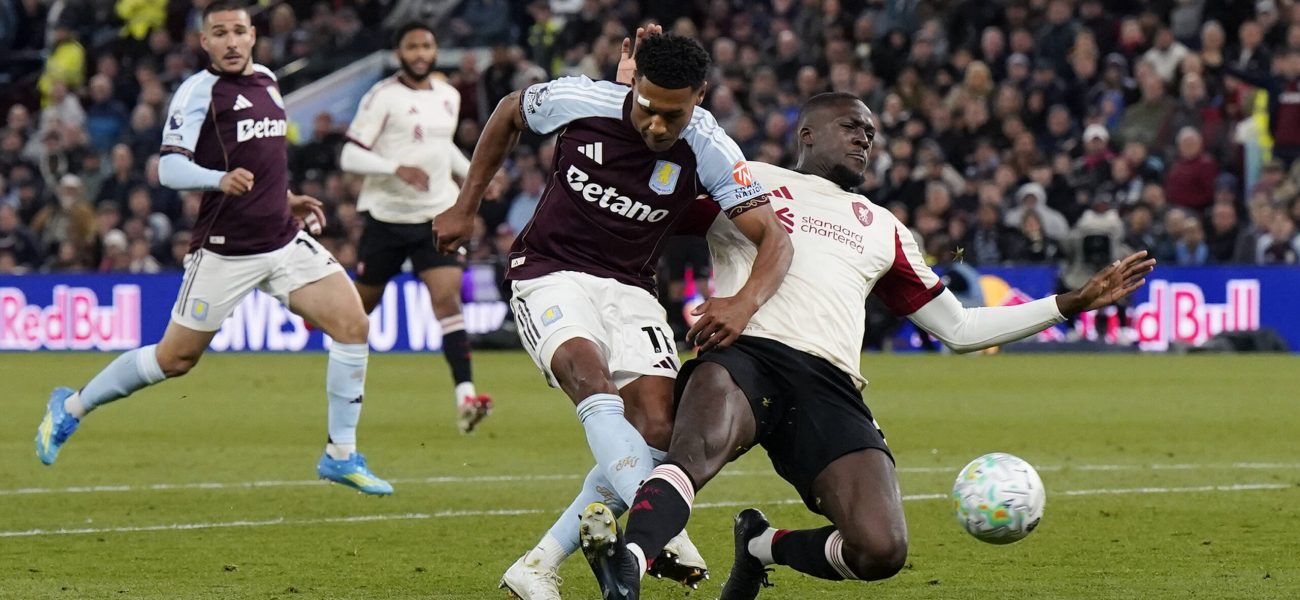
Because frankly, it’s getting rough. The kind of rough that echoes far beyond the terraces of Anfield. Liverpool, a brand recognized even in distant bazaars of Lahore — and Karachi, seems adrift. Their identity – that celebrated concoction of relentless pressing, thunderous attacks, and defensive fortitude – is eroding. For years, the club sold its narrative on intensity, on an unyielding belief in its system. Now? Now you see Alexis Mac Allister, a midfielder often lauded for his composure, getting tangled up with Villa’s Ezri Konsa and then hitting the deck. It wasn’t pretty. Carragher, never one to mince words about simulation, didn’t hesitate. “Honest to god. He goes down every game with something on his ankle. Get up. How embarrassing is that.”
That little moment—a flicker of performative anguish—spoke volumes. It wasn’t about cheating. It was about losing your nerve, a team that once radiated an almost intimidating mental toughness now displaying a curious fragility. And then there’s Ibrahima Konaté. The big French centre-back, ordinarily a rock, appeared out of sync, consistently on the wrong side of Villa striker Ollie Watkins. Watkins ran him ragged. “Konate is always the wrong side of Watkins,” Carragher declared, pinpointing a fundamental breakdown in defensive geometry. That isn’t a fluke; it’s a systemic crack.
And so, as the new manager, Arne Slot, eyes his imminent arrival, he doesn’t inherit a finely-tuned engine. He inherits a sputtering jalopy that has just registered its worst defensive return since the 1992-93 season, having conceded 77 goals across all competitions. That’s a staggering data point for any top-tier club, let alone one with Liverpool’s pretensions. For perspective, only two Premier League teams (Burnley and Sheffield United) in the previous full season conceded more than that. This isn’t just a blip; it’s a structural weakness, exposed over a sustained period.
But the ramifications stretch further than just the Premier League table. When a global sports giant struggles, it ripples through its colossal fanbase, stretching from Bootle to Bangkok. Fans in the Subcontinent, for instance, who often derive a sense of community and connection through these distant allegiances, aren’t just seeing a football team perform badly. They’re seeing an idealized narrative of unwavering excellence, a story sold to millions, start to fray. It questions the very commercial calculus and cultural imprint that drives clubs of this stature to penetrate new, lucrative markets. Is the product still premium if it’s this visibly tarnished?
📄 POLICY WIRE WHITEPAPER PUBLISHED: PAKISTAN'S NATIONAL SECURITY POLICY PRIORITIES
👉 READ BY CLICKING HEREAnd yes, the upcoming transfer window will demand heavy lifting. But you can’t just buy a new ‘mentality’ off the shelf. That’s the hard truth. Even the most ardent optimists in the Liverpool boardroom are surely beginning to feel the heat. As Club Director of Football, Julian Ward, was (hypothetically, of course, because officials speak carefully) quoted recently, “We acknowledge the clear need for rejuvenation across several departments. The next phase of this project will require not just significant investment, but a deep recalibration of expectations and operational methodology. We’re in a transition, certainly, but this performance demonstrates how challenging that transition can be.”
Carragher’s most damning verdict encapsulated it perfectly: “They don’t excel at anything. They’re a really, really average team. I can’t believe they’re fifth in the Premier League.” Such comments aren’t born of mere frustration over a single match. They reflect a deeper malaise, an institutional identity crisis that Slot must somehow fix. And he’ll need to do it quickly because in the brutally transactional world of modern football, average simply won’t cut it. Not for a club accustomed to kingship.
What This Means
The spectacular on-field struggles of Liverpool FC transcend mere sporting disappointment; they represent a significant case study in institutional decline, management transitions, and the very real economic implications for a global brand. Politically, the loss of consistent performance in such a high-profile entity often triggers introspection within governing bodies about league competitiveness, investment strategies, and fan engagement, particularly as European football seeks to cement its influence in emerging markets. Economically, this dip in form isn’t just about prize money. It impacts sponsorship deals, player market values – you don’t attract top talent as easily when you look directionless – and the merchandising ecosystem that underpins much of these super clubs’ revenue. There’s also the soft power aspect: a dominant Liverpool isn’t just good for Merseyside; it’s a globally recognizable emblem for British sporting excellence. A decline suggests, at best, fierce competition, and at worst, a complacency that risks being outmanoeuvred by sharper, hungrier rivals, echoing the struggles of any established, bureaucratic system facing disruption. But, just like nations in geopolitical flux, these giants don’t disappear. They adapt, or they cede ground. That’s the brutal calculus, for clubs — and countries alike. Slot’s immediate task is thus not just coaching, but a form of diplomatic state-building.