


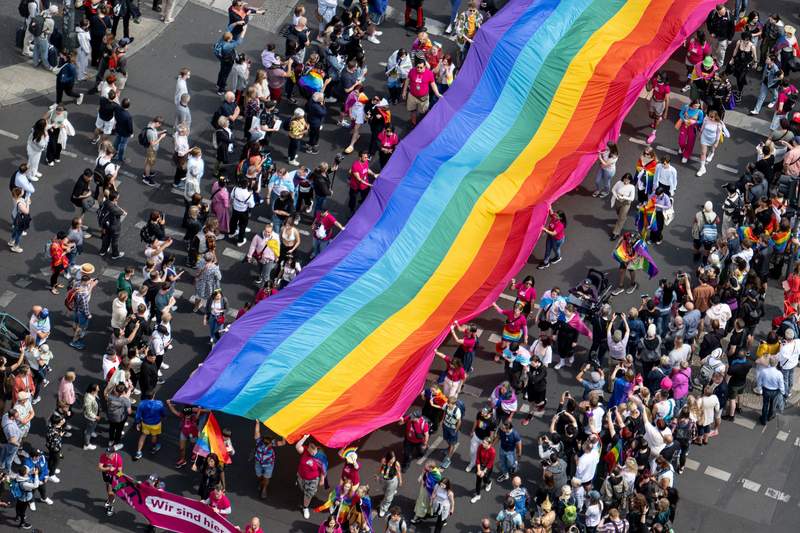
Germany’s Liberal Façade Strains: Queer Community Warns of State’s Slipping Grasp on Hate Crime
POLICY WIRE — Berlin, Germany — For a nation that’s painstakingly cultivated an image of enlightened tolerance, a certain unease has begun to settle over Germany. Not with its export figures, mind...

POLICY WIRE — Berlin, Germany — For a nation that’s painstakingly cultivated an image of enlightened tolerance, a certain unease has begun to settle over Germany. Not with its export figures, mind you, or the perpetual angst over Russian gas. It’s a gnawing suspicion that the state, for all its official declarations of inclusivity, is perhaps losing its grip on something far more foundational: the safety of its own citizens. Specifically, those who don’t conform to traditional gender or sexual norms. Turns out, not every progressive platitude translates to safe streets—or, for that matter, safe digital spaces.
It’s an uncomfortable truth for a country that prides itself on learning from its darkest historical chapters. But don’t look now; a leading LGBTQ+ advocacy group has slapped Berlin with a stark accusation. They’re claiming the state isn’t just dropping the ball; it’s practically fumbling the entire game when it comes to prosecuting and preventing hate crimes targeting the queer community. A bit inconvenient, isn’t it, when your international brand relies heavily on being the good guys?
Queer Deutschland, one of the nation’s most prominent advocacy organizations (a rather sober name for an organization battling quite fiery bigotry, one might observe), recently issued a scathing report. Their findings paint a bleak picture of rising assaults, discrimination, and pervasive online vitriol, all while law enforcement—they contend—remains largely ineffective, if not outright indifferent. It’s a system, they suggest, that’s just not built for this particular kind of nastiness. Or maybe it’s just slow to adapt.
“We’ve presented the data. We’ve screamed from the rooftops. And what do we get? More promises, less action,” fumed Markus Schneider, executive director of Queer Deutschland, in a recent press conference that, frankly, didn’t seem to make as many waves as it should have. “It’s like they’re waiting for another tragedy to finally realize this isn’t just some fringe issue. These are our friends, our family, being targeted. Every day. It’s pathetic, frankly, how long this has dragged on.” His exasperation wasn’t feigned; you could taste it in the air. The numbers don’t lie, either: the German Federal Criminal Police Office (BKA) recorded 1,496 anti-LGBTQIA+ hate crimes in 2022, a near 50% jump from the 1,005 incidents logged just the year before. Those aren’t just statistics; they’re lives impacted, injuries sustained, psyches shattered.
But how does a nation so invested in democratic norms get to this point? Some observers point to the complexities arising from Germany’s evolving demographics. Large-scale migration, particularly from parts of South Asia and the broader Muslim world, brings with it a kaleidoscope of cultures and value systems, not all of them as outwardly affirming of LGBTQ+ identities as modern German state doctrine attempts to be. It’s a challenging integration—to put it mildly—and it doesn’t take a genius to figure out that friction points will emerge.
📄 POLICY WIRE WHITEPAPER PUBLISHED: PAKISTAN'S NATIONAL SECURITY POLICY PRIORITIES
👉 READ BY CLICKING HEREBecause, let’s be honest, societies aren’t monolithic. You can pass laws, wave flags, and hold parades, but shifting deeply ingrained cultural or religious views is a different beast entirely. It takes generations, often. And in the interim? That’s where the policing — and protection come in, or at least, that’s where they’re supposed to. Critics say Germany’s political establishment often tiptoes around these sensitivities, worried about being labeled xenophobic, and inadvertently leaves a vacuum where intolerance can fester—or worse, flourish.
Julia von Weissenburg, a spokesperson for the Federal Ministry of Interior—who naturally opted for a far more diplomatic tone than Schneider—conceded that challenges remain. “Our commitment to protecting all citizens, regardless of their sexual orientation or gender identity, remains absolute. We recognize that incidents of hate crime are a stain on our society,” she articulated, choosing her words carefully, as ministerial spokespeople always do. “But we’re also bolstering training for law enforcement, improving reporting mechanisms, and working with community groups to build trust. It’s an ongoing process.” But ‘ongoing process’ can often feel like a euphemism for ‘slow motion.’ Or, worse, ‘damage control.’
What This Means
This isn’t merely an administrative hiccup; it’s a symptom of deeper societal fractures within Europe’s economic powerhouse. Politically, a failure to genuinely curb hate crimes could erode public trust, particularly among marginalized communities. It presents a potential vulnerability for ruling coalitions, giving opposition parties ammunition, especially those on the far-right, who might cynically frame it as a ‘failure of multiculturalism’ or use it to push their own nativist agendas—never mind that bigotry isn’t exactly exclusive to any one group. Economically, while not directly impactful on GDP, an image of an increasingly unsafe or intolerant society could subtly deter highly skilled international talent or even tourist traffic seeking progressive environments. Who wants to invest in a place where societal harmony is increasingly strained? For Germany, which prides itself on stability, this internal strife could become a rather unwelcome part of its global playbook. The implicit message, intentionally or not, from some parts of the system seems to be: “We’ve given you rights; now don’t expect us to baby-sit.” But rights without robust enforcement? Those are just suggestions. And in a global climate already bristling with war of images and identity conflicts, Germany’s soft power—its appeal as an open, just society—could take an unnecessary beating.