


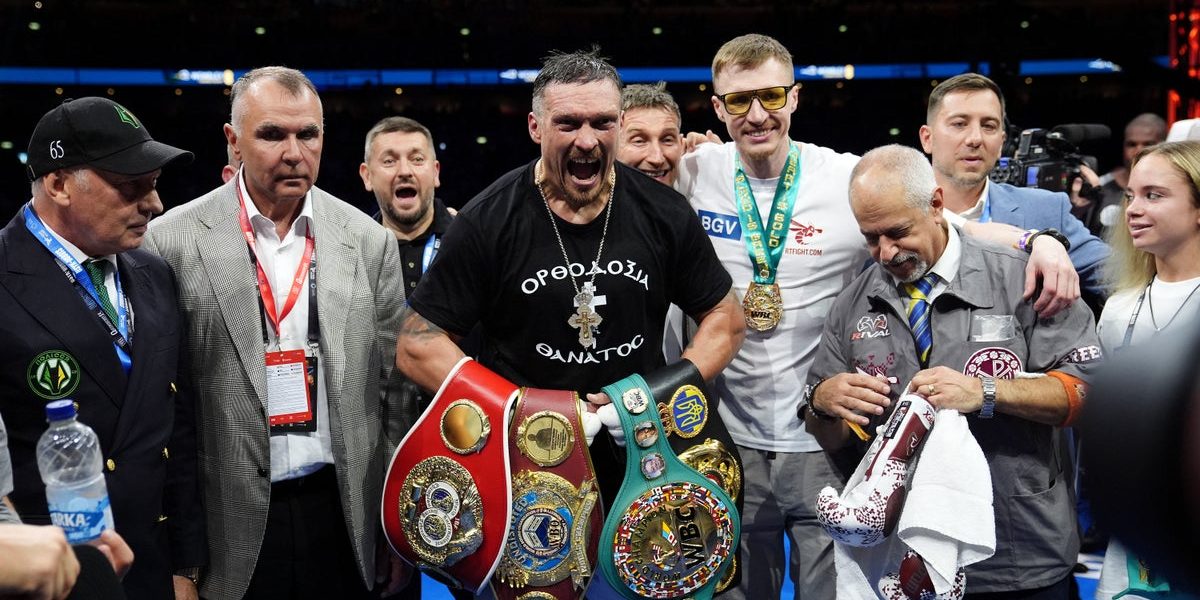
Usyk’s Pyramidal Gambit: IBF Greenlights Controversial Egypt Bout, but at a Cost
POLICY WIRE — Giza, Egypt — The ancient pyramids of Giza have stood for millennia, silent witnesses to empires rising and falling, to human ambition both sublime and ludicrous. Soon, they’ll...

POLICY WIRE — Giza, Egypt — The ancient pyramids of Giza have stood for millennia, silent witnesses to empires rising and falling, to human ambition both sublime and ludicrous. Soon, they’ll play backdrop to Oleksandr Usyk, arguably boxing’s most enigmatic heavyweight, as he squares off against kickboxing royalty Rico Verhoeven in a crossover clash that feels more like a promotional stunt than a sanctioned fight. And that’s exactly the messy bit, isn’t it? Because beneath the glitz of a spectacle staged against humanity’s grandest ruins, the International Boxing Federation (IBF) has been doing its level best to maintain a semblance of control over a sport frequently teetering on the edge of outright chaos.
It was never going to be simple. Not with Usyk, a man who seems to collect belts like casual souvenirs, dabbling in a different discipline against a guy who punches, kicks, and knee-strikes for a living. The May 23, 2026, showdown—set to take place right there in the shadow of Khufu—was green-lit by the WBC, but left the IBF, holder of one of Usyk’s precious titles, scratching its collective head. What a conundrum. Usyk’s camp, ever strategic, sent a missive on April 16, essentially asking for permission to dance an unsanctioned jig.
And so, after a good long chin-wag (a video conference, they call it), the IBF Board of Directors decided on April 29 to grant the Ukrainian maestro his special pass. But don’t misunderstand: this wasn’t a rubber stamp; it was a carefully negotiated surrender, peppered with clauses and conditions. “We recognize Mr. Usyk’s unparalleled achievements and the global interest this event generates,” an IBF spokesperson, who requested anonymity to speak candidly about internal deliberations, told Policy Wire. “But our primary mandate remains the integrity of our championships. It’s a fine line we’re treading, balancing fighter agency with organizational responsibility.” You could almost hear the corporate lawyers sharpening their pencils.
The rules are plain, mind you. IBF Rule 5.H states, quite clearly, that participating in an “unsanctioned contest” means your title is automatically “declared vacant.” Win or lose, poof! Gone. But this is boxing, after all, where rules are less ironclad law and more flexible suggestions, especially when a mega-star like Usyk is involved. So the IBF, caught between maintaining its stature and potentially stripping one of the biggest names in the sport, found a middle path—a serpentine one, fitting for its Egyptian backdrop.
Here’s the deal they cooked up: If Usyk, who’s 39, loses to Verhoeven, 37, then his IBF heavyweight title is immediately vacated. Fair enough. But if he wins, the IBF will acknowledge the WBC’s existing rotational claim (for Agit Kabayel, currently their mandatory challenger) and order their own mandatory bout 180 days after *that* one plays out. Or, if the WBA steps in with its own ‘special permit,’ then the IBF waits its turn for another 180 days after the WBA’s mandatory. It’s a classic case of ‘your turn, then your turn, then maybe my turn later,’ illustrating the constant turf wars between the various alphabet soup organizations. In this circus, the boxers often feel like the performers who have to navigate every hoop.
📄 POLICY WIRE WHITEPAPER PUBLISHED: PAKISTAN'S NATIONAL SECURITY POLICY PRIORITIES
👉 READ BY CLICKING HEREThe whole scenario points to the deep, often infuriating, fragmentation of boxing governance. “Look, I’ve got my eye on the big prize, the undisputed legacy,” Oleksandr Usyk reportedly declared to close confidantes, per sources close to his team. “Sometimes you gotta take a different path to get there, a path with some pyramids — and a kickboxer. But I’ll defend every belt, in due time.” His nonchalant confidence (or sheer brazenness, depending on your view) probably gave the IBF board members indigestion.
The fight venue itself—Giza—is a nod to a burgeoning trend: the Muslim world and broader South Asia emerging as key destinations for high-profile sports and entertainment events. From Saudi Arabia’s burgeoning sports economy to mega-concerts in Dubai, staging a fight at a truly iconic historical site like the pyramids taps into a global audience hungry for unique experiences. The spectacle transcends sport; it’s a global event, a cultural statement. It’s believed that the economic impact of such events for Egypt alone could soar past the $100 million mark, attracting significant tourism and media attention. Because sometimes, the setting sells tickets just as much as the fighters do.
What This Means
This ruling, and the Byzantine negotiations behind it, is a stark reminder of the fragile balance within professional boxing’s fractured leadership. It signals that sanctioning bodies, despite their rules and regulations, can be swayed by the commercial appeal of superstar fighters. It’s an implicit admission that Usyk, a true money-maker, wields considerable leverage. Had this been a lesser-known champion, he likely would’ve been stripped without a second thought. And it points to a future where mega-fights might increasingly occur under bespoke conditions, further eroding the standard framework that governs championship boxing. Expect more of these negotiated exceptions for the big draws. It also spotlights Egypt as a player on the world sports stage, demonstrating the country’s intent to host significant international events and perhaps mimic the geopolitical gamble that others in the region are making. And for Usyk? Well, he gets to have his cake, eat it, — and probably win a kickboxing match at the foot of the pyramids. But it won’t be without consequences for the future of his boxing legacy, as mandatory challengers linger like vultures, waiting for their chance at one of the few undisputed champions remaining in the modern, multi-belt era. You know, the brutal calculus of these elite sporting endeavors is always in motion, isn’t it?