

Fewer Pina Coladas: UK’s Waning Holiday Cheer Signals Deeper Economic Churn
POLICY WIRE — London, UK — Forget the sun-drenched Instagrams and the endless mimosas. Britain’s once-unquenchable thirst for its annual summer escape appears to be cooling, rather dramatically....

POLICY WIRE — London, UK — Forget the sun-drenched Instagrams and the endless mimosas. Britain’s once-unquenchable thirst for its annual summer escape appears to be cooling, rather dramatically. It’s not just a statistic; it’s a palpable shiver down the spine of the global leisure industry—a chill that says something profound about the British wallet, and by extension, the broader economic currents churning beneath the surface.
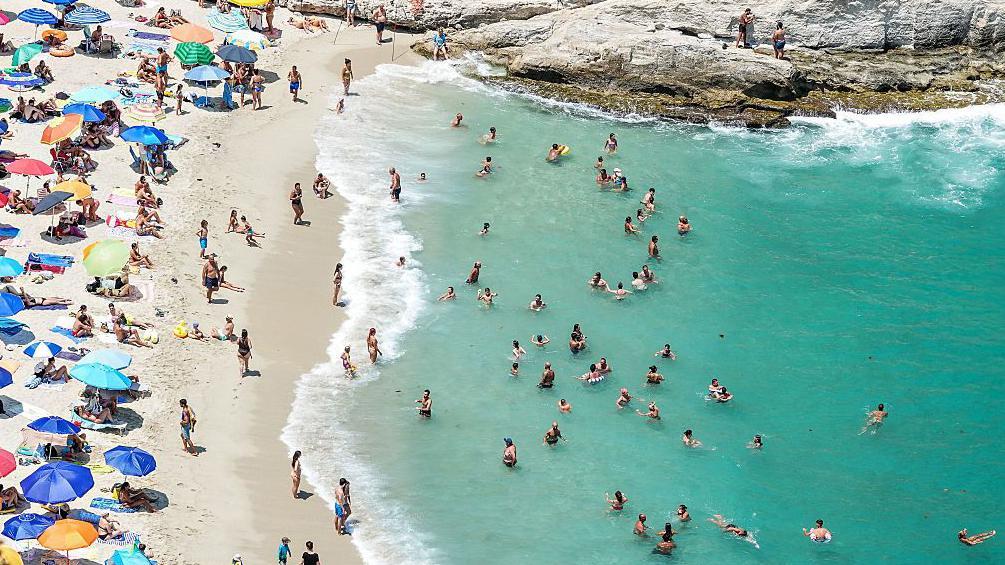
Tui, the mammoth travel operator, recently whispered (or perhaps, more accurately, announced via earnings report) a 10% dip in revenue from its UK clientele for summer holiday bookings. Ten percent. That’s not a rounding error. That’s a noticeable chunk of change that’s staying put in bank accounts, or, more likely, being funneled into rapidly inflating utility bills and grocery trolleys. It’s a sober little fact, this one, that manages to say more about the average Briton’s economic reality than a hundred inflation reports. People are simply foregoing their dose of Mediterranean vitamin D.
And it’s a stark indicator, isn’t it? Discretionary spending, the true barometer of household confidence, is contracting. We’ve heard the headlines about energy costs and mortgage rate hikes, but this — this is the moment those abstractions hit the beaches, or, more precisely, *don’t* hit them. It isn’t just about a holiday company; it’s about national mood. Because, let’s be honest, few things are as culturally ingrained for many Brits as their yearly break from soggy weather and existential dread. To give that up? That tells you where things are really at.
“We’re certainly seeing families make tough choices this year,” observed Helen Thornton, a spokesperson for the National Consumer Alliance, in a call with Policy Wire. “Many aren’t just cutting back; they’re scrapping plans entirely. It’s not just a holiday; it’s often the single largest discretionary spend, and that’s where the squeeze is most acutely felt.” She wasn’t exactly bubbling with optimism. You don’t often find spokespeople for consumer groups sounding overjoyed during times like these. The undertone? Things could get worse.
But the government, naturally, tries to offer a bit of buoyancy. “While any reduction in consumer spending is naturally a concern, we also recognize the resilience of the British economy,” stated Miles Cavendish-Jones, a junior minister at the Department for Business and Trade. His remarks, provided via an email statement, acknowledged global headwinds but also lauded domestic tourism as an alternative, (which, let’s be honest, is government-speak for ‘stay home, you’re too broke to leave’).
What This Means
This revenue dip isn’t some isolated incident; it’s a canary in the coal mine, singing a mournful tune about widespread economic stagnation. For the UK, still grappling with post-Brexit trade adjustments, persistent inflation, and interest rate hikes, it confirms that the average household is well and truly in a defensive crouch. This means a reduced circulation of money within the services sector, threatening jobs not just in travel but also in related industries like hospitality, retail, and even construction, if holiday resort expansions slow.
Economically, less outward spending on European holidays could theoretically mean more money stays within the domestic economy. However, if that money is immediately consumed by increased costs of living, it merely represents a shift in expenditure from discretionary to essential, rather than a genuine boost. It’s an illusion of balance. For policymakers, it presents a delicate balancing act: how to stimulate demand without further stoking inflation—a trickier maneuver than it sounds. Because once a population becomes accustomed to foregoing these simple pleasures, reversing that trend takes more than just a little good news.
From a global perspective, this isn’t unique to the UK. Many Western economies are feeling the pinch. Consider the ripple effects that spread across various international spheres. In places like Pakistan, for instance, a significant diaspora relies on remittances from family abroad. If economic hardship in the UK curtails the ability of overseas workers to send money home, it creates yet another pressure point for already fragile economies, potentially impacting foreign exchange reserves and local spending power. The British holidaymaker tightening their belt here can have unintended, compounding effects thousands of miles away—a phenomenon we’ve observed playing out with varying intensities across the Muslim world and South Asia. For instance, according to data from the World Bank, global remittance flows to South Asia saw a modest decline in the immediate wake of similar economic contractions, though sustained pressure could yield far steeper drops. That’s a direct, tangible consequence of belt-tightening in places like the UK, manifesting in family budgets from Karachi to Dhaka.
What’s next for the travel industry? Consolidation, certainly. And a frantic pivot towards ‘value’ offerings. You can expect to see more staycation pushes — and budget-friendly destinations. The dream of a carefree Mediterranean fortnight is now, for many, a luxury. It’s a sobering reset, a reminder that even escapism isn’t immune to the unforgiving grind of economic reality.
And while it’s easy to focus on the numbers, the human story is simpler: people are tired, stressed, and can’t afford to escape. It’s not a grand, sprawling geopolitical drama. It’s just families watching their dreams of a week on the Costa del Sol evaporate. And that, in its own quiet way, is as telling of the times as any macroeconomic report.