


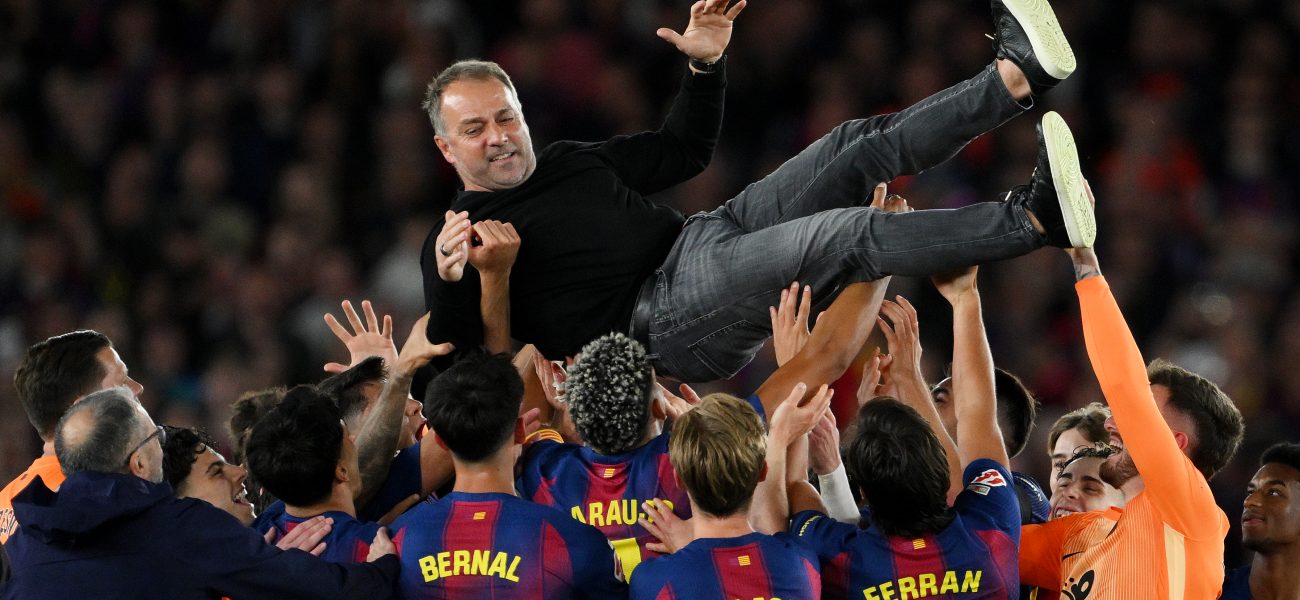
Flick’s Somber Triumph: Barça’s 29th Title Echoes a New European Football Order
POLICY WIRE — Barcelona, Spain — The shoulder-high carry, the triumphant roar from Camp Nou’s faithful—it looked like any other footballing coronation. But behind the celebratory facade of FC...

POLICY WIRE — Barcelona, Spain — The shoulder-high carry, the triumphant roar from Camp Nou’s faithful—it looked like any other footballing coronation. But behind the celebratory facade of FC Barcelona’s 29th LaLiga title, wrested from eternal rivals Real Madrid with a decisive 2-0 El Clásico victory, there lay a darker, more profound tableau: the raw, personal grief of Coach Hansi Flick, whose father had passed mere hours before the final whistle. A public spectacle of joy, a private crucible of sorrow. It’s a juxtaposition that lays bare the unyielding, often brutal demands of modern elite sport, where human tragedy bows to institutional momentum.
It wasn’t just another league title; it was a gritty reclamation of dominance after a period of self-doubt for the Catalan giants. They’d done it, not with the flamboyant, almost leisurely pace of past reigns, but with a stark, methodical precision that mirrored Flick’s Germanic discipline. And it’s not lost on anyone that this victory, secured against their most formidable adversary, comes amid murmurs—or rather, shouts—of institutional and financial rebalancing across European football. Real Madrid, for all its storied history, appeared unexpectedly brittle, a stark observation that rarely befalls the Madridista machine.
Barcelona’s President, Joan Laporta, ever the consummate politician, was quick to frame the victory in grand, almost mythic terms. “This title,” he stated, his voice resonating with an unshakeable conviction, “isn’t just about 29 trophies; it’s about a renaissance. It’s about reminding the world that even through our greatest challenges—our moments of introspection—we don’t just survive; we excel. It’s for Hansi, too, a profound moment of collective solidarity, truly demonstrating what this club means.” He didn’t mention the economic balancing act or the club’s controversial fiscal levers. One never does in such moments of glory, don’t they?
Across the Spanish sporting divide, the sentiment was predictably different. Florentino Pérez, Real Madrid’s influential President, a man whose tenure has been defined by a relentless pursuit of silverware, acknowledged the sting of defeat with a characteristically composed, albeit subtly strained, statement. “We extend our congratulations to Barcelona,” Pérez remarked, though his tone held the faint resonance of a man already planning his next strategic chess move. “But this club doesn’t merely participate; it aspires to perfection. We learn from every challenge. Next season won’t simply be a recovery; it’ll be a renewed assertion of our intrinsic place at the apex of European football, with new strategic investments reflecting that unwavering ambition.” It’s a tacit admission that even giants get wobbled. And you know he’s already on the phone.
The geopolitical reach of such contests isn’t something one can easily ignore. These clashes—these grand El Clásico spectacles—transcend Spain’s borders. They’re a globally recognized commodity. Consider Pakistan, for instance, a nation seemingly geographically distant from Iberian football rivalries. Yet, millions in cities like Karachi and Lahore wake up at ungodly hours, glued to screens, cheering for either Barcelona or Real Madrid. Reports from LaLiga indicate global viewership for El Clásico matches alone frequently surpasses 650 million, a figure comparable to Super Bowl numbers, with significant portions hailing from South Asia and the broader Muslim world, reflecting a massive and ever-growing market for European football’s narratives and drama. It’s a fervent engagement that illustrates the powerful economic and cultural pull of these institutions, even in regions with vastly different domestic sporting priorities.
The narrative isn’t just about who scores goals. It’s about global branding, merchandise sales in distant lands, and the relentless competition for eyeballs and allegiances that stretches from Doha to Dhaka. This win helps Barça’s balance sheet, plain — and simple. And in the world of mega-clubs, where debt is often as much a strategic asset as a stadium, every title is currency, a validation that keeps the money flowing—broadcasting rights, sponsorships, player valuations—it’s all interconnected.
What This Means
Barcelona’s recent triumph isn’t just another trophy; it’s a telling snapshot of the ever-evolving dynamics within top-tier European football. From a policy perspective, such dominance solidifies a club’s financial position, impacting everything from broadcasting rights negotiations to global sponsorship deals. These victories don’t merely generate fleeting jubilation; they provide tangible leverage in boardrooms across continents, affecting how money flows into and out of major sporting federations and nation-states. Consider how global marketing efforts target these immense fan bases, translating passion into purchasing power in emergent markets. A LaLiga title for a club like Barcelona isn’t just a localized celebration; it’s an international economic engine revving up, drawing in capital from diverse sources and solidifying Spain’s soft power—cultural export—on an impressive scale. It also puts pressure on rivals like Real Madrid to recalibrate, to perhaps invest even more aggressively, a feedback loop that fuels the global football economy. For every winner, there’s a Loser who needs to strategize for resurgence—it’s part of the global economic game these clubs play. We’ve seen similar high-stakes maneuvering in other leagues, where every play on the field has repercussions far beyond the stadium walls, echoing in everything from multi-billion dollar broadcast gambits to nuanced shifts in corporate sponsorships. This isn’t just sport; it’s high finance in cleats.