


Rome Rumbles: Young Guns, Old Guard Collide Amidst Grand Slam Build-Up
POLICY WIRE — Rome, Italy — In a sporting calendar perpetually obsessed with legacy, where echoes of titans past often drown out the nascent roar of the future, the Italian Open unfurled a few...

POLICY WIRE — Rome, Italy — In a sporting calendar perpetually obsessed with legacy, where echoes of titans past often drown out the nascent roar of the future, the Italian Open unfurled a few compelling counter-narratives this past Sunday. This wasn’t merely another pit stop on the grind toward Roland Garros; it became a stage for bold declarations and whispered uncertainties. Because for all the talk of seasoned champions, it’s the unsettling disruptions that truly capture attention.
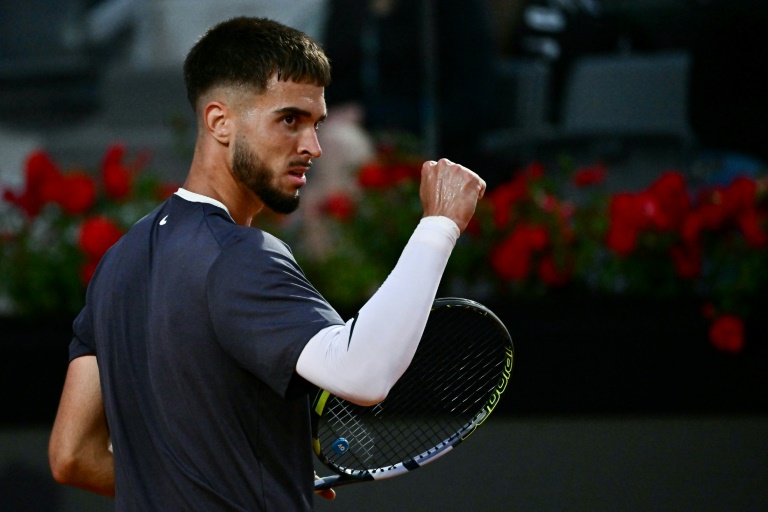
Take Dino Prizmic. A name perhaps unfamiliar outside the inner sanctum of tennis cognoscenti just days ago, he’s suddenly a talking point—and a headache for established order. Fresh off unsettling one of the game’s undeniable greats, Novak Djokovic, the Croatian continued his unexpected romp through the Foro Italico. He dispatched France’s Ugo Humbert, the 31st seed, with a conviction that bordered on impudence: a brisk 6-1, 7-5 victory. Prizmic wasn’t just winning; he was dismantling, particularly in that first set, which he snatched in a mere 28 minutes. It was clinical. It was aggressive. And frankly, it felt a little impudent, especially when he tried that between-the-legs trick shot. He’s making waves, and you know what? That’s exactly what the circuit needs.
But the narrative isn’t exclusively about youthful insurgency. Seasoned pros are also fighting to keep their footing, sometimes quite literally on the fickle clay. Alexander Zverev, the second seed, sailed past Alexander Blockx—again—in straight sets, 6-1, 6-4. No drama there, just German efficiency. He’s eyeing a third Rome title, maintaining that calm demeanor that suggests he’s seen it all before, even as younger threats multiply around him. “There’s a lot of young guys who are playing great tennis. He’s definitely one of them,” Zverev conceded, speaking generally about the circuit’s fresh faces. “But I’m going to go match by match, I think that’s the most important thing, not to look too far ahead and focus on the things that you can control.” That’s a textbook response, isn’t it? Very diplomatic.
Meanwhile, on the women’s side, Naomi Osaka is stitching together something that looks suspiciously like a comeback. After a series of challenging seasons—and let’s be honest, those moments happen—the four-time Grand Slam winner swiftly put away Diana Schnaider, 6-1, 6-2. This isn’t just a win; it’s a statement. It puts her on a collision course with Iga Swiatek, the three-time Rome champion, which Osaka views with undisguised eagerness. “For me those matches are the most fun,” Osaka confided to reporters. “I’m excited at the thought.” Her journey back from the brink of relevance is precisely the kind of grit fans—and advertisers—adore. The Japanese-Haitian star’s resilience might yet translate into deeper runs, proving that raw talent, once honed, isn’t easily forgotten. For now, that fragile revival often needs moments of clarity and dominant play. And this was certainly that.
Prizmic, with his rapid ascent, isn’t just winning games; he’s accruing significant ranking points. According to the latest ATP data, his performance in Rome already guarantees a jump of 11 places to world No. 68 by Monday week—a career high. That’s more than a number; it’s a direct ticket to better draws, bigger prize pots, and, eventually, a greater platform. But he isn’t getting carried away. “I just want to play my game and to be myself on the court and we will see,” Prizmic remarked, setting his sights a little higher. “Maybe for me the goal is to be top 30 at the end of the year but I just want to stay healthy and to play as much as I can.”
And so, Rome becomes a crucible, forging new contenders while testing the mettle of those who’ve held the reins. It’s a precursor to the French Open, certainly, but it’s also a micro-climate of shifting power dynamics, where every forehand and backhand holds the weight of aspiration.
What This Means
Beyond the yellow felt and clay dust, the happenings in Rome signify something deeper: the eternal, churning nature of elite sports and its increasingly globalized implications. The rise of players like Prizmic, who hails from Croatia—a nation of under 4 million—challenges the dominance often held by larger, historically established tennis nations. This kind of breakout performance provides inspiration across smaller economies and populations, showcasing that individual talent, not just national infrastructure, can carve a path to global prominence. It’s a compelling soft power narrative; every unheralded champion from an unexpected locale contributes to a mosaic of international engagement. Even regions grappling with complex geopolitical tensions, like parts of the Muslim world or South Asia, observe these shifts. Success stories, particularly from athletes whose journeys reflect resilience and unexpected victories, resonate in communities striving for representation on the world stage. the sheer economic engine of these Masters 1000 tournaments—tens of millions in revenue, jobs, and tourist dollars—creates an often-overlooked yet substantial footprint in host cities. The drama on the court isn’t just for entertainment; it’s a significant, if often unstated, driver of economic activity and international branding.