


Hoops & Havoc: College Sports Embraces Corporate Booze, But Who Pays the Tab for Smaller Games?
POLICY WIRE — Washington D.C., USA — Forget the slam dunk; the real spectacle in college athletics these days is the unholy fusion of big money and beer—or rather, wine and spirits, now official...

POLICY WIRE — Washington D.C., USA — Forget the slam dunk; the real spectacle in college athletics these days is the unholy fusion of big money and beer—or rather, wine and spirits, now official partners of the NCAA’s cash cow, March Madness. While billions slosh around college basketball, a more sobering reality plays out across campuses nationwide: venerable sports like tennis and golf are getting unceremoniously axed, casualties in a hyper-capitalist scrum for dwindling dollars. It’s a classic Darwinian showdown, — and guess which species is flourishing?
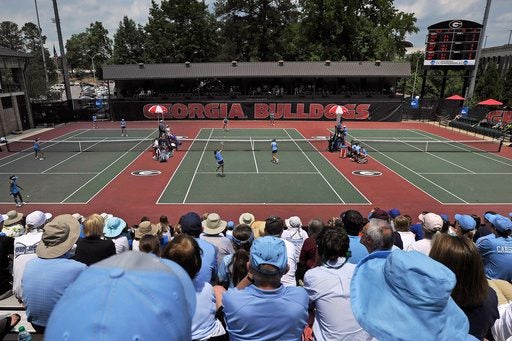
Arkansas, a behemoth in the Southeastern Conference (SEC), canned its entire men’s — and women’s tennis program recently. This wasn’t some fiscally challenged junior college; this was an SEC school, one of college sports’ wealthiest fiefdoms. Its tennis operation, men’s coach Jay Udwadia told Front Office Sports, cost a modest $2.5 million annually — pocket change, frankly, when compared to the price tag of a single high-profile wide receiver on a Power Four football roster. “My initial reaction was, ‘That’s funny. April Fools, right?’” Udwadia quipped, reflecting a sentiment surely echoed by many coaches and athletes now staring down the barrel of economic extinction. Turns out, it wasn’t a joke, and that specific cost-cutting measure accounts for just one fraction of the nearly 20 such programs eliminated across the NCAA this past year. Think about that for a second. Twenty programs gone.
Meanwhile, the expanded NCAA basketball tournaments, now a bloated 76-team affair, are projected to inject an extra $300 million into college sports coffers over the next six seasons. A hefty $131 million of that goes straight to the conferences fielding those tournament-bound teams. You can see the logic, I suppose. And it’s the logical conclusion when athletic departments transform into quasi-professional sports franchises, accountable more to revenue projections than athletic diversity.
But this isn’t just about basketball’s ascent. It’s about the system’s re-calibration post-NIL (Name, Image, — and Likeness) deals and revenue sharing. Schools aren’t just finding new ways to generate cash; they’re desperately finding them. We’ve seen the Big 12 dabble with private equity lines of credit—up to $30 million for member schools, though some, like Texas Tech, wisely steered clear. Duke, that academic powerhouse, just cut a landmark deal with Amazon to stream a few basketball games. Millions, they say. It’s all very transactional. You just can’t ignore it.
“The revenue generated from new sources, whether from expanded tournaments or novel media rights deals, isn’t merely for profit; it’s becoming essential for sustainable operation in this new landscape,” stated Dan Gavitt, the NCAA’s top man for Division I basketball, a statement dripping with the kind of calculated pragmatism administrators adopt when defending seemingly ruthless financial decisions. “It’s about balancing the books when player compensation is part of the equation, pure — and simple.”
📄 POLICY WIRE WHITEPAPER PUBLISHED: PAKISTAN'S NATIONAL SECURITY POLICY PRIORITIES
👉 READ BY CLICKING HEREAnd what about those players? The new regulatory body, the College Sports Commission (CSC), tasked with overseeing NIL deals, finds itself swimming in arbitration claims and struggling to get schools to sign a binding participation agreement. Paia LaPalombara, a former college administrator now at Church, Church, Hittle and Antrim, described the CSC’s nascent operations as experiencing “growing pains.” Litigation is brewing, because where there’s hundreds of millions, there’s usually a lawyer lurking. But don’t misunderstand—this legal quagmire isn’t an anomaly, it’s the cost of doing business in a system that once clung to a facade of amateurism and now operates as a barely disguised minor league.
Bubba Cunningham, the Athletic Director at North Carolina, summed it up perfectly when pressed on this existential question. “The ultimate solution is a bifurcated system. One where you’re paid to play, and another where you pay to play.” It’s a stark, almost brutal assessment, confirming the death knell for many aspirational athletes in less glamorous pursuits. It’s a structure not unlike many international athletic models where elite talent gets patronage and others foot their own bill, from European club sports to emerging academies in places like Pakistan, where government and private funding for grassroots athletic development—especially in less mainstream sports—remains perennially challenging, often forcing families to make enormous personal investments. But there, the expectation is professional payoff; here, it was once a college degree — and a medal.
What This Means
This escalating financial segregation within college sports isn’t just about athletic budgets; it’s a stark reflection of broader economic pressures filtering down to institutions traditionally seen as pillars of balanced educational and extracurricular development. The rush for revenue, often through lucrative—and culturally controversial—deals with alcohol brands, isn’t a luxury; it’s a desperate attempt to stay afloat as player compensation becomes normalized and expensive legal battles loom over the fledgling regulatory framework. We’re witnessing a professionalization that eradicates diversity, concentrating resources on sports that guarantee a broadcast payout, leaving “Olympic” sports on life support. This trend directly impacts America’s pipeline for international competitions. It reshapes the very identity of universities, making them economic actors first, educational institutions second. It’s a brutal calculus, certainly, transforming collegiate athletic departments into sophisticated, highly competitive enterprises where the haves expand their empires, and the have-nots — well, they’re simply fading away. Regulation proves tricky, and the market decides all.