


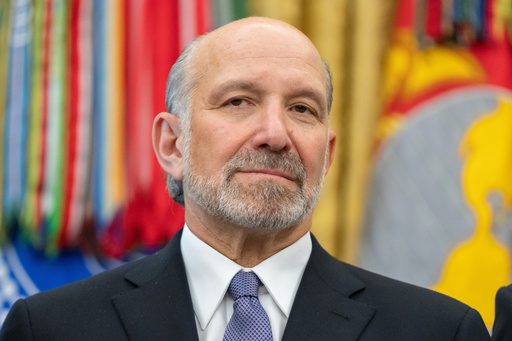
Lutnick’s Shifting Sands: Epstein Shadow Lengthens Over Commerce Secretary’s Capitol Hill Testimony
POLICY WIRE — WASHINGTON, D.C. — The spectral shadow of Jeffrey Epstein — that notorious financier and convicted sex offender — continues to cling to the polished corridors of power, long after his...

POLICY WIRE — WASHINGTON, D.C. — The spectral shadow of Jeffrey Epstein — that notorious financier and convicted sex offender — continues to cling to the polished corridors of power, long after his ignominious demise. Still, Washington’s elite find themselves reckoning with past associations, often accompanied by remarkably convenient lapses in memory. Commerce Secretary Howard Lutnick became the latest high-profile figure forced into this uncomfortable spotlight Wednesday, facing a House panel intent on unraveling his increasingly convoluted narrative concerning contact with Epstein.
It wasn’t merely Lutnick’s proximity to the scandal that drew the House Oversight Committee’s gaze; it was the peculiar elasticity of his recollections. For years, the story has morphed. He initially claimed a visceral aversion after a 2005 tour of Epstein’s lurid domicile prompted a vow to “never be in the room” again. Yet, as documents and previous admissions surfaced, that firm boundary seemed to have dissolved into a permeable membrane, allowing for subsequent meetings, island visits, and even shared investments.
And what a stark contrast it’s. Before senators earlier this year, Lutnick asserted, with a politician’s practiced gravitas, “I didn’t have any relationship with him. I barely had anything to do with him.” This declaration, however, strains credulity against a backdrop of emerging facts. For instance, in 2011, he endured an hour-long engagement at Epstein’s infamous residence. Then, a year later, his family even visited Epstein’s private Caribbean island for lunch – a locale now synonymous with unspeakable acts. The threads of connection, once dismissed as fleeting, now appear tightly woven, suggesting a degree of familiarity that belies casual acquaintance.
Behind the headlines, this isn’t just about Lutnick. It’s about a broader pattern of influential figures — including former President Donald Trump, whom Lutnick served and vigorously supported — having maintained, or at least downplayed, ties to Epstein even after his 2008 conviction for soliciting prostitution from an underage girl. The committee’s pursuit isn’t just punitive; it’s an exercise in public accountability, a test of how much scrutiny powerful men can evade when confronted with inconvenient truths.
“The American public deserves unvarnished truth, not a shifting narrative,” Rep. Nancy Mace (R-S.C.), herself no stranger to calls for transparency, shot back. “These are serious allegations, and powerful individuals must be held to account, regardless of their political allegiance.” But for some, the slow drip of revelations, combined with what appears to be selective memory, has worn thin. “It’s frankly baffling how many different versions of ‘no relationship’ one can offer before the facts simply overwhelm the narrative,” fumed Rep. Jamie Raskin (D-Md.), a senior member of the oversight panel. “Our committee won’t stop until we get to the bottom of this institutional amnesia.”
Documents show Lutnick and Epstein communicated via email as late as 2018, discussing a museum expansion that threatened their shared neighborhood views. More concretely, in a testament to their financial entanglement, Epstein even contributed a notable $50,000 to a 2017 dinner honoring Lutnick. And Lutnick, it emerged, extended an invitation to Epstein for a Hillary Clinton fundraiser in 2015. Such gestures rarely accompany mere passing acquaintances.
📄 POLICY WIRE WHITEPAPER PUBLISHED: PAKISTAN'S NATIONAL SECURITY POLICY PRIORITIES
👉 READ BY CLICKING HEREThe White House, for its part, has resolutely expressed support for Lutnick. He’s been a long-standing ally of the former president, an architect of his sweeping tariffs, and a significant fundraiser for his campaigns. But Lutnick isn’t the only figure whose Epstein connections continue to haunt Washington. Former Florida Attorney General Pam Bondi, who also served the Trump administration, is likewise scheduled to testify before the committee, underscoring the pervasive nature of the Epstein web. This relentless dredging up of past associations — a chilling reminder of the scandal’s reach — keeps the issue firmly in the public domain.
What This Means
This ongoing congressional scrutiny of figures like Lutnick isn’t merely political theater; it’s a profound test of accountability for Washington’s powerful. At its core, the issue erodes public trust in institutions — and the individuals who lead them. When high-ranking officials demonstrate a fluid relationship with truth — especially concerning such a morally reprehensible figure — it cultivates a corrosive cynicism. Economically, this persistent cloud of scandal can distract from genuine policy work, potentially impacting the Commerce Department’s effectiveness and, by extension, U.S. economic initiatives. For Lutnick himself, a continued inability to reconcile his differing accounts could render his position untenable, regardless of White House backing. His closed-door testimony, initially welcomed, now presents a significant reputational — and political peril.
Still, the implications stretch beyond America’s shores. In a global landscape, where U.S. moral leadership is frequently challenged, revelations of elite hypocrisy or a perceived lack of accountability resonate deeply. Countries in the Muslim world, for instance, often scrutinize Western nations’ commitment to human rights — and justice. When a senior U.S. official struggles to explain past associations with a convicted sex offender, it provides ample fodder for narratives questioning the sincerity of American values abroad. This, in turn, can subtly complicate diplomatic overtures and undermine efforts to foster alliances built on shared principles.