


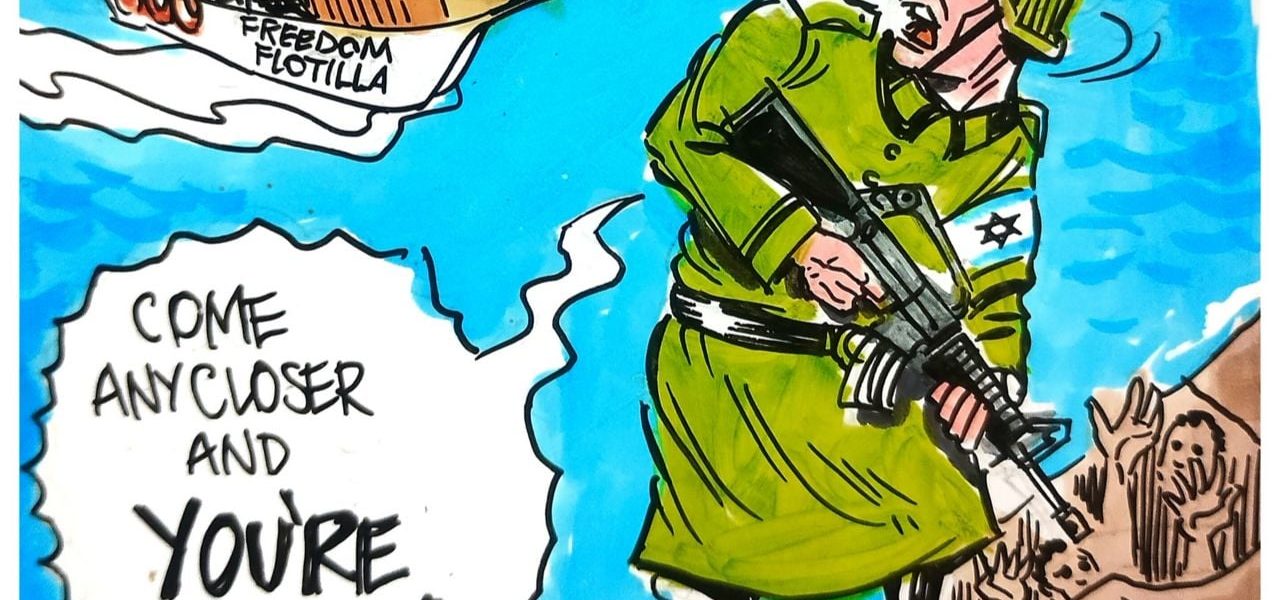
The Absurdist Turn: How a ‘Condom Flotilla’ Label Hijacked a Narrative and Burned Bridges
POLICY WIRE — Washington, D.C. — Wars, it turns out, aren’t just waged with bombs and bullets. Nor are they confined to battlefields or even diplomatic chambers. Often, the most consequential...

POLICY WIRE — Washington, D.C. — Wars, it turns out, aren’t just waged with bombs and bullets. Nor are they confined to battlefields or even diplomatic chambers. Often, the most consequential skirmishes unfold in the theater of public perception, where a single, well-placed phrase can detonate an entire narrative. And what a phrase it was.
It began as a humanitarian endeavor, at least in its stated intent: a flotilla of ships, brimming with aid, attempting to breach a naval blockade. This wasn’t some innocuous pleasure cruise, mind you. But the discourse shifted seismically when certain items, purportedly discovered aboard one vessel, were thrust into the unforgiving glare of international media. Not medicine. Not food. Rather, a collection of sex toys — and contraceptive devices – condoms, specifically. Thus, a solemn mission to alleviate suffering mutated, almost overnight, into the derisive ‘condom flotilla.’ And with that, Israel, then facing intense scrutiny over its deadly raid on the Mavi Marmara in 2010, found its moment to pivot, to weaponize absurdity.
The strategic deployment of this label wasn’t about truth; it was about delegitimization. It sought to paint the activists not as brave humanitarians, but as disingenuous provocateurs, perhaps even a touch ridiculous. Behind the headlines, it was a masterclass in media judo, leveraging the very outrage against Israel to discredit its accusers. Still, it begs the question: how did such a flimsy narrative gain traction, eclipsing the very real issues of blockade and civilian casualties?
Ofir Gendelman, then an Israeli Foreign Ministry spokesperson, shot back at critics with a sardonic edge. “These aren’t humanitarian activists; they’re political provocateurs,” he reportedly asserted. “Finding pornography and gag gifts amongst alleged aid – it’s not just disingenuous, it’s a calculated insult to genuine humanitarian efforts. We’re simply revealing the farcical reality behind their self-serving PR campaign.” His words, amplified across countless news cycles, carved deep, damaging fissures into the activists’ credibility. It worked, to a degree.
But for those on the receiving end of the blockade, and for many in the Muslim world, such dismissals only deepened the sense of injustice. Turkey, whose citizens formed the bulk of the Mavi Marmara’s passengers, vehemently condemned the Israeli operation and its subsequent media strategy. Ahmet Davutoğlu, then Turkey’s Foreign Minister, didn’t mince words. “To stoop to such depraved smears, to distract from a brutal blockade inflicting collective punishment on millions,” he countered, his voice sharp with indignation, “it tells you everything you need to know about their moral bankruptcy. This isn’t about condoms; it’s about control, and a desperate attempt to obscure their own violence.” And that’s the rub, isn’t it? Two entirely disparate realities, clashing not just over policy, but over semantics.
📄 POLICY WIRE WHITEPAPER PUBLISHED: PAKISTAN'S NATIONAL SECURITY POLICY PRIORITIES
👉 READ BY CLICKING HEREAcross the Muslim world, from Cairo to Islamabad, the Israeli narrative was largely rejected. For Pakistan, a staunch supporter of the Palestinian cause, the incident solidified existing convictions of Israeli aggression and callous disregard for international law. Media outlets in Karachi and Lahore, far from adopting the ‘condom flotilla’ moniker, instead focused on the loss of life and the continuing humanitarian crisis in Gaza. A 2010 analysis by the Pew Research Center indicated a significant dip in international public approval for Israel following the Mavi Marmara incident, with perceptions among Muslim publics particularly impacted, dropping by an average of 15 percentage points in several surveyed nations, despite — or perhaps because of — the Israeli counter-narrative. It wasn’t the soundbite that resonated; it was the bullet holes.
The incident underscored a pervasive problem in the modern information age: the triumph of the sensational over the substantial. One salacious detail, however peripheral, can drown out an entire ocean of pertinent facts. It’s a pernicious dynamic, one that reduces complex geopolitical realities to consumable, often misleading, soundbites.
What This Means
At its core, the ‘condom flotilla’ incident wasn’t just a PR skirmish; it was a potent demonstration of how narrative control can reshape international diplomacy and public opinion. The immediate political implication was a deepening of the rift between Israel and Turkey, a relationship that wouldn’t recover for years. Economically, the blockade on Gaza continued, albeit with renewed international pressure, sustaining a humanitarian crisis and stifling economic development in the Strip. For activist movements, it highlighted the double-edged sword of high-profile direct action: while it garners attention, it also provides adversaries with ample material for counter-propaganda, however absurd. Moving forward, governments and non-state actors alike learned valuable, if cynical, lessons about information warfare – namely, that an easily digestible, even if outrageous, accusation can often outpace a nuanced defense. It set a precedent, arguably, for an era where verifiable facts often play second fiddle to catchy, often manufactured, controversy. We’re still grappling with those implications today, aren’t we?