


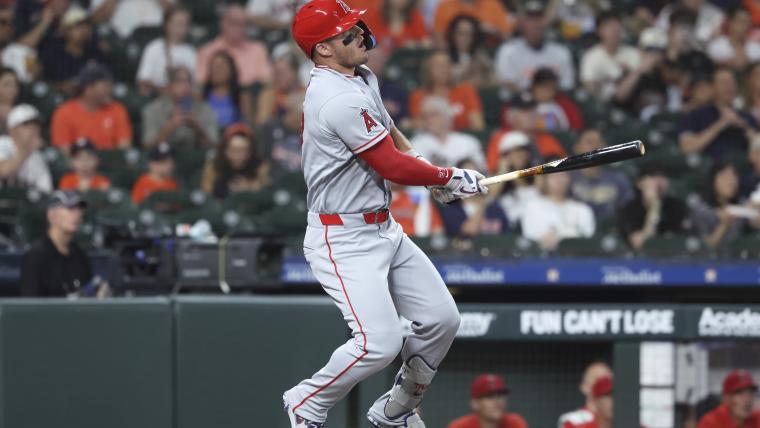
The Unbearable Weight of Loyalty: Mike Trout’s Golden Handcuffs and a Whisper from Detroit
POLICY WIRE — Anaheim, California — Few tales in modern sports epitomize the vexing tension between individual brilliance and organizational inertia quite like that of Mike Trout. It’s a...

POLICY WIRE — Anaheim, California — Few tales in modern sports epitomize the vexing tension between individual brilliance and organizational inertia quite like that of Mike Trout. It’s a narrative woven with prodigious talent, unwavering fidelity, — and a stark lack of collective triumph. For well over a decade, baseball fans have witnessed perhaps the game’s finest positional player — a statistical anomaly, really — toil in relative anonymity, his postseason appearances as rare as an honest politician.
And now, the whispers grow louder. They don’t speak of a burgeoning dynasty in Anaheim, but rather of an unthinkable egress. A departure for a destination as improbable as it’s potentially pragmatic: the Detroit Tigers, an American League Central outfit that, historically, has found itself far from the baseball zeitgeist. It’s an arrangement that, at first blush, feels like a speculative fiction, yet it underscores a brutal truth about professional athletics: even the purest loyalty has its breaking point, especially when juxtaposed against monumental financial commitments and the ticking clock of a Hall of Fame career.
Behind the headlines, this isn’t just about baseball; it’s a corporate drama writ large. The Los Angeles Angels, for all their sunny disposition, have become an emblem of squandered potential, consistently failing to build a winning infrastructure around their generational superstar. Trout, now in his 16th season, has graced the postseason just once, a fleeting cameo that feels like a statistical error given his sustained individual dominance. He’s been the unwavering anchor in a sea of underperformance. Still, his gargantuan contract — a reported 12-year, $426.5 million deal signed in 2019, with four years remaining after this season — coupled with a full no-trade clause, presents a labyrinthine challenge for any prospective suitor, let alone the Angels themselves.
“Look, Mike Trout is the Angels,” opined General Manager Perry Minasian recently, though not directly on this rumor. “His dedication, his work ethic, his presence — they define our franchise. Any discussion of his future always starts and ends with his unparalleled commitment to this organization, and frankly, the immense value he brings, both on and off the field. We’re not in the business of diminishing our own assets, nor of betraying trust built over fifteen years.” It’s a sentiment that rings of both admiration and, perhaps, a hint of desperation to retain their sole consistent draw. But what if Trout, approaching his mid-30s (he’s about to turn 35), decides competitive relevance trumps all?
Enter the Detroit Tigers. They’re not a perennial contender, certainly not a juggernaut. Yet, as FanSided’s Chris Landers mused, a path could exist. The Tigers need a dependable center fielder — or, more likely, a full-time designated hitter to anchor their lineup — and with potential payroll flexibility emerging (say, if they don’t retain a key arm like Tarik Skubal), the economic stars might, just might, align. For them, it’s a calculated risk, an audacious play for a guaranteed future Hall of Famer. “To acquire a talent of Trout’s caliber, even with his contract, would be a seismic shift for our club,” a Tigers executive, speaking anonymously on condition of broader organizational strategy, confided. “It’s about demonstrating ambition, galvanizing the fanbase, — and acquiring a proven winner’s mentality. We’ve got to explore every avenue to elevate this franchise.”
And it’s not as if Trout has shown any signs of diminished ability when he’s on the field. His 34 walks lead Major League Baseball, showcasing his elite plate discipline, and his .955 OPS ranks an enviable sixth in the American League (Major League Baseball data). He’s already blasted 10 home runs this season. So, the talent is still unequivocally there. The question isn’t whether he can still play, but where.
Such a blockbuster trade, though improbable, isn’t just a sports story; it’s a profound statement on the fluidity of global capital and the perception of value. In an era where sports franchises are increasingly seen as investment vehicles, attracting capital from diverse sources, including sovereign wealth funds from the Middle East and South Asia — regions where baseball isn’t king, but star power transcends borders — the calculus of a player’s worth shifts. A superstar like Trout, even in his twilight years, commands attention and, crucially, revenue streams that resonate far beyond the American heartland. It’s why the economic leverage of players, particularly those with no-trade clauses, becomes a crucial subplot in the grand theater of sports business.
What This Means
At its core, a Mike Trout trade would be a monumental capitulation by the Angels, acknowledging their failure to build around one of the game’s all-time greats. It would send shockwaves through the league, reshaping perceptions of player loyalty — and franchise stewardship. For Detroit, it represents a bold, potentially transformative gamble — a strategic play to inject immediate credibility and long-term fan engagement into a team craving both. Economically, it’s a massive payroll commitment that could either hamstring future moves or, conversely, pay dividends through increased ticket sales, merchandising, and national attention. And, it’s a reminder that even in the most individualized sports, the individual’s aspirations often collide with the cold, hard realities of organizational strategy and financial balance sheets. The political implications for team management and ownership are stark: failure to deliver a winning product with a player like Trout becomes an indelible mark. Such a move also highlights the increasing global reach of sports economics, where even a distinctly American game like baseball sees its narratives and financial stakes influenced by worldwide trends in investment and athlete branding. It’s a microcosm of how cities fight tooth and nail for flagship franchises, understanding the inherent value a successful sports entity brings to its civic identity.
Still, for a player who’s spent his entire prodigious career with one club, a trade would signal a fundamental shift in his personal priorities – from unwavering fealty to a relentless pursuit of a World Series ring. It’s a choice that many athletes face, but few at Trout’s stratospheric level. It’s not merely a transaction; it’s the potential rewriting of a legacy, one swing of the bat at a time. The echoes of such a move would reverberate for years, defining both the player — and the organizations involved.