


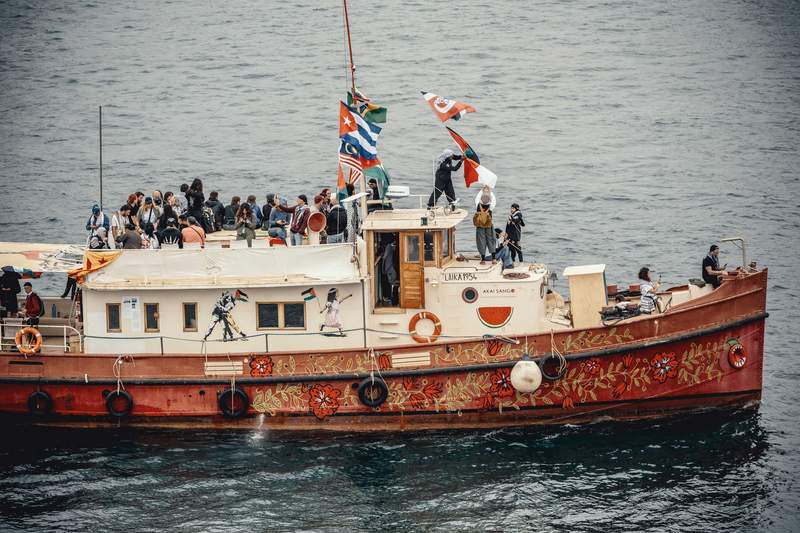
A Familiar Refrain: Gaza Aid Activists Detained, Blockade’s Echoes Persist
POLICY WIRE — Tel Aviv, Israel — The sea lanes off Gaza have long served as a stage for recurring geopolitical theatre, a familiar, often frustrating, tableau. And once again, the curtain rises on an...

POLICY WIRE — Tel Aviv, Israel — The sea lanes off Gaza have long served as a stage for recurring geopolitical theatre, a familiar, often frustrating, tableau. And once again, the curtain rises on an old act: the extension of detention for two activists associated with a recent aid flotilla, a move that hardly startled observers but nevertheless reverberated across the region, pulling at already frayed diplomatic nerves. It’s a development that underscores, brutally, the tenacious grip of the blockade and the perpetual cycle of resistance and containment.
At its core, this isn’t merely about two individuals — however consequential their plight — but about the unyielding struggle over access to a besieged strip of land. Israeli authorities, whose operations were reportedly swift and efficient, confirmed the extended custody of the unnamed activists. They’d been attempting to deliver humanitarian supplies, a gesture invariably cast by some as noble, by others as provocative. This isn’t the first time, nor will it be the last, that such attempts have met with an Israeli naval escort directly to a detention center rather than a Gaza port.
Still, the latest incident involved a vessel, reportedly modest in size, attempting to pierce the maritime cordon. The precise nature of the aid remains somewhat secondary to the symbolism; it’s the challenge to the blockade itself that animates both sides. Lieutenant Colonel Eitan Shai, a spokesperson for the Israel Defense Forces, shot back at criticisms, stating, “We won’t countenance any attempts to circumvent established security protocols, particularly when facing adversaries who exploit humanitarian pretenses for nefarious ends.” It’s a well-worn argument, emphasizing national security and prevention of arms smuggling, factors Israel insists necessitate the blockade.
But for those on the other side of the divide, particularly organizations dedicated to Gaza’s welfare, the detention constitutes a grave injustice. Dr. Fatima Zahra, a representative for the Gaza Aid Coalition, didn’t mince words. “These detentions aren’t just about two individuals; they’re about silencing the urgent pleas of a besieged population, desperate for basic necessities that shouldn’t be weaponized,” she asserted, her voice brimming with indignation during a virtual press briefing. Her sentiment echoes widely across humanitarian corridors, where concerns over Gaza’s rapidly deteriorating conditions have reached a crescendo.
Indeed, the numbers don’t lie: an astonishing 80% of Gaza’s population relies on humanitarian assistance, according to the UN Office for the Coordination of Humanitarian Affairs (OCHA). This isn’t just a political talking point; it’s a stark reality for millions. The blockade, instituted since 2007, has choked the enclave’s economy, decimated its infrastructure, and fostered a profound dependence on external aid, much of which struggles to reach those who need it most. It’s a testament to the resilience—or perhaps the sheer desperation—of activists that they continue these ventures, despite the predictable outcomes.
The implications of such detentions stretch far beyond the immediate protagonists. In the broader Muslim world, particularly across South Asia from Pakistan to Indonesia, these events often ignite passionate public responses. They feed into a narrative of collective suffering and perceived Western indifference, galvanizing popular support for Palestinian causes and often complicating diplomatic efforts. For many, it’s not simply an isolated act but another visible scar on the Pacific’s unseen scar of geopolitical tensions and enduring conflicts.
📄 POLICY WIRE WHITEPAPER PUBLISHED: PAKISTAN'S NATIONAL SECURITY POLICY PRIORITIES
👉 READ BY CLICKING HEREAnd so, the cycle continues. A flotilla attempts passage. It’s intercepted. Activists are detained. Outrage flares. The aid, if allowed, trickles in, a drop in an ocean of need. It’s a script that’s been performed countless times, each repetition hardening positions and deepening the trenches of an intractable conflict. There’s a certain tragic predictability to it all, isn’t there?
What This Means
The extended detention of these activists, while seemingly minor in the grand tapestry of Middle East conflict, holds significant political and economic implications. Politically, it reaffirms Israel’s unwavering commitment to its blockade policy, signaling to both internal and external actors that challenges to its maritime sovereignty will be met with force and legal action. This posture, while intended to bolster security, invariably ratchets up regional tensions and provides fresh fodder for international condemnation, further isolating Israel on certain diplomatic fronts.
Economically, the incident highlights the enduring stranglehold on Gaza’s nascent economy. Without unrestricted access to goods, services, and external markets, Gaza remains economically moribund, a humanitarian black hole requiring constant international assistance. The perpetuation of such incidents discourages potential investors and hinders any long-term development prospects, cementing Gaza’s status as a perpetual aid recipient rather than a self-sustaining entity. It also implicitly underscores the challenges faced by organizations like UNRWA’s perilous tightrope act in delivering essential services. This isn’t just about security, it’s about a deliberate, if unspoken, strategy of containment that carries profound human costs and perpetuates a regional powder keg.