


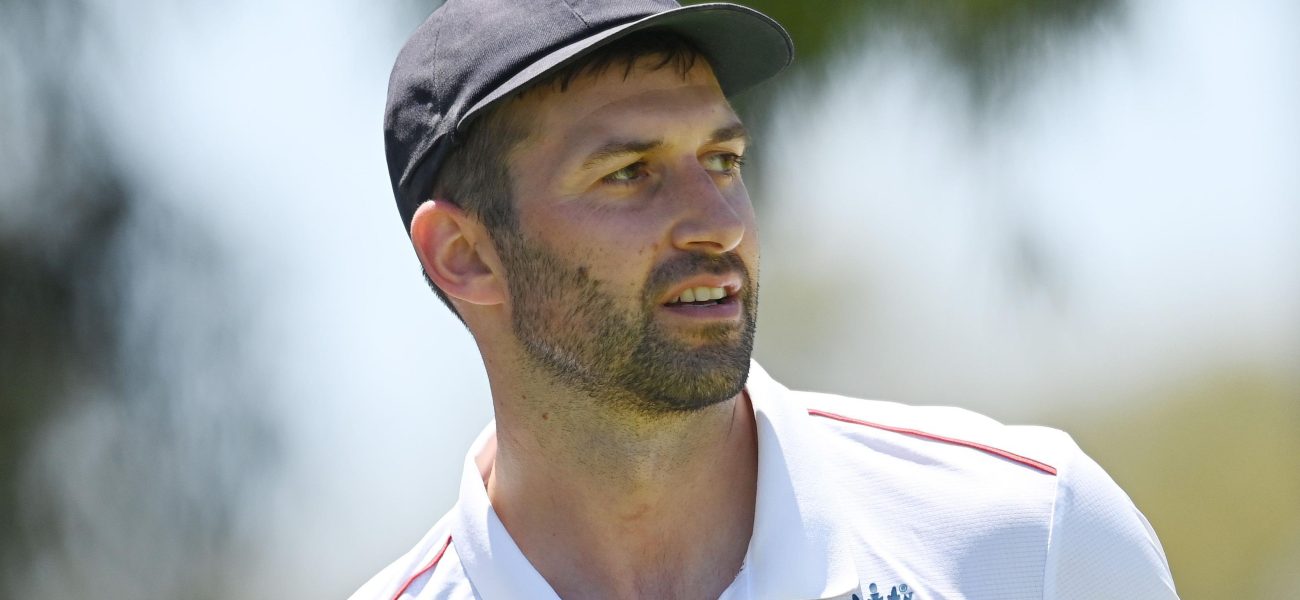
When the Pace Fades: Mark Wood’s Reckoning and the Unsettling Calculus of England’s Fast Bowling Future
POLICY WIRE — London, UK — The cruel arithmetic of elite sport often finds its most brutal expression in the fleeting careers of fast bowlers. Few embody this more starkly than Mark Wood,...

POLICY WIRE — London, UK — The cruel arithmetic of elite sport often finds its most brutal expression in the fleeting careers of fast bowlers. Few embody this more starkly than Mark Wood, England’s mercurial speed merchant, whose latest battle isn’t with opposing batsmen, but with the recalcitrant cartilage of his own left knee. It’s a saga of hope, despair, — and the relentless ticking clock that haunts every high-performance athlete.
Behind the headlines of Test match glory and Ashes rivalries lies a quieter, more personal struggle for Wood, 36, whose future on the international stage hangs by a tenuous thread. After a March 2025 surgery to address the injury that torpedoed his Ashes ambitions, his return to the fray in November against Australia was tragically brief. Eleven overs in Perth, a mere flicker of his former thunderbolt self, before being sidelined once more. That’s it. And for a man who has always ridden the precipice of physical extremity, the psychological toll must be immense.
“I need to take it slow,” Wood recently confided to the BBC’s Strategic Timeout programme, his voice tinged with a weariness perhaps unfamiliar to fans accustomed to his effervescent on-field persona. “Realistically I’ve got maybe one more chance at doing this right. If I rush it back, then it’s not good, that could be it.” It’s a candid admission, one that strips away the veneer of national heroics to reveal the fragile human underneath. Indeed, his contemplation of ‘life after cricket’ underscores the gravity of this juncture, even as he vows to “laser” his focus on adding to his 146 international caps.
Still, England’s national cricket apparatus must grapple with a wider, more systemic issue. Wood’s recurrent absences — a career defined as much by injury rehabilitation as by blistering spells — arrive at a moment of profound generational flux. With James Anderson and Stuart Broad recently retiring, and Chris Woakes also in the twilight of his career, the collective toll of 1,619 Test wickets shared amongst these stalwarts, a statistic often cited by the England and Wales Cricket Board (ECB), represents a void that cannot be easily filled. The notion of a ‘golden generation’ of pace bowlers, one that defined England’s fortunes for over a decade, is now undeniably fading.
“While we deeply value the contributions of our experienced campaigners, the future of England’s pace attack cannot hinge solely on the unpredictable whims of a cricketer’s knee joint,” remarked Ashley Giles, former Managing Director of England Men’s Cricket, in a statement to Policy Wire. “We’re actively investing in, — and accelerating the development of, the next generation. It’s a strategic imperative, not just a reactive measure.” Such pragmatism, though cold, reflects the inherent pressures on national sporting bodies, tasked with maintaining competitive advantage on the global stage.
📄 POLICY WIRE WHITEPAPER PUBLISHED: PAKISTAN'S NATIONAL SECURITY POLICY PRIORITIES
👉 READ BY CLICKING HEREThe quest for raw pace, a prized commodity in cricket, carries universal resonance. From the hallowed grounds of Lord’s to the dust-blown pitches of Karachi, the sight of a genuinely fast bowler ignites passion. But that same pursuit is also a pact with the devil, as the body pays an exorbitant price. Consider the illustrious careers of Pakistani legends like Shoaib Akhtar or Waqar Younis; their bursts of unmatched speed were invariably punctuated by periods of debilitating injury. This shared narrative — the high stakes, the physical sacrifice — ensures Wood’s predicament resonates deeply within the vast cricket-following diaspora, particularly in South Asian communities who understand intimately the fragile majesty of a truly quick bowler. It’s a universal language of struggle — and ambition. So, while Jofra Archer’s own injury travails — even during his high-profile stints in the IPL’s commercial crucible — are well-documented, the collective health of England’s fast bowling arsenal is becoming a critical strategic concern.
The upcoming home summer, commencing with a Test against New Zealand on June 4th, looms large. With Brydon Carse potentially sidelined, and others like Josh Tongue and Gus Atkinson now firmly in contention, the landscape is shifting rapidly. Matthew Potts — and Matthew Fisher, once on the fringes, now find themselves pushed into the spotlight. It’s a volatile ecosystem, where promise and potential are perpetually tested by the unforgiving realities of elite performance.
What This Means
At its core, Mark Wood’s struggle isn’t merely a personal medical drama; it represents a microcosm of strategic challenges facing England Cricket, and indeed, any major sporting enterprise. Economically, the absence of a star player — one capable of generating match-winning moments and drawing crowds — can impact broadcast deals, sponsorship value, and fan engagement. Politically, within the national sporting context, the ECB faces immense pressure to produce a winning team, an aspiration directly jeopardized by a depleted fast-bowling unit. the perceived ‘fragility’ of its prime assets forces a re-evaluation of youth development pipelines and talent management strategies. It begs the question: are modern training regimes adequately preparing bodies for the brutal demands of international cricket, or are we witnessing an inevitable consequence of pushing human physiology to its absolute limits? The answer, like Wood’s knee, remains stubbornly unclear.
📖 GET YOUR FREE COPY NOW OF POLICY WIRE DIGITAL MAGAZINE JULY 2026 EDITION
👉 READ & DOWNLOAD FREE MAGAZINE