


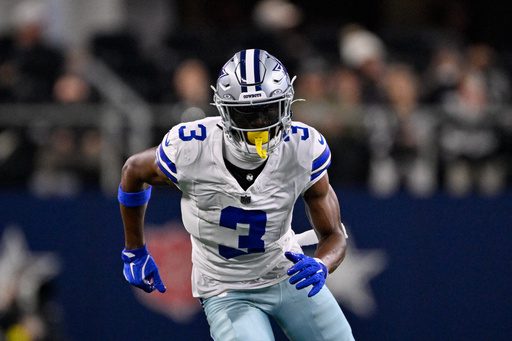
Gridiron’s Golden Handcuffs: Pickens’ $27.3 Million Tag Unveils Dallas’ Calculated Gambit
POLICY WIRE — FRISCO, Texas — It wasn’t the signature itself that drew the keenest interest this week. No, the real story unspooled in the days leading up to George Pickens finally affixing his...

POLICY WIRE — FRISCO, Texas — It wasn’t the signature itself that drew the keenest interest this week. No, the real story unspooled in the days leading up to George Pickens finally affixing his name to the Dallas Cowboys’ $27.3 million franchise tender. This wasn’t merely a transaction; it was a carefully orchestrated maneuver, a public negotiation played out with the dramatic flair one expects from America’s Team, culminating in a short-term financial bonanza that belies a more intricate, long-game strategic calculus.
Behind the headlines of guaranteed millions, a subtle power struggle has been underway. Pickens, the prodigious wide receiver acquired from Pittsburgh last year, had already signaled his intent to accept the one-year deal hours before the recent NFL draft — a public announcement that, ironically, fueled rampant trade speculation. Why? Because executive vice president Stephen Jones had only just indicated the club wouldn’t pursue a long-term pact with Pickens this offseason. So, the player’s acquiescence wasn’t a surrender, but a shrewd acceptance of an immediate, colossal payday, leveraging his recent on-field brilliance against the franchise’s cautious optimism.
For a player who, in his stellar sophomore season, tallied career highs of 93 catches for 1,429 receiving yards and nine touchdowns (a significant leap from his Steelers days), the tag represents an undeniable financial coup. Consider this: the $27.3 million secured for this single season absolutely dwarfs his entire four-year rookie deal, which totaled a comparatively paltry $6.8 million as a 2022 second-round pick from Georgia. It’s a stark reminder of the volatile, high-stakes nature of professional sports contracts, where one season’s performance can redefine a young athlete’s generational wealth.
But there’s always a wrinkle. The Cowboys, infamous for their methodical, some might say glacial, approach to extensions for high-value players, have a history here. Quarterback Dak Prescott and defensive end DeMarcus Lawrence both played under the franchise tag before securing their respective long-term agreements. Yet, tight end Dalton Schultz and running back Tony Pollard also experienced the tag’s embrace only to depart in free agency the following year. This dichotomy, this institutional push-and-pull, forms the essence of the Dallas strategy.
Owner and general manager Jerry Jones, ever the showman, has consistently maintained his enthusiasm for Pickens’ future in Dallas. “We wouldn’t extend such a lucrative offer under the tag,” Jones posited recently, his voice resonating with an almost paternal assurance, “if we didn’t possess an unwavering conviction that George remains a cornerstone of our aspirations well beyond 2026.” It’s a sentiment designed to soothe anxieties, both within the fan base and, presumably, Pickens’ camp.
Still, Stephen Jones offered a more pragmatic explanation for the current one-year arrangement. “The newness of George’s tenure with us played a consequential role,” he stated, emphasizing the organization’s preference for a measured assessment. One can read between the lines here, detecting the faintest echo of Pickens’ past. While his talent is undeniable, instances of petulant or indifferent behavior during his Steelers stint — enough for former coach Mike Tomlin to publicly question his maturity — haven’t entirely faded from the collective memory. (Though, to be fair, coach Brian Schottenheimer has never aired such grievances.) That benching in Las Vegas after a casino curfew breach? It wasn’t exactly forgotten, was it?
📄 POLICY WIRE WHITEPAPER PUBLISHED: PAKISTAN'S NATIONAL SECURITY POLICY PRIORITIES
👉 READ BY CLICKING HERESo, the $27.3 million, while staggering, isn’t just a reward; it’s an investment with a probationary undertone. It’s the team buying another year to fully evaluate Pickens’ fit, not just as a receiver, but as a franchise stalwart. And in a league increasingly dependent on salary cap management and strategic roster building, these decisions carry geopolitical reverberations, albeit indirectly. The astronomical sums involved in contracts like Pickens’ highlight the financial muscle of American sports, a spectacle followed avidly from Cairo to Karachi, where young aspirants from diverse backgrounds, including many across the Muslim world, dream of similar pathways to prosperity through athletic prowess. It’s a testament to the global appeal of gridiron, transforming local talent into international aspirations and, sometimes, multi-million-dollar realities. The sheer scale of financial opportunity is a powerful draw, a narrative that transcends borders.
What This Means
At its core, Pickens’ franchise tag signifies a classic high-wire act in NFL team building: marrying immediate performance with long-term fiscal prudence. For the Cowboys, it avoids the immediate cap strain of a mega-extension while retaining a crucial offensive weapon. It also provides another season to gauge Pickens’ maturation off the field, a factor that undeniably weighs heavily in any significant long-term investment. From a political economy perspective, it underscores the inherent tension in professional sports labor markets; players seek maximum security and compensation, while owners prioritize flexibility and risk mitigation. This dance, often protracted — and public, is a microcosm of larger contractual negotiations in any high-value industry.
The tag also ensures Pickens’ presence at mandatory offseason activities, crucial for building rapport with quarterback Dak Prescott and integrating new offensive schemes. But crucially, it keeps the pressure squarely on Pickens to deliver elite-level performance without the comfort of a multi-year deal. He’s essentially on a high-stakes, one-year contract audition for potentially one of the biggest paydays of his career. For Dallas, it’s a calculated risk, betting that Pickens’ on-field production will continue to outweigh any lingering concerns, ultimately justifying a more permanent commitment down the line – or, failing that, providing a valuable trade asset. It’s a temporary truce, not a definitive peace treaty, in the ongoing financial skirmishes between players and ownership.