


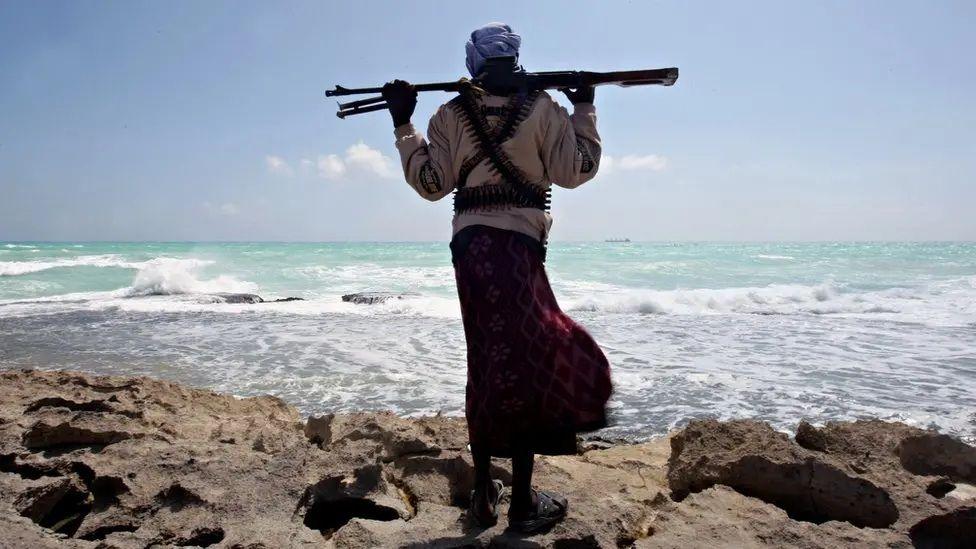
Shadows Return: Somali Pirates Seize Oil Tanker Amid Red Sea Turmoil
POLICY WIRE — Mogadishu, Somalia — Just when the global crowd fancied it’d consigned the phantom of Somali piracy to dusty history books, a ghastly reverberation from the past has punctured the...

POLICY WIRE — Mogadishu, Somalia — Just when the global crowd fancied it’d consigned the phantom of Somali piracy to dusty history books, a ghastly reverberation from the past has punctured the relative calm of the Horn of Africa’s vital shipping lanes. An oil tanker, its crew and cargo now at the mercy of armed brigands, reminds us how swiftly hard-won security gains can unravel. It’s truly a grim reminder.
This isn’t solely another maritime incident; it’s a stark re-emergence of a menace that once hobbled global trade. Pirates seized the vessel, reportedly carrying crude, off the Somali coast. Few details about the tanker’s flag state or its crew’s nationality have materialized, but the message is incontrovertible: piracy’s back, like a bad penny.
Back in 2011, Somali pirate attacks peaked at an astonishing 237 incidents, according to the International Maritime Bureau (IMB). Sustained international naval patrols, including contributions from Pakistan and India, then dramatically stymied these depredations. We saw a near-total cessation for several years. And yet, the underlying conditions that fuel piracy—poverty, lack of governance, and regional instability—never truly evaporated. That’s a crucial point, really.
“We’re working tirelessly to secure our coastline, but the current geopolitical climate stretches our resources and frankly, those of our international partners,” opined Mohamed Adan, Somalia’s Minister of Ports and Maritime Transport, in an exclusive interview with Policy Wire. “Global inaction, particularly in maintaining a robust presence across these vital shipping lanes, only incentivizes these criminal elements.”
His words illuminate a growing concern. The recent Houthi aggressions in the Red Sea have comprehensibly siphoned momentous international naval assets further north. That’s a momentous shift in focus, leaving a treacherous void—a sort of maritime black hole, if you will—in the Gulf of Aden and off the Somali coast.
Pirates, ever opportunistic, don’t overlook such openings. How thoughtful of them. This isn’t just about ransoms anymore; it’s about control, leverage, and the ability to disrupt the lifeblood of global commerce. Many analysts suggest a direct interplay between the current Red Sea crisis — and this sudden resurgence.
For nations in South Asia — and the wider Muslim world, this situation is particularly dicey. Major shipping routes connecting the energy-rich Gulf to markets in India, Pakistan, and beyond pass through these very waters. Increased threats translate directly into higher insurance premiums, longer transit times as ships reroute, and ultimately, inflated costs for consumers—a genuinely worrying thought, if you ask me.
But make no mistake, these aren’t isolated events. They reflect a broader regional insecurity. Nations like Pakistan, with its burgeoning trade ambitions and significant naval capabilities, have long been participants in international anti-piracy missions. This new development will unquestionably necessitate a re-evaluation of maritime security strategies across the entire Indian Ocean Rim. It’s a big deal, frankly.
“The current geopolitical climate in the Red Sea — and Gulf of Aden engenders a perfect storm,” articulated Dr. Eleanor Vance, Director of Maritime Security Studies at the International Maritime Bureau (IMB). “Houthi attacks draw naval assets north, leaving a vacuum where Somali pirates, operating with renewed impunity, find fertile ground. It’s a classic case of threat displacement.”
Her assessment rings true. Are we witnessing the dawn of a second wave of Somali piracy, magnified by current events? It’s the question on everyone’s mind, isn’t it?
What This Means
The hijacking of an oil tanker off Somalia carries deep-seated ramifications, far beyond the immediate fate of the vessel and its crew. Economically, we’re likely to see a sharp uptick in maritime insurance rates for voyages through the Gulf of Aden and the Arabian Sea. Shipping companies, already grappling with Red Sea rerouting and increased fuel costs, will pass these expenses onto consumers, potentially stoking inflationary pressures globally. What’s a global economy to do?
Politically, it puts renewed pressure on international naval coalitions. Commanders face an unenviable choice: continue focusing on the Red Sea’s Houthi threat or redeploy assets southward to counter resurgent piracy. This isn’t just a tactical dilemma; it’s a strategic bind—a real Gordian knot, actually—that demands considerable thought, navigating both immediate perils and long-term stability goals. Somalia’s nascent government, endeavoring for stability, finds its efforts embroiled by a return to lawlessness on its coast. It’s quite the pickle, you know?
Diplomatically, expect a fresh round of calls for international cooperation, potentially including increased aid for coastal communities in Somalia and enhanced intelligence sharing. It’s a potent reminder that global security is intertwined; a problem in one theatre often spawns issues elsewhere, much like a noxious weed. Washington’s subtle South Asia shift, for instance, must now contend with a more complex maritime picture. That’s a given.
So, this isn’t merely a regional problem, either. Energy security for Europe — and Asia pivots upon these trade routes. Any protracted disruption or sustained increase in risk presents a structural impediment to global supply chains. Period. No way around it.
Ultimately, this incident isn’t an aberration. It’s a distress signal. Marcus Bellamy, a senior maritime risk analyst at Lloyd’s of London, warns, “Unless international navies re-establish a visible and sustained deterrent presence in these waters, and fast, we’ll see more than just an isolated hijacking. We could be on the cusp of a full-blown resurgence, and the global economy simply can’t afford that right now.” His sobering forecast leaves little room for doubt about the gravity of the moment—a situation that truly couldn’t be more dire, could it?