


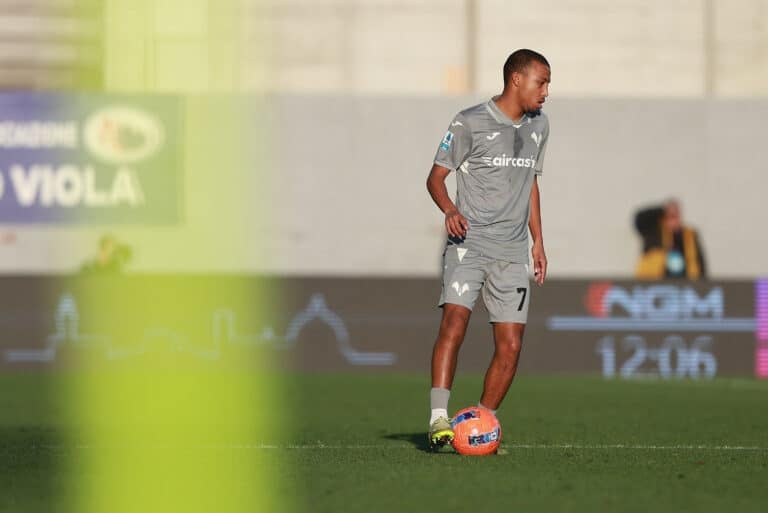
The Silent Auction: Roma’s Discreet Pursuit of Verona’s Algerian Dynamo Unmasks Football’s Economic Currents
POLICY WIRE — Rome, Italy — The European football market, a labyrinthine bazaar of whispers and speculative maneuvers, rarely operates with overt declarations. Instead, it thrives on an ecosystem of...

POLICY WIRE — Rome, Italy — The European football market, a labyrinthine bazaar of whispers and speculative maneuvers, rarely operates with overt declarations. Instead, it thrives on an ecosystem of astute observation and calculated discretion, a phenomenon perhaps best exemplified by AS Roma’s reported, yet unconfirmed, interest in Hellas Verona’s promising full-back, Rafik Belghali. This isn’t merely about securing a promising talent; it’s a granular excavation for the next diamond in the rough — a strategic maneuver in an increasingly volatile transfer landscape where every Euro counts.
Behind the headlines — or rather, the lack thereof — a silent auction is underway. Journalist Alfredo Pedullà, a seasoned chronicler of Italy’s footballing machinations, asserts the Giallorossi have cast their acquisitive gaze upon the 23-year-old Algerian, born in Belgium. But as with so many potential deals, the critical caveat remains: no formal discussions have commenced. Still, the mere whisper of interest sends tremors through the financial substrata of two distinct clubs, each with its own precarious economic realities.
Belghali, a recent discovery by Verona’s sporting director Sean Sogliano, embodies the modern footballing commodity. He arrived in Italy only last summer, yet swiftly carved out a niche, featuring in 21 games and netting two goals for the Venetian outfit. His profile — a blend of relentless running, formidable physicality, and a knack for precise crossing — seems to align perfectly with the tactical demands of coaches like Gian Piero Gasperini, whom Roma has reportedly considered.
At its core, this pursuit isn’t just about a player’s statistics; it’s about identifying the confluence of potential and market value before the herd arrives. Frederic Massara, Roma’s sporting director (whose own tenure, ironically, remains a subject of considerable speculation), is reportedly a keen admirer. He and his team are tasked with a perpetual balancing act: bolstering the squad while navigating the stringent financial fair play regulations that perpetually hem in European clubs. “Our mandate remains clear: identify and cultivate talent that aligns with our strategic vision — players who can not only perform but who embody the club’s future direction,” Massara recently opined in a rare, albeit brief, policy statement. “Belghali presents an intriguing profile, certainly one on our radar for potential assessment.”
For Verona, the scenario is equally telling. They’ve long operated as a crucible for talent, often unearthing gems only to sell them on for a handsome profit. Sogliano’s latest ‘discovery’ from the Benelux region appears ripe for this established model. And it’s a model that sustains smaller clubs in an ecosystem dominated by financial titans. “Every player has his price, especially when they’ve proven their mettle in a demanding league,” Sean Sogliano shot back when pressed on Verona’s stance regarding rising interest in their roster. “We’re committed to nurturing our assets, but also to making fiscally responsible decisions that secure the club’s longevity. It’s a delicate balance, isn’t it?”
Rafik Belghali’s dual heritage, Algerian by descent and Belgian by birth, quietly underscores a profound geopolitical thread in contemporary football. He represents a vast and growing cohort of players from the Muslim diaspora who have become foundational to European clubs. Their success resonates far beyond the pitch, inspiring millions in North Africa, the Middle East, and even across South Asia, where European football enjoys a fervent following, often eclipsing local sports. For a young Algerian-Belgian, a move to a club like Roma isn’t just a career step; it’s a symbol of broader transnational aspirations and the intricate cultural tapestry woven into the global game.
This dynamic plays out in a market where astronomical figures are the norm. According to FIFA’s Global Transfer Market Report, international transfers in men’s professional football surpassed $7 billion in fees in 2023, representing a 48% surge from the previous year, underscoring the market’s burgeoning, often bewildering, liquidity. That’s a staggering sum, and it illustrates why every club, from the giants to the minnows, scrutinizes every potential acquisition or sale with forensic intensity. This isn’t just sport; it’s a multi-billion-dollar economic engine.
What This Means
Roma’s nascent interest in Belghali, while seemingly a minor transfer rumor, is a microcosm of larger trends shaping European football’s political economy. Firstly, it spotlights the increasingly sophisticated scouting networks employed by top clubs to identify undervalued talent from smaller leagues or developing teams. These ‘discoveries’ offer a cost-effective alternative to established stars, aligning with the necessity for shrewd financial management amidst persistent debt and UEFA’s financial regulations. Secondly, it highlights the precarious position of mid-tier clubs like Verona, which are often forced to become feeder clubs, their success predicated on developing and then offloading their most valuable assets. This creates a perpetual cycle of renewal — and divestment, a sort of Darwinian struggle for financial solvency. And finally, the player’s heritage is consequential. The growing prominence of players from diverse backgrounds, particularly from the Muslim diaspora, isn’t just a feel-good story; it represents a significant demographic shift in professional football, reflecting broader societal changes and global migration patterns. These players carry the weight of expectation from their communities and often serve as cultural ambassadors, expanding the sport’s reach and marketability into new territories, ultimately enhancing its global economic footprint. It’s a complex interplay of individual ambition, club strategy, — and geopolitical currents.
So, while formal talks remain elusive, the ripples of Roma’s interest are already being felt. It’s a testament to the quiet power of speculation, the relentless quest for efficiency, and the undeniable human element that remains, miraculously, at the heart of this colossal, profit-driven enterprise.