


Miami’s Gridiron Gambit: The Policy Wire Deconstructs the Human Futures Market of the 2026 NFL Draft
POLICY WIRE — Miami, USA — It isn’t merely about gridiron glory, not anymore. At its core, the annual National Football League Draft has transmuted into a global human futures market, where...

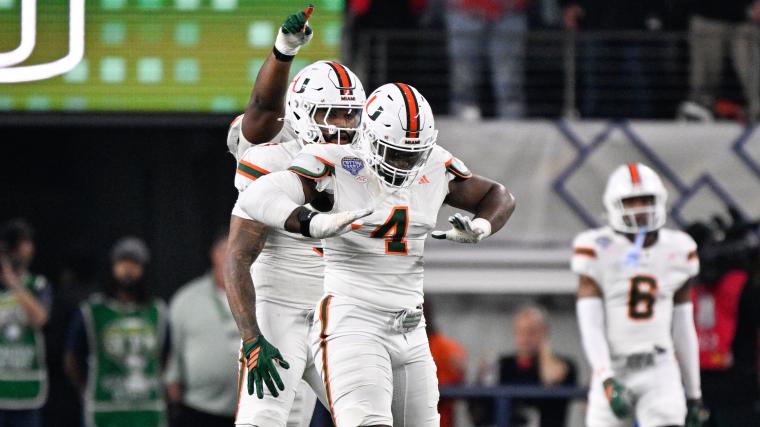
POLICY WIRE — Miami, USA — It isn’t merely about gridiron glory, not anymore. At its core, the annual National Football League Draft has transmuted into a global human futures market, where collegiate athletes, barely beyond adolescence, are parsed, projected, and ultimately purchased as speculative assets. And few institutions are churning out more high-yield prospects for this high-stakes exchange than the University of Miami, which, whispers suggest, could see an astonishing fifteen of its players called in the 2026 NFL Draft.
This isn’t merely a boast; it’s a policy statement, a declaration of a talent pipeline operating at peak efficiency. Head Coach Mario Cristobal, the architect of this impending deluge, isn’t just coaching football; he’s managing a complex portfolio of human capital. He posited, with characteristic gravitas, “We’re not just building football players here; we’re cultivating future leaders, professionals. Their success on Sunday reflects years of dedication—theirs, and ours.” It’s a noble sentiment, of course, but beneath the veneer of collegiate idealism lies an increasingly ruthless economic reality.
Consider the prime commodities: Francis "Sisi" Mauigoa, an offensive tackle of prodigious size and skill, whose "top 5" projection places him squarely in the realm of generational talents, commanding a salary commensurate with a small nation’s GDP. Rueben Bain Jr., a defensive end whose explosive production would typically ensure a top-ten slot, now contends with the whispered critique of "short arms," a micro-defect in an otherwise monumental talent, perhaps shaving millions from his eventual contract. It’s the brutal calculus of talent, where inches — and milliseconds delineate fortunes.
Beyond these marquee names, the depth chart reads like a prospectus of promising ventures. Akheem Mesidor, Keionte Scott, Markel Bell—each represents a different tier of investment, their "stock" fluctuating with every combine drill and media pundit’s prognostication. Carson Beck and CJ Daniels, quarterback and wide receiver respectively, are late-stage risers, their profiles suddenly deemed more "liquid" by scouts after impressive seasons. Even deep sleepers like Samson Okunlola — and Raul Aguirre Jr. carry latent value, a "call option" on undeveloped potential. It&s a volatile scene.
But what does it truly signify? An anonymous NFL General Manager, whose organization will soon be sifting through this very crop, offered a starker perspective: “Every draft pick is a calculated wager, isn’t it? You’re betting on potential, mitigating injury risk, — and hoping your evaluation trumps everyone else’s. Miami, they’re certainly giving us plenty of chips to play with this year.” His words underscore the inherent uncertainty, the speculative nature of this enterprise, where raw ability is scrutinized through a filter of durability, character, and market demand.
This fervent pursuit of athletic excellence, with its attendant economic uplift, isn’t unique to American shores. Across the globe, from the English Premier League to Pakistan’s Super League in cricket, elite sports serve as potent engines for individual and communal advancement. Just as a promising fast bowler in Lahore can capture the fervent hopes and economic aspirations of a nation, elevating entire communities through his success, these American collegiate athletes become ephemeral projections of immense wealth and influence. Their potential futures, much like futures contracts on commodities, are traded sight unseen, bridging cultural divides through the universal appeal of human achievement and financial reward. The spectacle, after all, is just the surface.
📄 POLICY WIRE WHITEPAPER PUBLISHED: PAKISTAN'S NATIONAL SECURITY POLICY PRIORITIES
👉 READ BY CLICKING HEREIndeed, the odds are stacked: only about 1.6% of NCAA football players ever make it to the NFL, according to the NCAA’s own data, a stark reminder of the selectivity, of how many hopes are dashed for every triumph. This makes Miami’s projected output not just impressive, but statistically anomalous, a testament to a program that has mastered the art of player development—or perhaps, more accurately, player monetization.
What This Means
Behind the headlines of draft day jubilation, a more complex narrative unfolds. The anticipated exodus of Miami talent isn’t just a win for the school; it reflects the profound financialization of college athletics. These young men are no longer just students playing a game; they’re increasingly perceived as raw materials, processed and polished for the professional marketplace. The Name, Image, and Likeness (NIL) era has only accelerated this, transforming amateurism into a quasi-professional proving ground where personal brands are cultivated long before a professional contract is signed.
This phenomenon casts collegiate programs like Miami’s as de facto minor leagues, albeit ones with significant academic trappings. The university benefits immensely from the prestige, recruitment advantages, and public attention these prospects generate. And their coaches, like Cristobal, become kingmakers, their reputations inextricably linked to their ability to shepherd raw talent into lucrative professional careers. This model, while lucrative, also raises questions about player welfare, the immense pressure placed on young athletes, and the true cost of chasing such aspirational success. It’s a system that, for all its glitter, operates on the brutal calculus of talent, where every dream has a price tag, often paid years before it’s collected. It’s truly Valhalla’s Velocity, yet with very real, human consequences.