


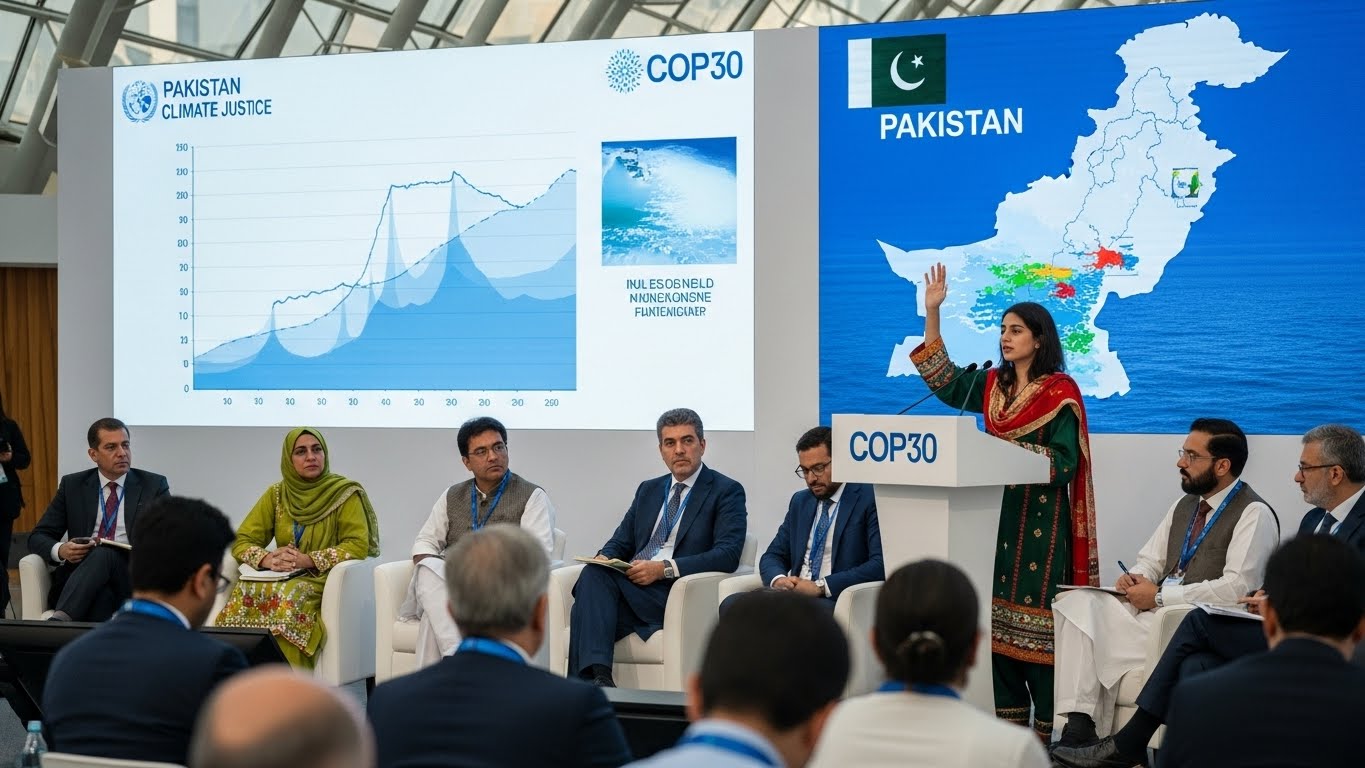
Pakistan’s Climate Justice Debate at COP30
At COP30 in Belém, Brazil, Pakistan once again emerged as a moral compass for climate-vulnerable nations, reminding the world that the countries least responsible for global warming are the ones...

At COP30 in Belém, Brazil, Pakistan once again emerged as a moral compass for climate-vulnerable nations, reminding the world that the countries least responsible for global warming are the ones drowning, burning, and breaking under its weight. Despite contributing less than 1% to global greenhouse gas emissions, Pakistan demanded what it has long been denied: predictable, grant-based climate financing for nations that did not create this crisis yet live through its worst consequences every year.
The call was delivered at a high-level side event—“Operationalising Loss and Damage: Financing Resilience and Recovery in Vulnerable Countries”—co-hosted by Pakistan’s Ministry of Climate Change and UNICEF. It was a moment that showcased both Pakistan’s leadership in global climate diplomacy and the unjust burden crushing countries that are trapped between disaster and debt.
A Low-Emitting Nation Bearing a Global Burden
Climate Change Secretary Aisha Humera Moriani reminded delegates of a truth that should shame the world: Pakistan’s emissions are negligible, but its suffering is immense. The 2022 super floods engraved this injustice into global memory:
- 33 million people affected
- 2 million homes destroyed
- 26,000+ schools damaged
- Over $30 billion in losses
Then came the 2025 floods, hitting districts still struggling to rebuild. These were not “acts of God”—they were acts of global emissions, accumulated over decades by wealthier nations.
Moriani emphasised that Pakistan is investing heavily in resilience, but no developing country—already carrying economic strain—can rebuild from catastrophe after catastrophe alone. “The disasters we face reflect global emissions, not Pakistan’s,” she declared, urging climate justice based on responsibility, not charity.
Debt Grows While Support Lags Behind
A central message at COP30 was stark: climate-vulnerable countries are drowning not only in floods, but in debt. More than half are already in debt distress. Pakistan, too, is forced to redirect money meant for schools, hospitals, and development into emergency relief and reconstruction.
Despite these realities, most financial support arrives slowly—and as loans. For Pakistan, taking loans to recover from disasters it did not create is not just unaffordable; it is unethical. Speakers insisted that the Loss and Damage fund must deliver grants, fast approvals, and easy access—otherwise the world will be offering sympathy where justice is needed.
Children at the Frontline of the Crisis
With nearly half its population under 18, Pakistan’s children are the silent victims of climate injustice. UNICEF highlighted the staggering human cost:
- 10 million children required urgent support in 2022
- Outbreaks of waterborne diseases spread across submerged districts
- Millions faced interrupted education
“These disasters are not just breaking infrastructure; they are breaking opportunities for our children,” Moriani warned. The future of an entire generation is being reshaped by climate shocks they had no role in causing.
Simplifying Access: The Real Test of Global Intent
Pakistan strongly supported the Barbados Implementation Modalities (BIM), calling them essential for ensuring climate finance actually reaches those who need it. If countries must navigate years of bureaucracy while their citizens struggle to rebuild, the very purpose of Loss and Damage financing collapses.
📄 POLICY WIRE WHITEPAPER PUBLISHED: PAKISTAN'S NATIONAL SECURITY POLICY PRIORITIES
👉 READ BY CLICKING HEREBIM emphasises:
- Rapid approval processes
- Easy paperwork for countries with limited administrative capacity
- Flexible funding for both sudden disasters and slow-moving climate impacts
For Pakistan, these are not procedural upgrades—they are lifelines.
Addressing Invisible Losses That the World Ignores
Ministry spokesperson Muhammad Saleem Shaikh highlighted a neglected dimension of climate damage: non-economic losses. These include psychological trauma, displacement, cultural destruction, and the fragmentation of communities.
Entire villages washed away in 2022; cultural heritage sites vanished; families who lived on ancestral land for centuries were uprooted. Pakistan urged the global community to acknowledge and fund recovery for these human, cultural, and emotional losses.
Pakistan Submits Proposals for Rebuilding and Resilience
Pakistan also announced its readiness to submit two projects under the Fund for Responding to Loss and Damage (FRLD), focusing on rebuilding essential social infrastructure and strengthening climate resilience—especially in agriculture and water security. While Pakistan continues investing in early warning systems, wetlands restoration, and climate-resilient infrastructure, officials stressed that domestic resources alone cannot match global-scale climate destruction.
A Firm Call for Climate Justice
Pakistan reiterated that climate finance is a matter of justice, not goodwill. The principle of Common but Differentiated Responsibilities (CBDR-RC) remains central. “Climate justice demands immediate access. Our people cannot wait,” the ministry stressed.
Pakistan’s message at COP30 was clear and unyielding:
Those who fueled the climate crisis must help rebuild the nations now paying its price.
Author