
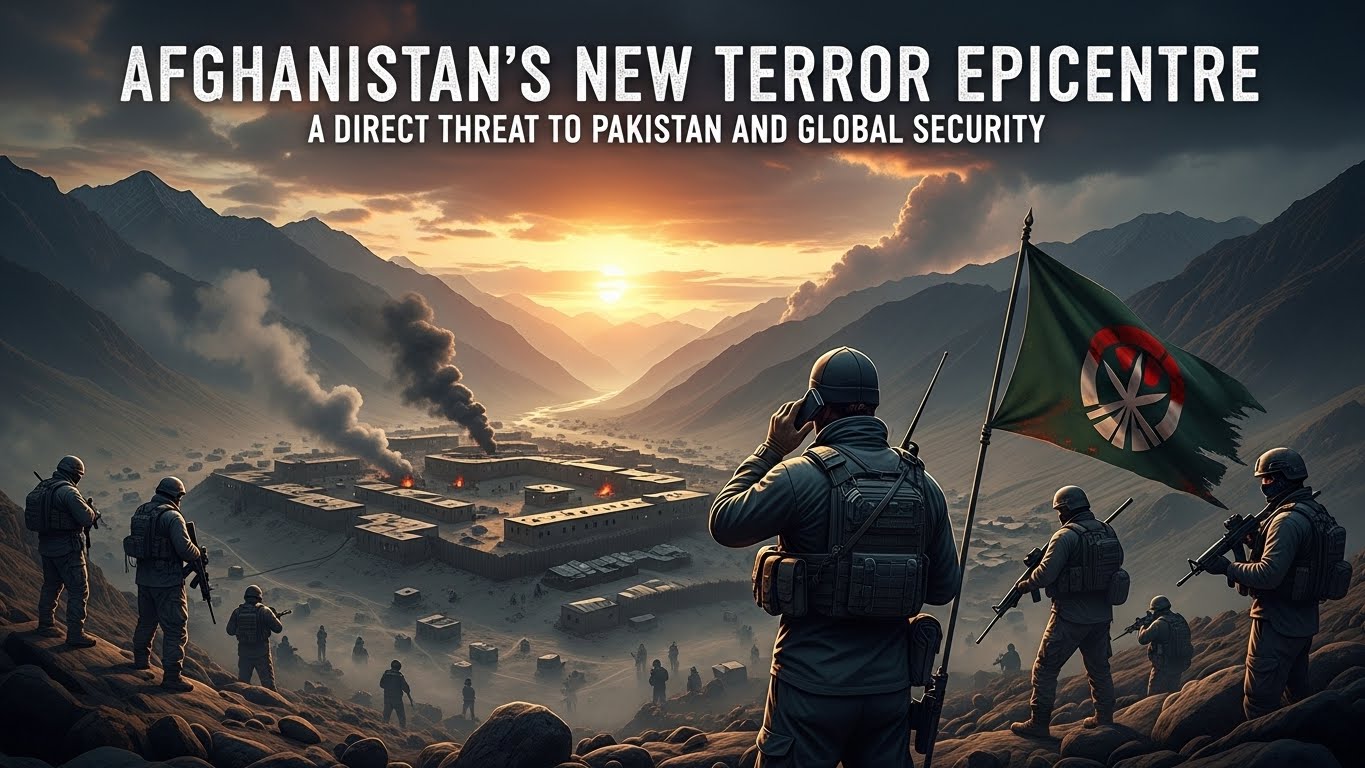
In 2020, the Taliban signed the Doha Agreement with the international community. In that agreement, they promised that Afghan soil would not be used for terrorism and that they would help reduce violence. The world hoped these commitments would bring peace and stability to the region. However, these promises have not been fulfilled. Instead of stopping extremism, Afghanistan has turned into the world’s biggest centre of violent terrorism. This is a direct threat to Pakistan and to global peace.
Doha Commitments That Were Not Fulfilled
The Doha Agreement was expected to encourage peace and responsible behaviour from those controlling Afghanistan. But after coming into power, the Taliban regime did not take action against terrorist organisations operating inside the country. Groups such as Al Qaeda, ETIM, IMU, ISIS-K, and especially Fitna al Khawarij (FAK) have expanded their activities. They have new bases, new fighters, and more freedom than ever before.
The Taliban regime has not shown real effort to control or eliminate these groups. There is no serious monitoring or cooperation with the international community. Because of this, Afghanistan has once again become a safe haven for terrorists to train, plan, and launch attacks.
Afghanistan as the Largest Hub of Extremist Violence
Today, Afghanistan has more active terrorist organisations than any other country in the world. Several United Nations reports confirm this reality. The withdrawal of international forces and the Taliban regime’s close links with many extremist groups have created a dangerous environment. Terror training camps are running, propaganda is being spread openly, and foreign terrorists have returned to Afghan regions. Many young people are being radicalised through online videos and extremist teachings.
This situation affects the whole world. A terrorist network of this size is not only a danger to Pakistan or South Asia. It can easily expand to Central Asia, the Middle East, Africa, Europe, and beyond. World history has shown that when extremist safe havens are allowed to grow, they eventually cause global tragedies.
Pakistan as the Biggest Victim
Pakistan is suffering the most from the rise of terrorism inside Afghanistan. Pakistan has always supported peace, dialogue, and stability in the region. It helped Afghanistan through humanitarian support, trade, and political engagement. But in return, Pakistan is now facing a new wave of cross-border terrorism. Terrorists enter Pakistan from Afghan territory, carry out attacks, and escape back into Afghanistan.
The human cost is extremely painful. From 2021 to 2025, more than 5,000 Pakistanis were martyred or injured, including civilians, soldiers, police personnel, and CTD officials. Almost 80 percent of these attacks were linked to Fitna al Khawarij (FAK) networks based inside Afghanistan.
This clearly shows that these threats are not random. They are planned, organised, and supported by terrorist structures operating freely across the border.
Fitna al Khawarij (FAK) Under Taliban Regime Protection
United Nations reports confirm that nearly 6,000 members of Fitna al Khawarij (FAK) are living inside Afghanistan. They are not hiding. They operate openly with full freedom of movement. According to the reports, the Taliban regime provides them safe areas, training facilities, weapons, and even financial assistance.
Because of this protection, FAK has become the biggest terrorist group inside Afghanistan. They work under the umbrella of the Taliban regime and openly support extremist causes. They run online campaigns, recruit new terrorists, and plan cross-border attacks against Pakistan. Their main leaders live comfortably in Afghan provinces like Kunar, Khost, Nuristan, Paktika, and Kandahar. This support has made FAK stronger, more confident, and more dangerous.
Rising Threats and New Terror Units
The threat continues to grow. Fitna al Khawarij (FAK) has not only increased its numbers but also formed new units, including specialised suicide bombing groups. This was visible in the attack on the Islamabad High Court and several other recent incidents.
📄 POLICY WIRE WHITEPAPER PUBLISHED: PAKISTAN'S NATIONAL SECURITY POLICY PRIORITIES
👉 READ BY CLICKING HERETaliban regime-aligned factions and FAK leaders issue open threats against Pakistan. They use social media and online channels to radicalise youth and glorify terrorism. Their messaging encourages violence, rebellion, and hatred against Pakistan. These activities show that these groups are preparing for long-term conflict and expansion.
Pakistan’s Clear and Firm Demands
Pakistan has formally demanded that the Taliban regime dismantle all networks of Fitna al Khawarij (FAK) and the BLA that are operating from Afghan territory. Pakistan expects the Taliban regime to shut down training sites, remove their leadership, cut off their funding, and stop them from launching attacks into Pakistan.
These demands are based on security, justice, and international law. No country in the world can allow terrorists from a neighbouring state to repeatedly kill its soldiers and civilians. Pakistan has shown patience, shared intelligence, and raised concerns many times. But the attacks continue. Pakistan has now informed global partners that the threat from Afghanistan is increasing rapidly and must be addressed urgently.
A Global Security Challenge
The world must understand that this problem is not limited to Pakistan. A country that becomes a sanctuary for dozens of terrorist groups becomes a danger for everyone. Terrorists trained in Afghanistan can easily travel to other regions. They can influence people online and inspire attacks far from South Asia. They can destabilise whole regions if not stopped in time.
Ignoring this situation would be a major mistake. The world made a similar mistake before 9/11 when it overlooked the rising extremist environment in Afghanistan. The cost of that mistake was huge. The cost of ignoring today’s threat may be even higher.
Conclusion
Afghanistan today stands at a turning point. Instead of honouring their promises made in the Doha Agreement, the Taliban regime has allowed extremist groups to grow stronger. Pakistan is the biggest victim of this situation. Thousands of lives have been lost because of terrorist attacks supported by safe havens inside Afghanistan. Fitna al Khawarij (FAK), protected and facilitated by the Taliban regime, has become the largest terror group in the country.
The world must take this threat seriously. Strong international pressure, joint regional action, and strict monitoring are urgently needed. Afghanistan cannot be allowed to remain a centre of terrorism. If this rising threat is not stopped now, it will soon become a danger not only for Pakistan but for the entire world.
Author