

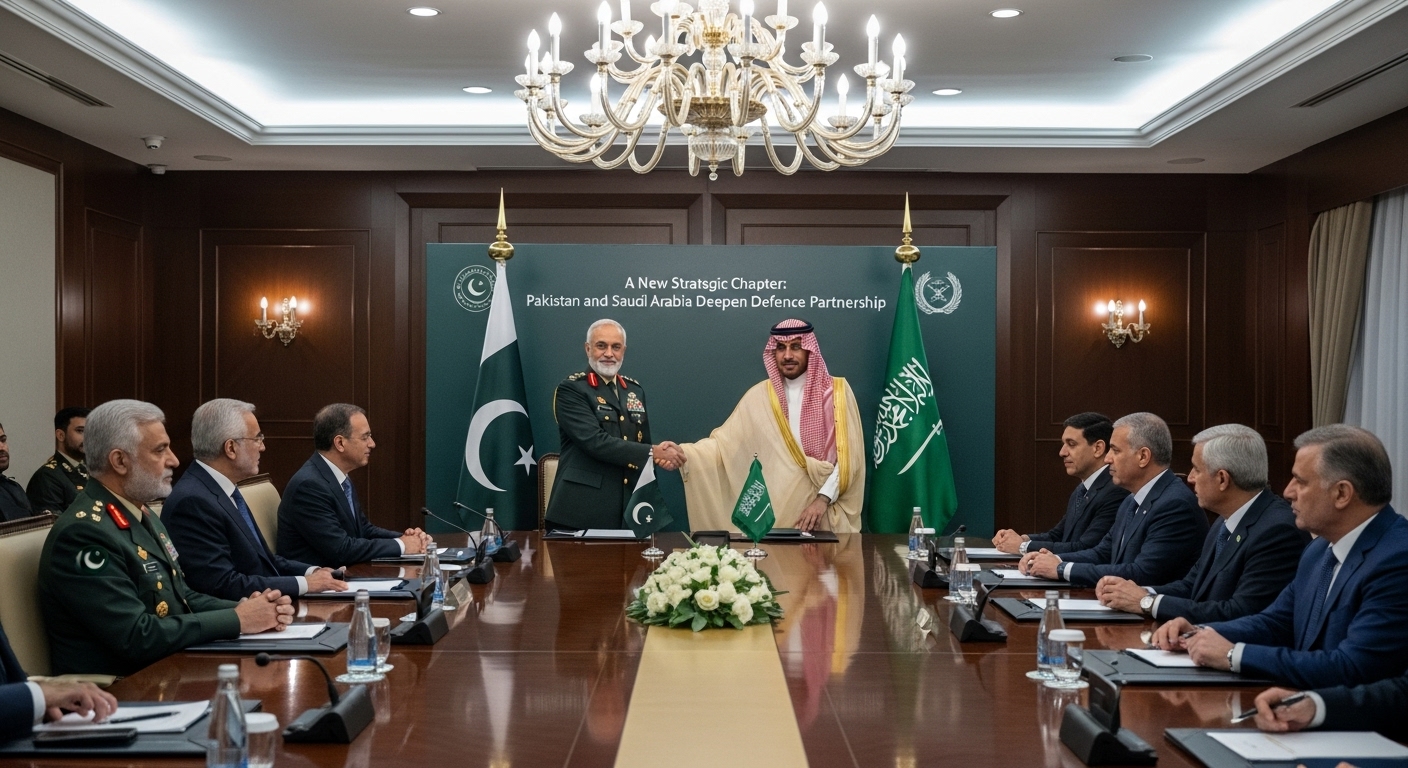
A New Strategic Chapter: Pakistan and Saudi Arabia Deepen Defence Partnership
On 24 November 2025, Pakistan and Saudi Arabia reaffirmed their resolve to deepen their long-standing military partnership. At GHQ Rawalpindi, Pakistan’s Army Chief, Field Marshal Asim Munir, hosted...
On 24 November 2025, Pakistan and Saudi Arabia reaffirmed their resolve to deepen their long-standing military partnership. At GHQ Rawalpindi, Pakistan’s Army Chief, Field Marshal Asim Munir, hosted General Fayyadh bin Hameed Al Rowaili, Chief of General Staff of the Saudi Armed Forces, for high-level talks on defence cooperation, counter-terrorism, and regional security.
This engagement is part of the broader effort to operationalize the landmark Strategic Mutual Defence Agreement (SMDA), signed in Riyadh on 17 September 2025. The pact stipulates that any act of aggression against one state will be treated as aggression against both, establishing a formal collective-security framework unprecedented in Pakistan–Saudi ties.
Rooted in History, Aimed at the Future
The SMDA is not an abrupt shift but the formalization of decades of military cooperation. Pakistan has long contributed training, advisory expertise, and operational support to Saudi Arabia, building a deep reservoir of trust. The timing of the agreement is critical: with changing geopolitical alignments in the Middle East and rising security challenges, both states are seeking stable, dependable defence partners. The SMDA provides exactly that.
From Agreement to Action: The 24 November Meeting
According to Pakistan Today, senior Pakistani officials—including Prime Minister Shehbaz Sharif, Defence Minister Khawaja Asif, and the Army Chief—met General Al Rowaili to chart a concrete roadmap for implementing the SMDA.
Both sides agreed to expand joint military training, intensify exercises, and enhance professional exchanges. Prime Minister Sharif called the SMDA a “milestone,” highlighting that Pakistan and Saudi Arabia share not only strategic interests but also deep religious and cultural ties. General Al Rowaili reaffirmed Riyadh’s commitment to elevating defence cooperation, calling the partnership “very strategic.”
Why This Matters: Strategic and Security Gains
1. Reinforcing Regional Deterrence
The SMDA provides a formal mechanism for collective defence, signalling a powerful deterrent to external threats. For both states, it strengthens strategic credibility and showcases a willingness to stand by one another during crises.
2. Counter-Terrorism Cooperation
Counter-terror coordination remains a central pillar. With Pakistan’s extensive counter-insurgency experience and Saudi Arabia’s struggle against extremist ideologies, deeper cooperation promises significant gains. The November meeting reaffirmed joint efforts to combat terrorism at the operational and intelligence levels.
3. Strengthening Conventional Defence Ties
Defence Minister Khawaja Asif emphasized Pakistan’s battlefield readiness, underscoring that the SMDA reflects confidence in Pakistan’s military capacity. Joint drills, training, and expanded coordination signal a more integrated defence posture. Analysts note that Pakistan’s strong conventional capabilities strengthen the Gulf region’s security architecture.
4. Economic and Institutional Spillovers
The defence pact has triggered a broader deepening of ties. After the SMDA, Pakistan established an 18-member high-level committee for economic talks with Riyadh—demonstrating that the relationship is transitioning from financial aid to strategic investment in energy, infrastructure, labour, and technology. Saudi capital could play a pivotal role in Pakistan’s economic resilience.
📄 POLICY WIRE WHITEPAPER PUBLISHED: PAKISTAN'S NATIONAL SECURITY POLICY PRIORITIES
👉 READ BY CLICKING HEREA Blueprint for Islamic Solidarity
Some analysts see the SMDA as a potential model for defence cooperation across the Muslim world. By institutionalizing mutual security commitments, Pakistan and Saudi Arabia are pioneering a framework for collective defence rooted in shared values, strategic need, and political trust.
In an era of shifting alliances and uncertain great-power guarantees, such indigenous security frameworks could become increasingly important for Muslim-majority states.
A Strategic Win for Both Nations
The 24 November 2025 meetings in Rawalpindi demonstrate that Pakistan and Saudi Arabia are moving beyond symbolic cooperation toward an operational, meaningful defence partnership. With expanded training, increased counter-terror coordination, and institutionalized deterrence, both countries stand to gain significantly.
For Pakistan, the pact enhances regional influence and leverages its military expertise. For Saudi Arabia, it provides a reliable and experienced security partner rooted in faith and long-term partnership.
If successfully implemented, the SMDA could evolve into more than a bilateral defence pact—it could become a cornerstone of collective security in the Islamic world, built on mutual trust, shared history, and strategic resolve.
Author