

Pakistan’s Deadly Floods Amid Climate Crisis
The year, 2025 has proved that the climate crisis is not something that threatens us in the future. It is an everyday truth playing itself out across continents, destroying lives and economies with...

The year, 2025 has proved that the climate crisis is not something that threatens us in the future. It is an everyday truth playing itself out across continents, destroying lives and economies with impunity. Southern Europe was stunned by a blistering heatwave in June and July that killed over 2,300 people in Italy, Spain, and France. Forests were burning out of control, with over 400,000 hectares of land lost and tens of thousands displaced. In America, the first half of the year recorded 15 distinct billion-dollar catastrophes. California was smothered by wildfires, the East Coast pounded by storms, and the Midwest flooded out as emergency services were overwhelmed.
Asia too has taken the hit of climate extremes. In India and Bangladesh, monsoon floods displaced millions while damaging fragile infrastructure. Typhoons in Vietnam and the Philippines destroyed crops and transport networks, while landslides and record rainstorms in Japan affected tens of thousands of people. Climate disasters have become global and indiscriminate, demonstrating no nation is exempt, regardless of wealth or prosperity.
Pakistan contributes less than one percent of total greenhouse gas emissions or climate pollution in the world, although it is in the top ten of climate-vulnerable countries. Its vulnerability does not lie in the emissions but instead lies regionally. Pakistan occupies a climatic location where nearly all vulnerable ecosystems converge, glacier-fed mountain ranges to the north, fertile plains of the Indus basin, the deserts of Sindh and Balochistan, and a long Arabian Sea coastline.
This climatic diversity, once an advantage, is now a curse under changing climate systems. The melting glaciers in Gilgit-Baltistan are responsible for outburst floods when the melt exceeds masses of ice. The deserts suffer from recurring droughts and dangerous heat waves. The plains of the Indus basin become affected by unpredictable monsoonal rain. The cities of Karachi and Gwadar prepare for rising oceans and cyclone threats. Few countries suffer from so many climate vulnerabilities at one time, yet this is the common burden Pakistan suffers today.
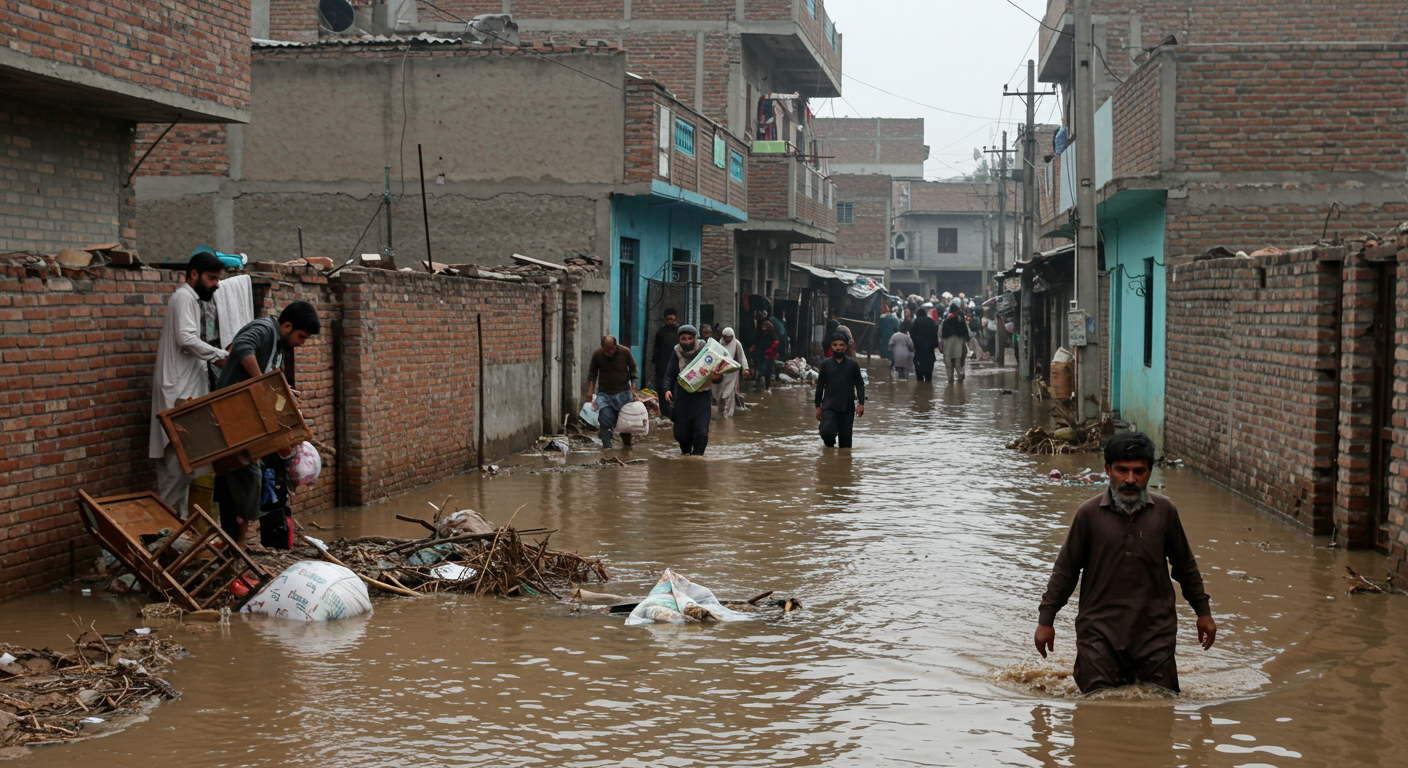
The floods of 2025 clearly demonstrate this vulnerability, with more than 650 dead since late June. Khyber Pakhtunkhwa has been the worst affected from August 15, after cloudbursts and flash floods hit Swat, Bajaur, Buner, Shangla, and Mansehra. Whole families were buried alive in villages, where walls of mud and walls of water washed away homes. Thousands were displaced with nothing more than the clothes they wore. Others are still looking for family members who are missing. This devastation is not an isolated disaster, rather it is a manifestation of a dangerous new normal. Weather events that were once considered rare are now occurring more frequently and are in almost every case becoming bigger. Displaced communities barely have time to recover before facing another catastrophic event.
The state has acted with urgency. Chief Minister Ali Amin Gandapur guaranteed aid for survivors, pledged reconstruction of schools, hospitals, and roads, and announced relocation of households from high-risk flood areas to safer settlements. Relief camps supply food, water, and medical care, while engineers restore basic services. Authorities emphasized that the scale of the disaster was the result of extraordinary climate extremes, showing that this struggle cannot be won by the state alone. Resilience depends on solidarity. Communities that build awareness, stay prepared, and adopt climate-resilient practices can save lives. Too often tragedies are worsened because preparedness is weak or collective action is missing. When people stand shoulder to shoulder with their government, losses can be reduced and recovery expedited.
📄 POLICY WIRE WHITEPAPER PUBLISHED: PAKISTAN'S NATIONAL SECURITY POLICY PRIORITIES
👉 READ BY CLICKING HEREPakistan’s survival will depend on how fast it adapts. Flood-prone areas need resilient housing, robust forecasting, and better water management in deserts and floodplains. Cities must be redesigned to cope with cloudbursts, while rural areas require heat and water-resistant farming practices. Equally, Pakistan’s suffering underscores international climate justice. The country has contributed very little to emissions, yet it faces some of the worst consequences. The world has an obligation to fund adaptation for nations like Pakistan that are reaping what they did not sow.
The floods of 2025 are a number of things, both a tragedy and a portent. They show that the climate crisis is not an issue that we will tackle someday when we find the time. The climate crisis is an urgent fight for survival. For Pakistan, a couple of significant takeaways included the following: first, geography has placed Pakistan on the front lines; and secondly, resilience comes from solidarity. If the state and society manage to adapt and respond collectively, the people of Pakistan will weather the strongest storms. While climate disasters may be inevitable, the dying is not. Pakistan’s current predicament is representative of humanity’s shared struggle against an enemy that has no borders
Author