

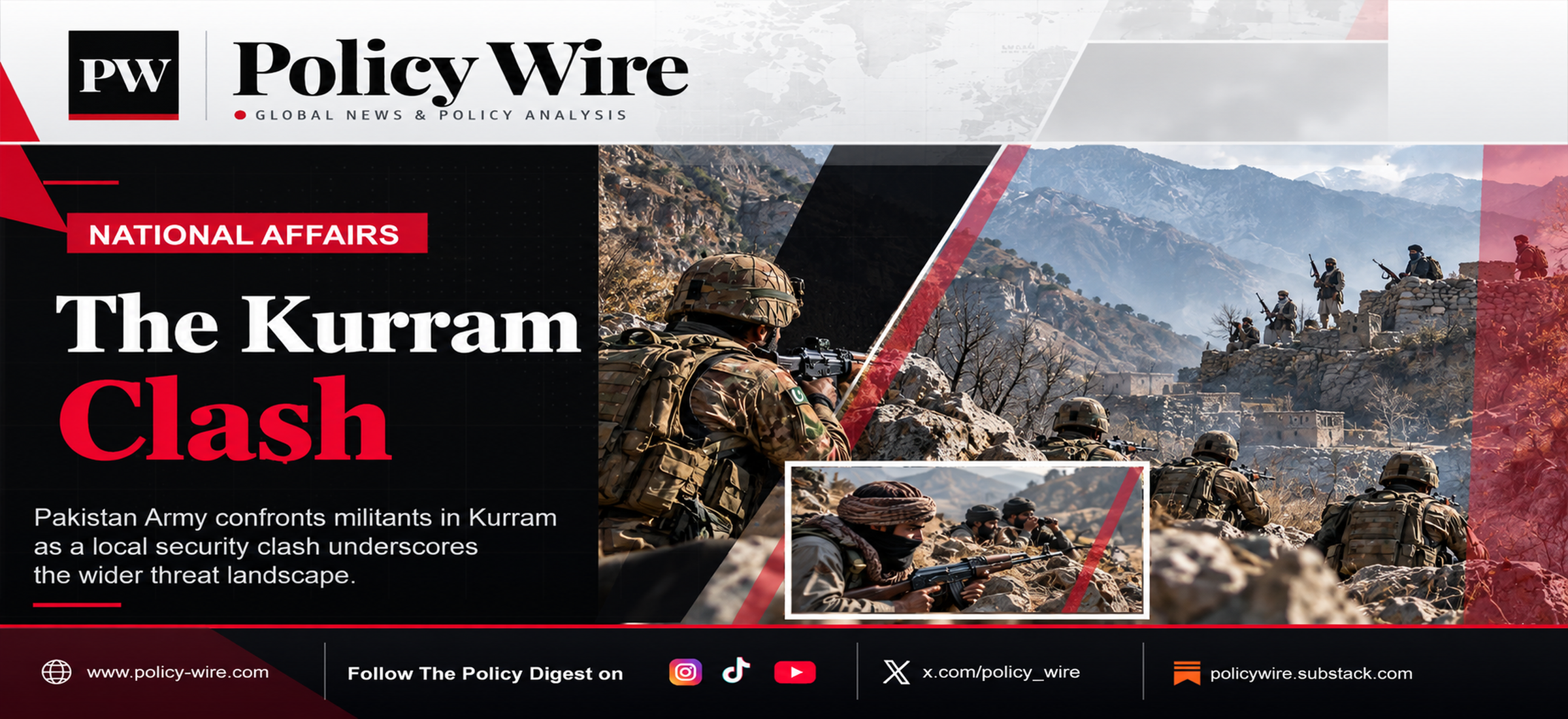
The reported killing of 12 militants on the Kurram frontier is the latest episode in a confrontation that a year of strikes, ceasefires and mediation has failed to settle.
On the evening of Saturday, 10 October, Pakistani troops on the Kurram frontier detected a group of armed men moving towards the border from the Afghan side. What followed, according to Pakistan’s military, was an infiltration attempt broken up by fire, an exchange with Afghan Taliban border posts, and a death toll of 12 on the other side. One Pakistani soldier, Naib Subedar Hidayat Aman, a 40-year-old from Ghizer district, was killed.
The account came the next day in a statement from Inter-Services Public Relations (ISPR), the military’s media wing. It identified the group as members of the Tehreek-e-Taliban Pakistan (TTP) and said Afghan Taliban posts had opened fire to support their crossing. The 12 dead, the statement said, included both TTP fighters and Afghan Taliban personnel, without specifying how many of each. A clearance operation continued in the area.
On its own, the clash is one more entry in a long ledger of border incidents. Set against the past year, it reads differently. Pakistan and Afghanistan’s Taliban government have moved from diplomatic complaint to air strikes, ground battles, a declaration of “open war”, Chinese mediation and back to strikes again. Kurram is where that unresolved confrontation surfaced this week. It will not be the last place it does.
One account, many open questions
The immediate facts of the Kurram clash rest largely on the Pakistani military’s statement. The Afghan Taliban authorities had not publicly responded to it in the reports reviewed for this article, and no independent source has yet verified the casualty figures or the sequence of events.
The most consequential claim is the one hardest to test. Pakistan alleges an attempted militant crossing and also active fire support from Afghan Taliban border personnel. If substantiated, that second allegation would turn a counterterrorism engagement into a direct military exchange between two governments’ forces. It would also lend weight to Islamabad’s broader charge that the TTP operates from Afghan territory with the protection of the authorities there. The ISPR statement drew that conclusion explicitly, describing the incident as further proof of the Taliban government’s failure to meet its counterterrorism obligations.
Several questions remain open. Was this a deliberate crossing attempt under covering fire, or an exchange that widened once shooting began? How many of the dead were TTP fighters and how many were Afghan border personnel? And what does Kabul say happened? Until those are answered, the incident is best understood as an allegation with serious implications rather than an established fact.
Why Kurram
Kurram is no ordinary stretch of frontier. The district juts into Afghanistan, bordered on three sides by the provinces of Nangarhar, Paktia and Khost, and its northern reaches around Parachinar sit closer to Kabul than almost anywhere else in Pakistan. That geography has made it a corridor for movement in both directions for decades, and a natural pressure point whenever relations between the two capitals sour.
The district is also fragile in its own right. Kurram has a long history of sectarian violence between its Sunni and Shia communities. In November 2024, an attack on a passenger convoy near Parachinar killed more than 40 people and set off clashes and a road closure that left parts of the district cut off for months. A border that carries militant traffic runs through a population already under strain, and instability on one side of that line feeds instability on the other.
The 10 October clash was not the district’s first this autumn. On 23 September, security sources said troops had foiled another infiltration attempt in the Kurram sector, after which Afghan Taliban forces fired on Pakistani posts with heavy weapons and mortars and Pakistani artillery responded. The pattern of an attempted crossing followed by an exchange between border forces has now repeated within three weeks.
The pressure is not confined to the border. Pakistan recorded its highest monthly number of militant attacks in 12 years in September 2026, a figure that explains why Islamabad treats every attempted crossing as part of a wider campaign.
A year of escalation
The Kurram clash sits at the end of a year in which the confrontation repeatedly broke through every attempt to contain it. In October 2025, Pakistani air strikes on suspected militant bases in Afghanistan triggered retaliatory attacks and the worst fighting between the two in years. Talks facilitated by Qatar and Turkey produced a ceasefire, and Saudi-hosted talks followed, but no settlement.
The ceasefire collapsed in February 2026. After a series of deadly attacks inside Pakistan, Pakistani aircraft struck what Islamabad described as TTP and Islamic State camps in eastern Afghanistan. Taliban forces attacked Pakistani border posts on 26 February, Pakistan struck targets in Kabul, Kandahar and Paktia, and Defence Minister Khawaja Asif declared the situation “open war”. The campaign that followed, which Pakistan named Operation Ghazab lil Haq, included the 16 March strike on a drug rehabilitation hospital in Kabul, where the UN mission later recorded at least 269 people killed. Pakistan denied targeting any civilian facility.
China stepped in. Informal trilateral talks in Urumqi from 1 to 7 April produced an agreement to keep talking and a shared description of terrorism as the core issue between the two neighbours. They did not produce a mechanism to address it.
By September, the strikes had resumed. Pakistani raids hit Kunar and Paktika on 21 September and Kandahar, Paktia and Khost three days later. On the night of 30 September, strikes in Kunar and Helmand killed at least 10 civilians, most of them children, according to the UN mission in Afghanistan. Pakistan’s information ministry said the strikes had hit militant hideouts and killed 22 militants. UNAMA had already documented more than 1,100 civilian deaths and injuries in Afghanistan from cross-border violence this year.
Each episode has produced competing accounts. Pakistan reports militants killed; the Taliban report civilians killed; the UN confirms some of the civilian toll and calls for restraint. Without a shared account of events, every strike and every border clash hardens the positions on both sides.
Sanctuary against sovereignty
Beneath the incidents lies a single dispute that neither side has found a way to resolve. Pakistan holds that the TTP plans and launches attacks from Afghan territory with the support of elements within the Taliban government, and that any lasting settlement requires concrete, verifiable action against the group. The Taliban reject the charge, insist their territory threatens no one, and describe Pakistan’s insecurity as an internal matter.
The UN’s monitoring of the Taliban sanctions regime gives Islamabad’s position considerable support. The Security Council’s Monitoring Team, in a report covering December 2025 to June 2026, found that continued Taliban support for the TTP had contributed to more frequent and lethal attacks in Pakistan, while noting some initial steps by Kabul to restrain the group.
For Kabul, the issue is sovereignty. Every Pakistani strike inside Afghanistan, and especially every strike that kills civilians, allows the Taliban to recast the dispute as one of foreign aggression rather than its own conduct towards militant groups on its soil. The September and October strikes drew condemnation from the Taliban and from former president Hamid Karzai alike, uniting Afghans who agree on little else.
The two positions feed each other. Pakistan escalates because it sees no other way to change the Taliban’s behaviour. The Taliban resist because escalation lets them frame resistance as national defence. The border, where TTP fighters, Afghan border forces and Pakistani troops all operate within range of one another, is where that logic turns into gunfire.
What would break the cycle
The past year has shown what does not work on its own. Military pressure has imposed costs on militant networks without changing the conditions that sustain them. Ceasefires have paused fighting without addressing its cause. Mediation by Qatar, Turkey, Saudi Arabia and China has kept channels open without producing commitments either side can verify.
A more durable arrangement would need to address the problem the Kurram clash exposes most clearly: the absence of any agreed way to establish what happened on the border. Joint or third-party verification of serious incidents, functioning hotlines between border commanders, and a monitoring mechanism for commitments on militant activity would not resolve the underlying dispute. They would, however, reduce the chance that each contested incident becomes the trigger for the next round. The Urumqi process, which both sides have described as substantive, is the obvious place to build them.
The killing of 12 militants, as reported by Pakistan’s military, may close one episode of fighting in Kurram. It leaves open the question at the heart of the crisis: whether Islamabad and the Taliban authorities can build a workable arrangement to stop militant violence from repeatedly drawing their forces into confrontation. Until they do, the border will keep flaring, and Kurram will keep marking where.
Author