


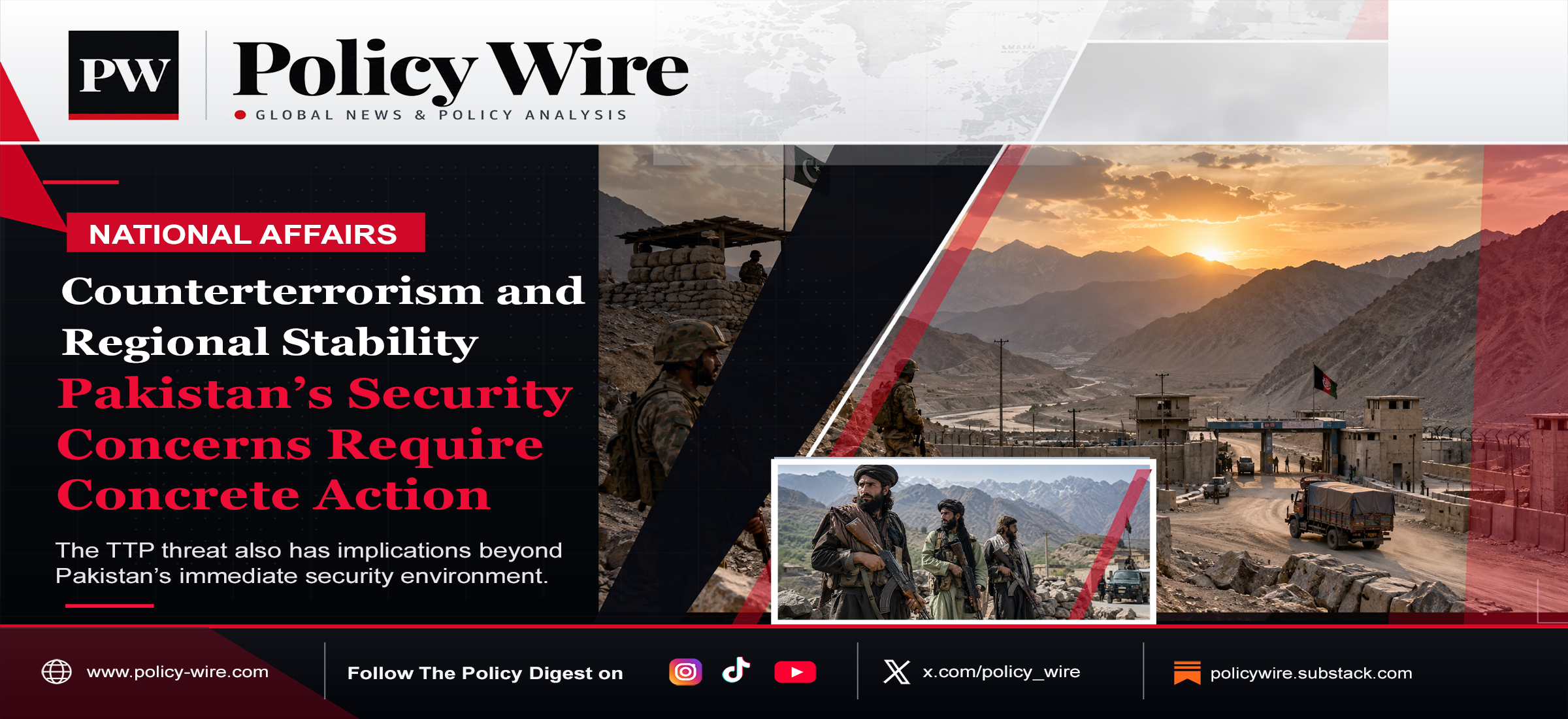
Counterterrorism and Regional Stability: Pakistan’s Security Concerns Require Concrete Action
Durable Pakistan-Afghanistan relations require verifiable counterterrorism measures against cross-border militant sanctuaries and operational networks.

POLICY WIRE — The security of a country cannot be separated from the conditions prevailing beyond its borders. When armed groups exploit neighbouring territory to organise attacks, the resulting threat becomes a matter of national security, bilateral responsibility and regional stability. For Pakistan, the persistent threat posed by the Tehreek-e-Taliban Pakistan (TTP) has made effective counterterrorism cooperation with Afghanistan an urgent necessity.
Pakistan’s position is based on a clear principle: Afghan territory must not be used to plan, facilitate or launch terrorist attacks against Pakistan. Deputy Prime Minister and Foreign Minister Ishaq Dar reiterated this position on 12 October 2026, calling on the Afghan authorities to take concrete, verifiable and irreversible action against the TTP and other terrorist groups. This is not simply a diplomatic demand. It reflects Pakistan’s responsibility to protect its citizens, security personnel and territorial integrity through official diplomatic channels.
Bridging Assurances and Verifiable Action
The central issue in Pakistan-Afghanistan relations is therefore not the exchange of political statements, but the gap between assurances of regional cooperation and the practical measures required to prevent cross-border terrorism. Pakistan has repeatedly raised concerns about militant sanctuaries and operational networks on Afghan soil. Its demand is that these concerns be addressed through demonstrable action rather than general assurances.
Political disagreement cannot resolve a security challenge of this magnitude. Nor can the complexity of Pakistan’s domestic affairs serve as an answer to questions concerning the activities of armed groups operating across an international border. Every country faces political, economic and social challenges, but these do not diminish its responsibility to prevent its territory from being used to threaten another state. The same principle applies universally, irrespective of the political differences between governments.
Implications for Bilateral and Regional Ties
The TTP threat also has implications beyond Pakistan’s immediate security environment. The continued presence of militant networks undermines confidence between the two neighbours, complicates border management and obstructs opportunities for economic cooperation. Pakistan and Afghanistan share geographical proximity, historical connections, religious ties and important commercial interests. These factors provide a strong foundation for cooperation, but durable relations require mutual respect for sovereignty and a shared commitment to preventing violence.
Pakistan’s position should not be confused with hostility towards the Afghan people. Islamabad has consistently maintained that its concerns relate to terrorism and the use of Afghan territory against Pakistan, not to ordinary Afghans or Afghanistan’s legitimate interests. A peaceful and stable Afghanistan remains vital for regional connectivity, trade and economic development across South and Central Asia. However, these shared interests can only be fully realised when security concerns are addressed in a credible manner.
Concrete Measures for Restoring Trust
This distinction is essential because the issue requires a practical solution rather than an indefinite exchange of accusations. The Afghan authorities can help restore confidence by taking measurable steps against militant leadership, recruitment, training, financing and operational infrastructure. Effective intelligence cooperation, border coordination and sustained action against identified networks would provide a stronger basis for bilateral engagement. Such measures would also demonstrate that counterterrorism commitments are being translated into policy.
Pakistan, for its part, has continued to emphasise counterterrorism operations, intelligence coordination and diplomatic engagement. Its stated approach combines domestic security measures with efforts to secure international cooperation against terrorism. Where attacks originate from across the border, Pakistan maintains its right to defend its people and territory, while stressing that defensive measures are directed against terrorist threats and must be distinguished from hostility towards the Afghan population.
The International Stake in Counterterrorism
The wider international community also has a stake in this question. Terrorist organisations do not necessarily confine their ambitions to one country, and networks allowed to operate without effective restraint can threaten regional security more broadly. International engagement should therefore encourage verifiable counterterrorism measures, discourage the instrumentalisation of militant groups and support mechanisms that reduce the risk of escalation between neighbouring states.
Ultimately, the credibility of any commitment to regional peace depends on what governments do, not merely on what they declare. Pakistan has articulated its concerns and called for actionable guarantees. The way forward lies in addressing the security challenge directly, maintaining channels of communication and ensuring that neither country’s territory becomes a platform for violence against the other.
A stable Pakistan-Afghanistan relationship remains possible, but it must rest on a clear foundation: respect for sovereignty, responsible border management and an unequivocal rejection of terrorism. For Pakistan, protecting its citizens is a national obligation. For Afghanistan, preventing its territory from being used against a neighbour is an essential responsibility. Turning these principles into verifiable action is the most credible path towards restoring trust and advancing regional stability.
📖 Strategic Analysis in The Policy Digest
Read detailed security assessments in The Policy Digest Magazine October 2026 Edition.
Author