


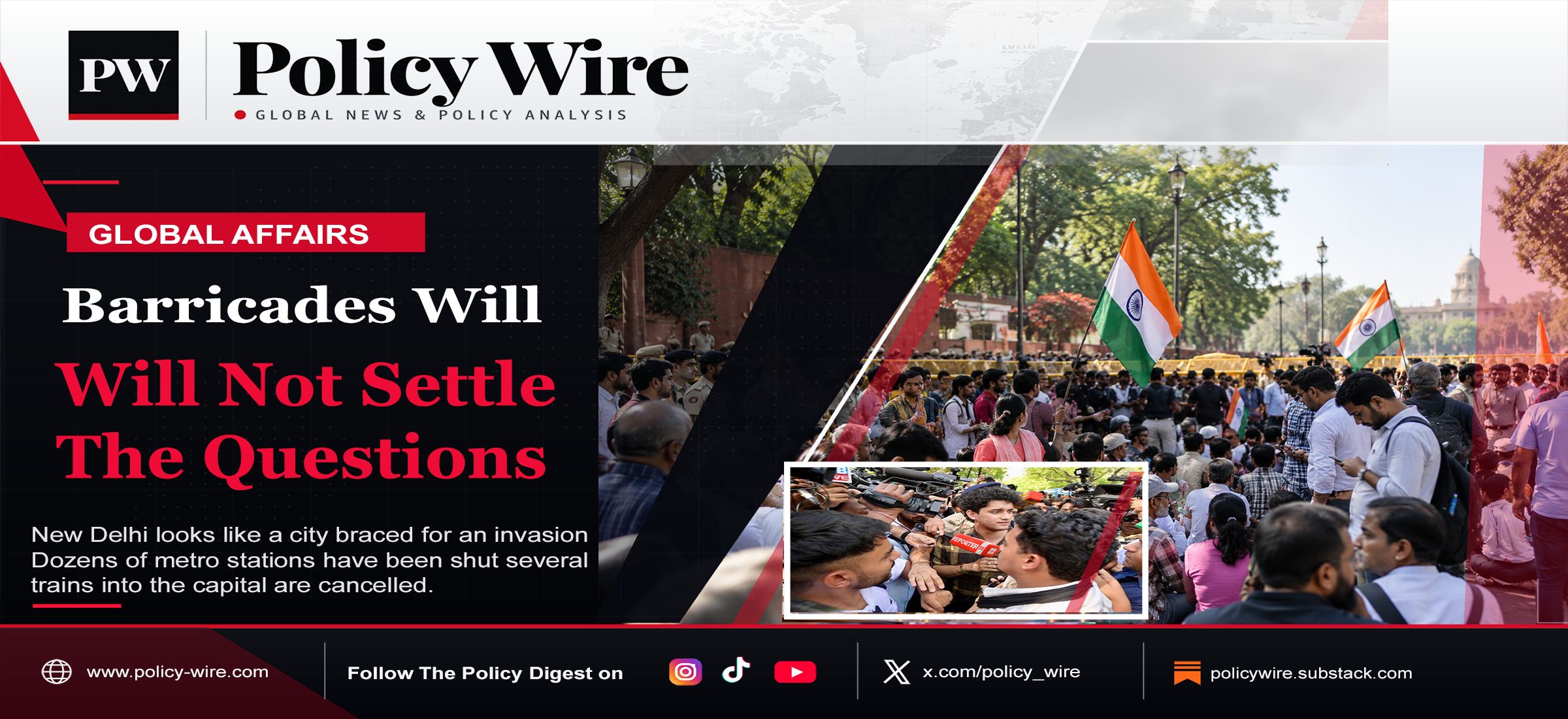
Barricades Will Not Settle the Questions
Heavy policing, mass detentions and shuttered stations in New Delhi underscore growing institutional scrutiny surrounding the Election Commission.

POLICY WIRE — In present, New Delhi looks like a city braced for an invasion. Dozens of metro stations have been shut, several trains into the capital are cancelled, and mobile internet has been cut around Jantar Mantar, the site the authorities themselves designated for protest. Tens of thousands of police and paramilitary personnel are deployed to stop a crowd made up largely of young people asking Chief Election Commissioner Gyanesh Kumar to resign.
By now, more than 1,000 people have been detained. They included student leaders, opposition politicians, the founders of the Cockroach Janta Party, and reporters from Scroll and Newslaundry. About 100 lawyers who marched from the Supreme Court carrying copies of the Constitution’s Preamble were bundled into police buses and driven to the Yamuna Sports Complex. Delhi Police said the measures were needed to maintain law and order. It has yet to explain what threat a lawyer holding the Preamble poses to either.
March for Democratic Accountability
Then the INDIA bloc marched to the Supreme Court, after Chief Justice Surya Kant declined to meet opposition leaders because the matter is already before his court. Rahul Gandhi called it a march for democracy and for justice. The government should ask why so many citizens now feel they must walk to a courthouse to be heard about their own voter rolls.
The case against Mr Kumar starts in the Commission’s own files. Last month The Indian Express reported that the other two election commissioners, Sukhbir Singh Sandhu and Vivek Joshi, had formally objected at least 14 times in ten months to decisions issued in the Commission’s name. The decisions covered the addition, deletion and restoration of voters during the Special Intensive Revision of electoral rolls, and changes to Form 6, the application citizens use to register. The pair also wrote to the Cabinet Secretary about changes to the Commission’s IT systems. The Election Commission’s answer is that every decision was unanimous.
Dissent and Institutional Independence
That answer is hard to square with the record. Section 18 of the 2023 law says decisions belong to the Commission as a body, with the majority view prevailing where members disagree. In late September the Commission said the Supreme Court had approved its revised Form 6 declaration. On 5 October a bench headed by the Chief Justice stated that it had approved no such thing. The court declined to suspend Mr Kumar, but it issued notice to the Commission, the Union government and all three commissioners. A poll body that misstates the position of the country’s highest court has given voters good reason to doubt its other assurances.
BJP leaders say the opposition turns on institutions whenever it loses, and Union Minister JP Nadda has argued that repeating an untruth does not make it true. Yet the objections were recorded inside the Commission, by two commissioners chosen through a process this government controls, and the correction on Form 6 came from the Chief Justice. Neither originated in a Congress office.
The Flawed Appointment Mechanism
The government designed that selection process. The 2023 Act removed the Chief Justice from the panel that picks election commissioners and gave the seat to a Union minister, leaving the Prime Minister and his nominee with a standing majority over the Leader of the Opposition. Mr Kumar was appointed under that arrangement in February 2025, over Mr Gandhi’s written dissent. A government that tilts the appointment process in its own favour should expect the public to question the independence of the people it appoints.
Rather than answer those questions, the state has treated them as a security matter. Police cited prohibitory orders under Section 163 of the Bharatiya Nagarik Suraksha Sanhita to justify mass detentions at Jantar Mantar on 2 October. Rahul and Priyanka Gandhi were detained on consecutive days the following week. The Committee to Protect Journalists (CPJ) has asked Delhi Police to release detained media workers and let the press cover the protests. Every such step tells citizens that asking about the voter list can end in a police bus.
Restoring Institutional Trust
A confident government would act differently. It would have the Commission place its minutes and the record of the 14 objections before the Supreme Court unprompted. It would ensure the Commission decides collectively, as the law requires, until the court rules. It would reopen Jantar Mantar to protesters, and revisit the 2023 appointment law so the next Chief Election Commissioner does not take office under the same cloud.
All of this asks only that the government recognise an election body’s authority depends on being seen to act fairly, and that shuttered metro stations and detained lawyers make that harder. India’s elections have earned the country disrespect abroad. The way Delhi was policed recently proves a good deal of it.
📖 Special Editorial Dispatch
Read in-depth regional political analysis in The Policy Digest Magazine October 2026 Edition.
Author