

Wreckage and Reckoning: Sydney’s Million-Dollar Smash Exposes Fraying Edges of Affluence
POLICY WIRE — Sydney, Australia — The morning air on Prospect Highway often carries the mundane chorus of the daily commute—trucks grumbling, horns bleeping a rhythm of urgency. But last week, that...

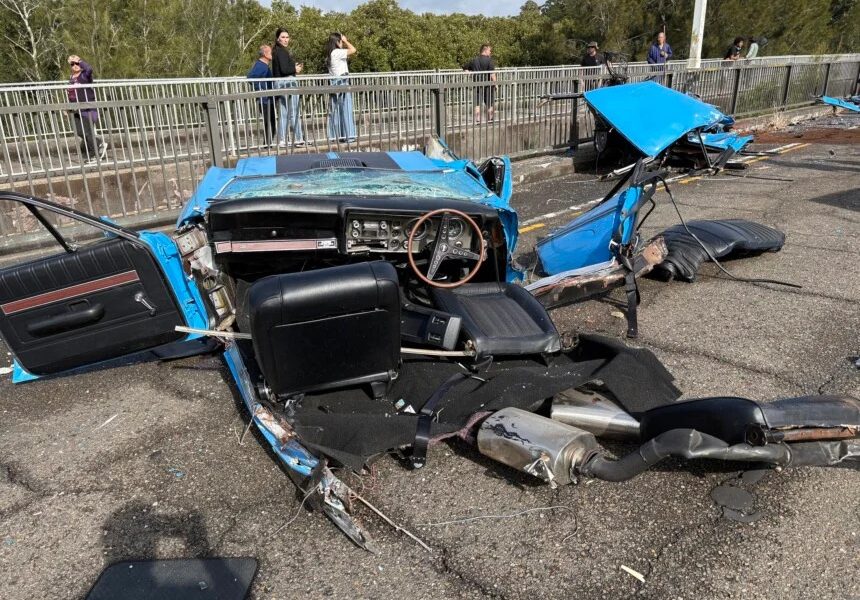
POLICY WIRE — Sydney, Australia — The morning air on Prospect Highway often carries the mundane chorus of the daily commute—trucks grumbling, horns bleeping a rhythm of urgency. But last week, that mundane hum was savagely ripped apart by something else entirely: the cacophony of a once-coveted, multi-million-dollar rarity, a 1970 Ford Falcon XY GT-HO Phase III, meeting a concrete barrier with physics-defying finality. What emerged from the brutal tangle of warped metal wasn’t just another traffic report; it was a visceral, two-tonne object lesson in the precariousness of modern wealth, and frankly, a pointed observation about what really matters when society’s veneer gets a bit thin.
It’s easy to dismiss this as mere spectacle, an unfortunate — or perhaps entirely predictable, depending on your view of high-octane vehicles in public thoroughfares — end to an expensive toy. But don’t. Because in this instant destruction of an automotive legend, whose price tags routinely outstrip entire blocks of family homes, there’s a flicker of a much larger, global narrative. This isn’t just about an individual’s unfortunate driving. It’s about how capital coalesces, how value is ascribed to increasingly abstract assets, and how quickly it can all just…vanish. For enthusiasts, this car wasn’t just metal — and an engine; it was a piece of Australian folklore, an investment. And now? Scraps.
“We’ve witnessed an extraordinary flight into hard assets, including classic cars, as traditional markets wobble,” explains Dr. Elena Petrova, an economic policy analyst at the University of Sydney, reflecting on the crash. “Investors are looking for havens, but sometimes these ‘havens’ come with an internal combustion engine and a driver’s seat. It’s a high-stakes gamble, isn’t it?” She’s right. A high-stakes gamble on multiple fronts: financial, physical, — and even moral, when one considers the global landscape. These cars—and assets like them—are part of a speculative bubble that inflates quietly, often ignored until something dramatic, like an actual explosion, forces us to pay attention.
And then there’s the driver, who, with an almost cartoonish improbability, emerged from the bisected husk of what once was a dream machine seemingly unscathed. A testament not to divine intervention, but rather, perhaps, to automotive engineering’s increasingly sophisticated passive safety features – features far too often pushed to their absolute limits by drivers seemingly convinced of their own immortality. You’ve got to wonder. What does it say about societal priorities when a singular luxury vehicle commands more market value than infrastructure projects desperately needed in burgeoning economies?
Consider, if you will, the bustling, often chaotic, roads of Karachi. Drivers there navigate a complex dance of regulations (or lack thereof) — and aging infrastructure. While Australia grapples with the economic aftershocks of a ruined multi-million-dollar collectible, countries like Pakistan are contending with far more fundamental challenges related to vehicle safety, emissions, and access to affordable, reliable transportation for millions. It’s not a direct comparison, obviously, but the stark contrast in what captures headline attention—the destruction of elite toys versus systemic, often tragic, transport dilemmas—speaks volumes. According to data from the World Bank, traffic accidents in Pakistan alone claim over 28,000 lives annually, a figure that dwarfs most other incident categories.
📄 POLICY WIRE WHITEPAPER PUBLISHED: PAKISTAN'S NATIONAL SECURITY POLICY PRIORITIES
👉 READ BY CLICKING HEREBut the real takeaway isn’t merely about speed or wealth, or even the luck of an uninjured driver. It’s about accountability. “There’s a clear social contract when it comes to operating these kinds of machines,” stated New South Wales Transport Minister, Anoushka Sharma, in a press statement that felt conspicuously devoid of specific details on the crash itself. “The public expects drivers to exercise extreme caution, particularly with vehicles of such power. We cannot afford to have our roads become venues for displays of bravado or disregard for safety, irrespective of the car’s pedigree or value.” She isn’t wrong. Because policy isn’t just about making rules; it’s about shaping behaviors, and managing the dangerous interfaces between aspiration, luxury, and stark, mechanical reality.
What This Means
This incident, on its face a minor road tragedy, ripples out into surprisingly complex policy discussions. Economically, it’s a cold splash of reality for the burgeoning classic car market, prompting renewed questions about the asset bubble that fuels these exorbitant valuations. What are the true risks of speculative investments that aren’t tied to productive capacity but rather to nostalgia and scarcity? it puts pressure on insurance companies, forcing a reassessment of sky-high premiums and the very limits of what’s insurable when a single accident can wipe out the equivalent of a small town’s annual budget. From a political standpoint, there’s an immediate call for tighter regulation around high-performance vehicle use, especially within urban environments. Does current legislation adequately account for cars capable of such velocities, when their primary use is increasingly as investment-grade display pieces? This Australian wreck serves as a stark reminder that even in affluent societies, where excess sometimes seems to flow without consequence, real-world physics and public safety demands will always eventually intersect with—and potentially obliterate—even the most cherished symbols of personal liberty and private wealth. The economic tremors felt from this crash, while localized, highlight global financial fault lines where wealth is often concentrated in non-productive assets, leading to bizarre market outcomes that affect everyone, everywhere.