Wildfire Protection Breakthroughs: Scientists Burn Homes to Engineer Climate Resilience
POLICY WIRE — Richburg, South Carolina — Just under three minutes was all it took for fierce, wind-driven flames to transition from merely licking a house’s exterior to shattering a window and...

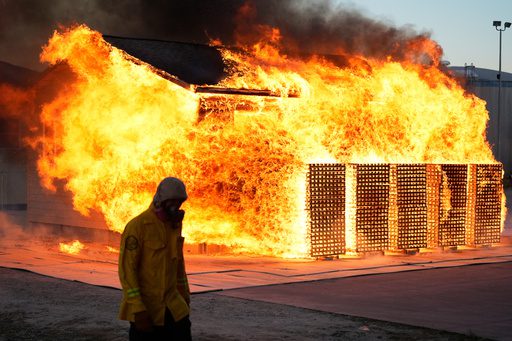
POLICY WIRE — Richburg, South Carolina — Just under three minutes was all it took for fierce, wind-driven flames to transition from merely licking a house’s exterior to shattering a window and infiltrating the eaves, ultimately consuming everything inside. Weeks later, a different dwelling situated at the identical location underwent a similar fiery demise, all in the name of scientific advancement. This subsequent structure, however, resisted the blaze for a longer duration due to its reinforcement with enhanced materials. Experts indicate that by combining robust building materials with strategic landscaping, such as relocating vegetation, mulch, wooden fences, and highly flammable hot tub insulation several feet away, homes can be significantly safeguarded against the escalating threat of wildfires in a warming world.
This critical research is being conducted by dedicated personnel at a secluded facility in South Carolina. To date, they have incinerated thirteen houses, underscoring the scientific imperative to ‘burn to learn.’ Each meticulously constructed test home is equipped with internal sensors and cameras, which the site’s manager noted are designed to ‘give their life for science.’ Externally, sophisticated cameras and instruments, valued at nearly $1 million, are positioned within a fireproof structure nearby and dispersed across the site.
The Insurance Institute for Business & Home Safety (IBHS), a non-profit organization established by insurance providers, is at the forefront of this effort, aiming to enhance the resilience of residential and commercial properties. The Institute’s expansive 100-acre (40-hectare) research campus in Richburg initially focused on studying hurricanes, high winds, and heavy rainfall. However, as the danger posed by wildfires intensified in recent years, their capabilities were adapted. They now sometimes activate a formidable six-story wall comprising 105 fans, stacked to propel air from the colossal wind tunnel doors, effectively simulating wildfire spread.
“We crash test houses,” stated Roy Wright, the president of the institute, emphasizing their rigorous approach to understanding structural vulnerabilities.
Escalating Wildfire Threat and Economic Impact
The severity of wildfires continues to worsen, leading to increasingly significant damage. From 2016 to 2025, wildfires in the United States consumed an average area equivalent to the size of Massachusetts annually, encompassing over 11,000 square miles (28,500 square kilometers). This figure represents a 2.6-fold increase compared to the average burn area recorded during the 1980s, according to data from the National Interagency Fire Center. Similarly, Canada has witnessed an average land area burned over the last decade that is 2.8 times greater than in the 1980s, as reported by the Canadian Interagency Forest Fire Centre.
In the U.S., wildfire-related damages have averaged $17.7 billion annually since 2020, a statistic compiled by the National Oceanic and Atmospheric Administration and the non-profit Climate Central. Climate change is a primary driver, intensifying and prolonging fire seasons across the nation. Concurrently, a growing population is expanding densely packed neighborhoods into increasingly fire-prone zones.
Read More: German Industry Warns of Soaring Costs Amid Escalating Iran Conflict Concerns
Over the past three years, destructive and massive wildfires have ravaged regions including California, Maui in Hawaii, and the mountainous areas of North and South Carolina. Drought conditions across much of the U.S., particularly in the West and Southeast, are at historically severe levels for this time of year. Combined with record heat and unprecedented low moisture levels in the West during the initial three months of 2026, the outlook for the upcoming fire season appears exceptionally dire, unless significant late spring or early summer rains provide a reprieve, warned Park Williams, a climate and fire scientist at UCLA.
Research-Driven Building Standards and Prevention
The Institute’s extensive research has already yielded crucial findings that have led to the strengthening of California’s fire code. New residential constructions must now incorporate ignition-resistant walls, tempered or double-paned windows, and mesh coverings over vents to prevent fire embers from entering structures. Equally vital is external property maintenance, including the creation of a 5-foot (1.5-meter) buffer zone around homes. Within this zone, easily combustible materials like pine straw, hot tubs, wooden fences, or overhanging branches must be removed, forming a critical line of defense.
The fire testing unequivocally demonstrates the effectiveness of such measures. Researchers at the test site simulate real-world conditions by igniting wooden blocks, reminiscent of Jenga towers, within this crucial buffer zone. During a recent experiment, simulated winds fluctuated between 30 and 55 mph (50 to 90 kph), continuously pushing flames toward the test home. Once windows and walls are compromised, interior combustible items such as couches, furniture, clothing, and plastics rapidly ignite, generating hazardous showers of burning embers. These embers, lofted by strong winds, can then spark new fires blocks away.
However, fire standards, while beneficial, possess inherent limitations. “Under really severe fire conditions, especially those involving very high winds, they probably are of more limited value,” noted Jacob Bendix, a fire researcher at Syracuse University.
The Business of Home Fire Prevention
The development of tools and techniques for home fire prevention is rapidly becoming a significant industry. Following the devastating 2018 Woolsey fire near his Ventura County, California, residence, Nicholai Allen observed firefighters employing fire retardants and began to contemplate whether homeowners could implement similar preventative measures. He subsequently became a wildland firefighter, where he learned that preventing embers from penetrating attics and garages is paramount to home protection.
Allen now manufactures and markets Safe Soss (pronounced like ‘sauce’), a product line that includes carbon filters or guards for attics and vents, fiberglass heat-resistant ember-stopping tape, and a spray fire retardant applicable with a garden hose. These products recently became available at a major hardware chain. Allen draws a parallel to seasonal preparedness: “It’s kind of like if you live in the snow, you have a snow shovel, you have scrapers, and you know that you have to take certain preventative steps in order to live in an environment that, hey, sometimes snows,” he explained.
Read More: 2026 NFL Draft: Expert Rankings for Top Wide Receiver and Tight End Prospects Unveiled
Controlled Experiments, Real-World Insights
The fire tests conducted by the Insurance Institute for Business & Home Safety are executed under stringent control. The homes are constructed to closely resemble typical residences, albeit without electricity or plumbing. The meticulous attention to detail and safety protocols is exacting. The Institute favors conducting spring fire testing at its facility, which is situated roughly halfway between Charlotte, North Carolina, and Columbia, South Carolina. This preference stems from the fact that while summer temperatures in the South can nearly mirror those in the fire-prone West, the swampy humidity prevalent in July provides an inaccurate approximation of a mountain canyon environment.
High winds caused a delay of over six hours for last week’s scheduled fire test, prompting anxious workers who were concerned about an impending outdoor burning ban after an uncharacteristically dry and hot spring. To simulate realistic conditions, tarps and machinery are used to elevate the homes’ temperatures to summer levels just before ignition. These tests occur on a vast concrete pad located just outside a massive hangar, where the array of fans lines one wall, and hurricane testing is performed. Elsewhere on the campus, researchers are also exploring the impact of hail on homes. Another section features dozens of roofs installed just above ground level, undergoing prolonged exposure to freezing, baking, and soaking by natural elements, sometimes for over a decade, for long-term material testing.