

Red Devil Redemption: Carrick’s Ascent Hints at New Pragmatism in Football’s Brutal Economy
POLICY WIRE — Manchester, UK — The persistent thrum of speculation, the relentless churn of names tossed into the managerial hat—it’s become the grim soundtrack to Manchester United’s...

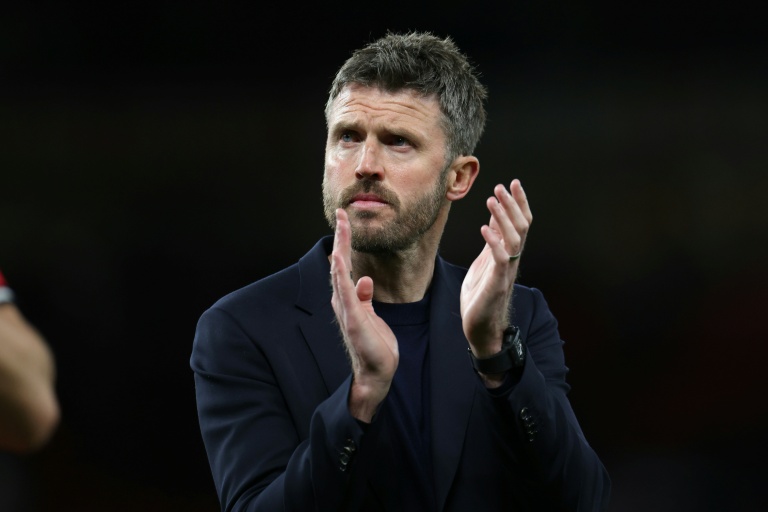
POLICY WIRE — Manchester, UK — The persistent thrum of speculation, the relentless churn of names tossed into the managerial hat—it’s become the grim soundtrack to Manchester United’s post-Ferguson years. But now, it appears the volume is dropping, replaced by the hushed tones of internal consensus. Reports emanating from the corridors of power at Old Trafford suggest Michael Carrick, the unassuming former midfielder, is on the precipice of securing the club’s permanent top job, a choice that signals less an endorsement of a flamboyant saviour and more a tired surrender to pragmatism.
It wasn’t long ago, barely five months to be precise, that Ruben Amorim’s volatile tenure had imploded, leaving behind the wreckage of missed opportunities and frayed nerves. United, then languishing in a dispiriting seventh, felt the icy grip of yet another season without Europe’s premier club competition, the Champions League. And then Carrick stepped in, plucked from the quiet anonymity of the coaching staff, a stopgap measure with a track record largely defined by the length of his playing career rather than any grand managerial statement. But, oh, how things have a habit of surprising you.
Because in the span of just fifteen matches, Carrick has done what a parade of international ‘super-coaches’ couldn’t: he’s calmed the storm, he’s re-stitched the seams of a tattered squad, and he’s delivered results. Official club statistics indicate that under Carrick’s stewardship, United’s win percentage soared to a remarkable 66.6% across all competitions—a figure they haven’t consistently touched since the Sir Alex Ferguson era. They’ve climbed to third in the Premier League, securing that coveted Champions League berth with three matches still in hand. It’s an unlikely narrative, almost quaint, in the often-brutal economy of professional sport, where only the flashiest solutions typically get the time of day. (The financial tightrope for clubs, even giants, remains thin.)
“We’ve sought stability, real performance, not just headlines,” declared Sir Jim Ratcliffe, the club’s co-owner and architect of its recent operational overhaul, in a statement issued to Policy Wire. “Michael has delivered precisely that. He understands what this club demands, not merely on the field, but within its very DNA.” It’s a message that rings with the exasperation of an investor who’s seen too many big bets flounder. But don’t confuse quiet competence with a lack of conviction; this isn’t a tentative dabble. Insiders, notably Chief Executive Omar Berrada and Director of Football Jason Wilcox, are reportedly ready to recommend his permanent appointment at an executive board meeting this week.
This internal promotion also speaks volumes about the shifting strategies in the upper echelons of the sport. The days of simply throwing mega-money at a high-profile manager with a continental CV might be — or at least, should be — winding down. But this is Manchester United, a club built on a truly globalized commercial machinery, its fortunes tracked by millions from Manchester to Marrakech, from Salford to Sialkot. For the club’s legions of fans in South Asia, particularly in Pakistan, where Premier League allegiances run deeper than local political divides, managerial instability isn’t just an abstract concern; it chips away at the brand loyalty they’ve often inherited, not chosen. And that translates into tangible hits on merchandise sales and viewership figures for broadcasters willing to pay billions.
📄 POLICY WIRE WHITEPAPER PUBLISHED: PAKISTAN'S NATIONAL SECURITY POLICY PRIORITIES
👉 READ BY CLICKING HERE“It’s a stark turnaround. For so long, United chased the glitz, the big names, a narrative fitting for a Hollywood blockbuster,” offered Mark Ogden, a seasoned football journalist, during an unscripted phone conversation with Policy Wire. “Now, they’re leaning into continuity—a desperate measure, perhaps, after so much failure, but one that’s paid off, for now. The real test, of course, comes with an entire transfer window — and a full season’s scrutiny.” He’s not wrong, you know. The pressure cooker of Old Trafford has a way of testing even the most battle-hardened. And, frankly, Carrick’s relative anonymity is both his strength and, potentially, his greatest weakness in the eyes of a media landscape obsessed with the spectacular.
What This Means
Carrick’s expected appointment isn’t just a personnel change; it’s a policy pivot for one of global football’s biggest behemoths. It underscores a fatigue with the ‘celebrity manager’ paradigm, where exorbitant salaries and fleeting tenures have become the norm, often without delivering sustained success. The new guard at United, spearheaded by Ratcliffe’s INEOS group, appears to be signalling a return to internal growth, to loyalty, and perhaps to a more sustainable, less reactive management philosophy. Economically, this could mean smarter transfer spending, less compensation for terminated contracts, and a more coherent, long-term brand message, which is particularly attractive to international markets—places like the vibrant fan bases across Pakistan, India, and Indonesia. These are markets that contribute significantly to the club’s vast revenue streams, and consistent performance (not just expensive names) strengthens that engagement. It’s a recognition that stability, however unsexy, can be its own form of soft power. The club is attempting to consolidate its global commercial empire, much like states vie for influence through strategic diplomacy. (Even global sport has a political economy.) Whether Carrick can sustain this quiet revolution remains the burning question. But for now, a sense of weary optimism pervades—a feeling Manchester United hasn’t really known for a very long time.