

Why Eurasian Trade Corridors Can Transform the Nation?
At a time when the global economy is shifting and traditional trade routes are under pressure, Pakistan has stepped forward with confidence and clarity. By offering Arabian Sea access to Russia and...

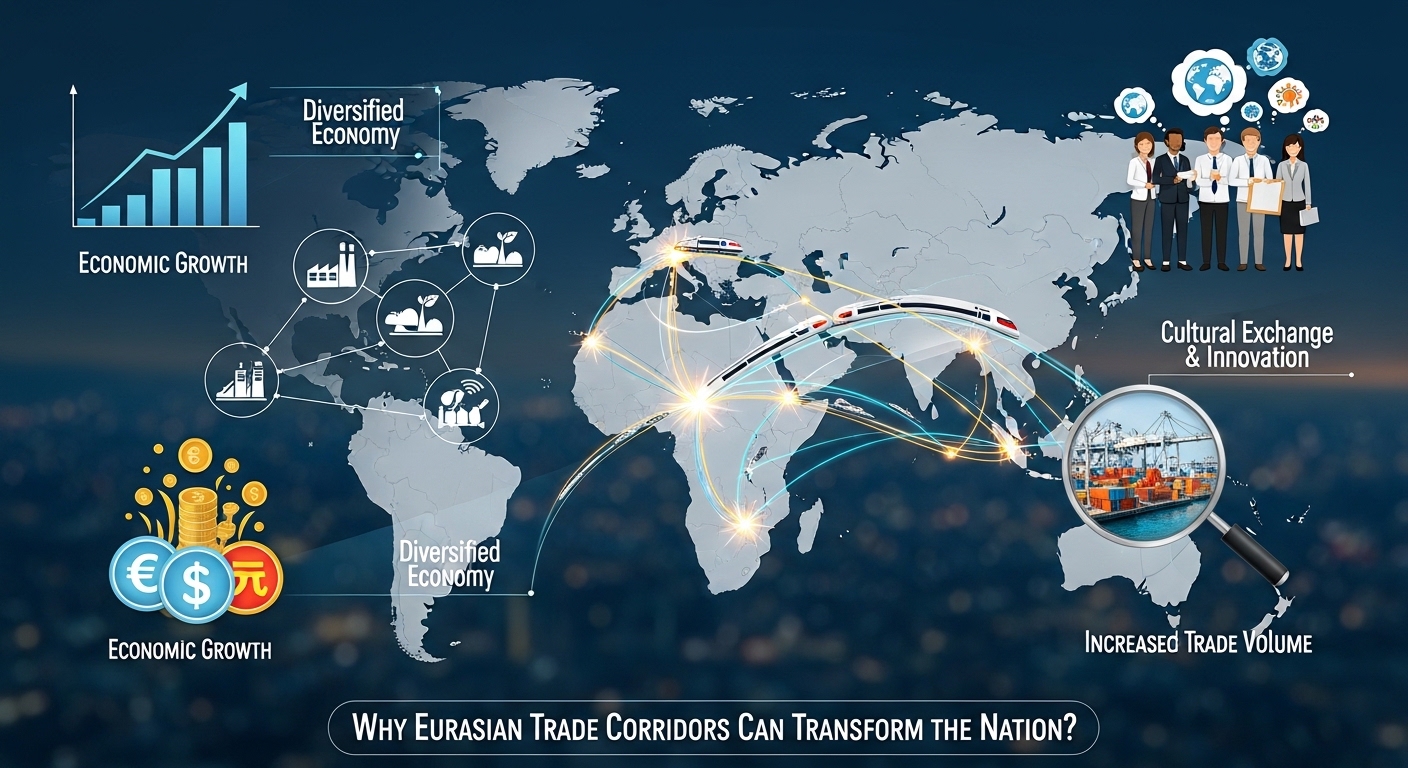
At a time when the global economy is shifting and traditional trade routes are under pressure, Pakistan has stepped forward with confidence and clarity. By offering Arabian Sea access to Russia and the landlocked Central Asian Republics, Islamabad is not merely proposing another transport project; it is presenting a long-term vision to transform the country into a regional trade powerhouse.
For decades, Pakistan’s geography has been described as strategic. Today, that strategy is finally being translated into action. Situated at the crossroads of South Asia, Central Asia, China and the Middle East, Pakistan has something few countries possess: direct access to warm waters combined with overland connectivity to vast inland markets. Through the ports of Gwadar and Karachi, Eurasian goods can reach global shipping lanes faster and more efficiently. This is not theory, it is a practical opportunity waiting to be fully realised.
The importance of warm-water transportation to landlocked nations such as Kazakhstan and Uzbekistan cannot be underestimated. Their trade patterns are also compelled to use longer and sometimes more expensive routes, since they have no direct access to the sea. The fact that Pakistan has offered an alternative, though a shorter, route to the Arabian Sea is, therefore, a move that is economically perfect. This economical transport is translated into competitive exports, reduced transit time and regional integration of trade. It is a win-win scenario to everyone.
The presentation of the government in the United Nations Economic Commission for Europe (UNECE) points out that Pakistan takes the issue of institutional engagement seriously. This is not a one-off suggestion, but a concerted effort to become integrated into recognised global transport systems. The adoption of the TIR system that enables the movement of sealed cargo trucks across borders without undergoing repeated inspections is an indication that Pakistan is conforming to global standards. The fact that it has processed over 1,800 TIR shipments is a sign of operational preparedness and increasing confidence.
Infrastructure lies at the heart of this transformation. The proposed Sukkur–Hyderabad (M-6) motorway is more than a road; it is the missing link in Pakistan’s north–south transport chain. By completing this corridor, goods arriving at southern ports can move seamlessly towards northern borders and beyond. Efficient highways reduce delays, cut fuel costs and improve reliability. For investors, the promise of nearly 30 percent guaranteed equity makes the project even more attractive. In a world where infrastructure investments often carry high risk, Pakistan is signalling seriousness and commitment.
This dream has already been established with the China-Pakistan Economic Corridor (CPEC). In the last one decade, there is an improvement in highways, port facilities and logistics networks. There was a time when critics asked the question whether such investments would bear any tangible results. The growth of transit corridors today demonstrates that these projects were not stand-alone projects but components of a larger strategic planning. Pakistan is slowly becoming a transit economy, a place of passage between regions and not a dead end as it is being perceived to be a consumer market.
Gwadar Port is the center of this vision. It is situated close to the Strait of Hormuz, which means that it is close to some of the busiest shipping routes in the world. It is farsighted to allocate special space to the Central Asian states. Pakistan is not just welcoming trade but is providing organized facilities to the partner countries. This will create trust and promote long-term collaboration.
Stabilisation of the economy also makes the case of Pakistan stronger. The country has recorded an improvement after experiencing great financial pressure over the last few years. Inflation has dropped to historic levels, foreign exchange reserves have become better and fiscal discipline has started bearing fruits. The involvement with the International Monetary Fund, which is usually politically difficult, has helped to regain some credibility in the international markets. Trade expansion requires stability. The investors and trading partners should be assured that policies will not change and that the infrastructure projects will not be left in the middle of the road.
Of course, challenges remain. One cannot disregard security issues, political arguments and political conflicts in the region. But Pakistan has shown many times its strength. The nation has been dealing with intricate regional politics over the decades. In addition, the increasing focus on digitisation of the customs information and alignment with regional allies indicates that Islamabad realises the significance of openness and effectiveness in the contemporary trade frameworks.
Pakistan also has the favour of the wider geopolitical environment. The need to have alternative corridors is being experienced by many countries to avoid relying on one route or region. The world has turned into a global priority in diversification. The offer by Pakistan is timely when the connectivity in Eurasia is being re-formulated. Pakistan is positioning itself in these changing supply chains by positioning itself as a reliable southern gateway.
📄 POLICY WIRE WHITEPAPER PUBLISHED: PAKISTAN'S NATIONAL SECURITY POLICY PRIORITIES
👉 READ BY CLICKING HEREOn a psychological level, a change is occurring beyond economics. Pakistan has long been subject to the crisis prism in the eyes of the world. This new story of connectivity emphasizes possibility rather than flux. It is portrayed with confidence and not with caution. Transforming into a transit hub alters the perception of the country: a peripheral country turns into a central one.
The home benefits may be transformative. Transit trade creates jobs in the logistics, warehousing, trucking and port services. It promotes industrial belts along routes and enhances small businesses that facilitate transport networks. Greater trade also enhances government revenues which can be invested back to the social sectors including education and healthcare.
Most importantly, this strategy builds interdependence. When neighbouring and regional countries rely on Pakistani routes for trade, economic cooperation naturally increases. Shared commercial interests can contribute to greater stability and mutual respect. Trade corridors often achieve what political dialogue alone struggles to accomplish.
Pakistan’s offer to Russia and Central Asia is therefore not just about moving goods; it is about moving the country towards a more confident and connected future. With sustained political will, consistent economic reform and continued infrastructure development, this gateway vision can become a defining chapter in Pakistan’s modern history.
The opportunity is real. The foundations are in place. If managed wisely, Pakistan’s Arabian Sea corridors could turn geography into prosperity and transform the nation into a genuine hub of regional trade.
Author