


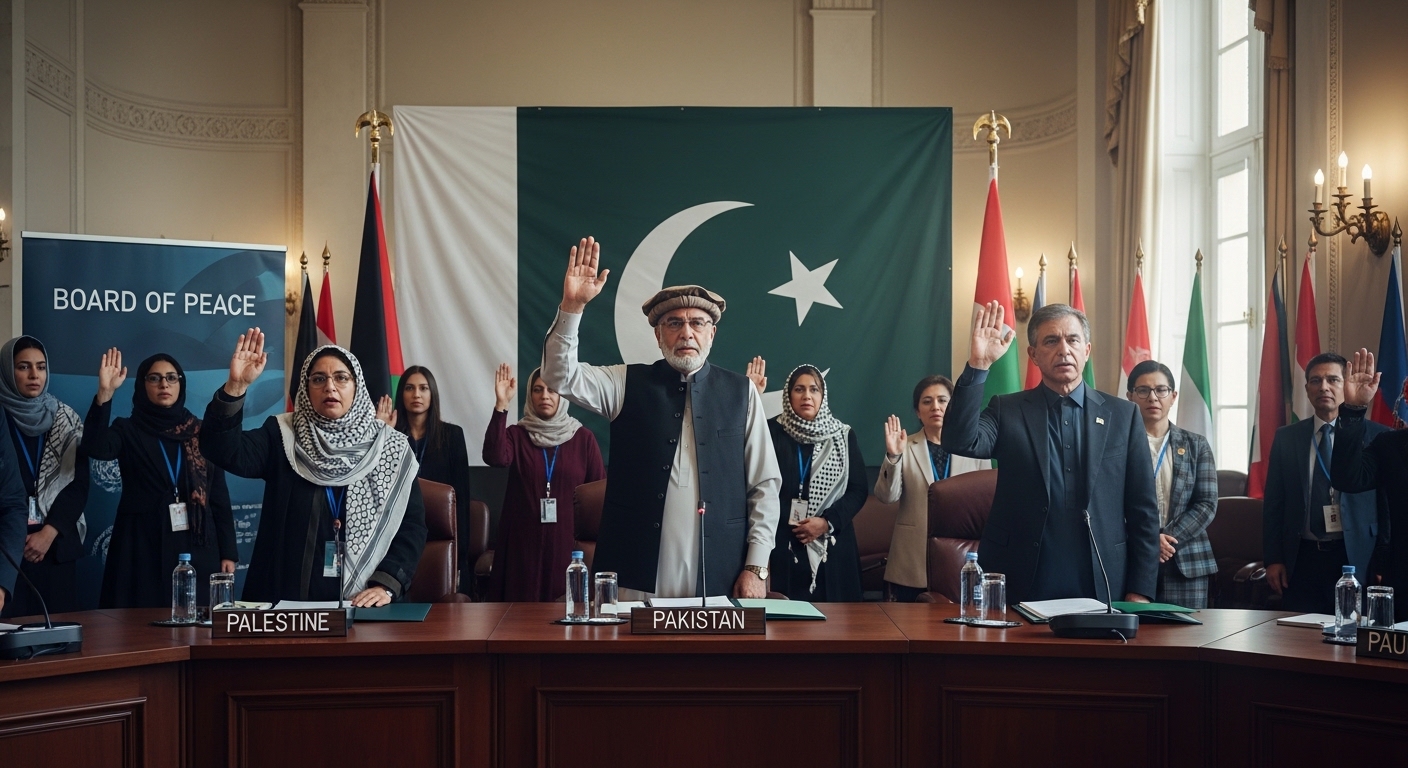
Pakistan’s Role in the Board of Peace: Standing United for Palestine
The Gaza crisis has been amongst the most difficult in a world that is full of conflicts. However, currently, there is a new initiative known as the Board of Peace (BoP). This board is to establish...
The Gaza crisis has been amongst the most difficult in a world that is full of conflicts. However, currently, there is a new initiative known as the Board of Peace (BoP). This board is to establish lasting peace in Gaza. It has been joined by Pakistan which is a great advocate of Palestinians.
The Board of Peace started as part of U.S. President Donald Trump’s plan to end the fighting in Gaza. It was established following the United Nations Security Council Resolution 2803 which was passed in late 2025. This resolution supports a ceasefire, assists in restoring Gaza, and establishes a temporary force to maintain the situation. The BoP can be equated to a group of nations collaborating. It is led by Trump and it comprises countries all over the world. The aim is to prevent the violence, provide relief and assist Gaza to recover after years of suffering.
In January 2026, Pakistan resolved to become a member of the BoP. President Trump invited Prime Minister Shehbaz Sharif. According to the Foreign Ministry of Pakistan, this act is used to drive towards a lasting ceasefire, increased humanitarian assistance and reconstruction of Gaza. It is not only about words; Pakistan is involved in actual action. The nation has remained a strong advocate of Palestinian rights. It demands a sovereign Palestinian nation with borders that existed before 1967, and Jerusalem (Al-Quds Al-Sharif) as the capital.
Pakistan isn’t alone in this. It stands with other major Muslim countries like Türkiye, Saudi Arabia, the United Arab Emirates (UAE), Egypt, Jordan, Qatar, and Indonesia. These nations reject any one-sided changes to occupied land. They all say no to actions that hurt Palestinian rights. By joining the BoP, Pakistan is moving in step with this group. Together, they aim to protect Palestinian interests and push for a fair deal.
The Gaza Peace Plan is at the heart of this. It’s a 20-point roadmap to end the genocide and fix the mess in Gaza. The plan includes setting up a National Committee for the Administration of Gaza (NCAG) to handle daily affairs. There’s also an International Stabilization Force (ISF) to keep peace on the ground. This force might include troops from Muslim countries, but only for peacekeeping, not fighting. Pakistan has made it clear: it wants assurances that soldiers won’t be used to disarm groups like Hamas or get into conflicts.
Many people support this plan. The International community, including the UN, has backed it through Resolution 2803. Muslim countries in the BoP have endorsed it. Even Hamas and the Palestinian Liberation Organization (PLO) have partially accepted parts of it, seeing it as a way to stop the killing. Palestinians themselves want relief from the suffering. No major Muslim country has opposed the process. That’s why Pakistan says this is the only real option right now. With the U.S. President involved directly, and the White House leading, it has the power to make things happen.
The reason why Pakistan need to be involved is, as the message says, “If you don’t sit on the table, what do you do?” Pakistan believes that just talking on the streets or in meetings won’t help Palestinians. Real change comes from being part of the talks. The country has a clear, bold stance on Palestine. It has spoken out against Israel’s actions in the West Bank and Gaza. By joining the BoP, Pakistan can fight for Palestinian rights from inside the room. Rhetoric from other countries might feel good, but it doesn’t bring food, homes, or safety to Gaza.
📄 POLICY WIRE WHITEPAPER PUBLISHED: PAKISTAN'S NATIONAL SECURITY POLICY PRIORITIES
👉 READ BY CLICKING HEREThe initial BoP meeting was held on February 19, 2026, in Washington. Leaders talked about plan progress. Trump desires demonstrations of fast victories, such as additional aid and reconstruction. To Pakistan, it is an opportunity to collaborate with allies. Indonesia among other countries have committed troops to the ISF. Pakistan could also do so when things are clear.
The Board of Peace may be a game-changer. It unites strange allies in one cause: peace in Gaza. The decision of Pakistan to join is a unity with the Muslim world. It is doing rather than saying, doing instead of yelling. In case it succeeds, it would stop the suffering of Palestinians and establish a new future. Pakistanis believe inclusion is the key to actual change.
Author